Last week, I reviewed Inception and mentioned that I intended to see the film again and write some more about it. Now that I've seen it a second time, I think there are three things that need to be discussed about the film: emotional maturity, the state of narrative ambiguity, and the music. All three have been discussed by film critics and fans, but I think that they are all important enough to address further, particularly because of what Inception might very well represent for science fiction film (i.e. a revolution of sorts). But because these three things deserve considerable attention, I'm going to break them up into three posts. First up is motion.
Inception: Emotionally Bereft or Misunderstood?
One of the things that Inception has been attacked for is its supposed lack of emotional maturity. Visually, the film is gorgeous and the narrative elements are quite intriguing and complex,

Saturday, July 31, 2010


Friday, July 30, 2010
Poll Results: Would you read an ebook?
It seems like times are really changing. A couple of years ago, I could have asked the same question and received completely different results. Our mentality has changed on the whole ebook thing, and I hope that this change is for good reasons.
So, here are the results:
So, here are the results:
- 15 (78%) -- Yes
- 2 (11%) -- No
- 2 (11%) -- Maybe
The vast majority of those who voted would read an ebook. That's fascinating. I suppose the question is phrased in such a way that to say "no" could imply that you'd never ever read an ebook, while "yes" could imply that you would read one, but not necessarily. Issues of preference are obviously not a part of the poll. My next poll will likely be on that.
Out of curiosity, what were you all expecting from the results? Exactly as above? More evened out across the categories? The exact reverse?
Top 10 Most Ridiculous Moments in Science Fiction and Fantasy Film in the 90s
Many months ago I posted a list of the top 8 most ridiculous moments in science fiction and fantasy film in the 21st century. It turned out to be the most popular post in the history of this blog, to my surprise, and inspired me to pursue further the plan I had already set up in my mind. What was that plan? To go backwards through time, decade by decade, picking out the most ridiculous moments in science fiction and fantasy film for each of those decades, as far back as I can reasonably go. So, here we are, with another list (slightly larger, of course) set one decade earlier than the last, and likely just as controversial.
Note: the fact that two Dennis Hopper's movies appear on this list is not a coincidence.
Here goes (after the fold):
Note: the fact that two Dennis Hopper's movies appear on this list is not a coincidence.
Here goes (after the fold):
Thursday, July 29, 2010
Poll Results: Help Me Name My Fern
You voted (along with some folks on another website) and the results are finally in. And here they are:
So, my Boston fern is now named Salvador. And as if that weren't enough, Salvador has been so kind as to grow some unexpected things in the last month, such as these wonderful heart-shaped leaves that I'm sure are Salvador's attempt to communicate joy to me (you know, because I'm the one doing all the feeding here). Here's a picture of those heart-shaped goodies:

- Dave -- 5 (19.2%)
- Fred -- 0 (0%)
- Salvador -- 11 (42.3%)
- Fern -- 4 (15.4%)
- Kiwi -- 3 (11.5%)
- Charlie -- 2 (7.7%)
- Bill -- 0 (0%)
- Captain Adama -- 1 (3.9%)
So, my Boston fern is now named Salvador. And as if that weren't enough, Salvador has been so kind as to grow some unexpected things in the last month, such as these wonderful heart-shaped leaves that I'm sure are Salvador's attempt to communicate joy to me (you know, because I'm the one doing all the feeding here). Here's a picture of those heart-shaped goodies:

Haul of Books 2010: Stuff For Me v.16
At some point in the last month or so, I won a whole bunch of books and a very unusual object. Imagine my surprise when I showed up at the front office of my apartment complex to find out that someone had sent me an enormous box of stuff that I didn't order and didn't know was coming. No, I didn't acquire a zombie head in a cooler or a magic wand from a strange world dominated by giant blue monkeys. I acquired this (after the fold, I hope):
Wednesday, July 28, 2010
In Glowing Support of NPR (National Public Radio)
CREDO is running a petition to be sent to the White House asking for seat recently vacated by Helen Thomas in the White House press briefing room (where you see Gibbs answering questions and what not) to be given over to NPR (National Public Radio). Other organizations vying for a spot include Bloomberg News and FOX News. I signed the petition for obvious reasons, but I did add the following statement:
If you want to see NPR covering the White House press briefings, sign the petition. If not, then you're a jerk, because NPR is awesome.
It should be noted that while the content of this petition denounces FOX, I personally would also denounce organizations like MSNBC, which use similar tactics as FOX News (or have, in my memory), and who I don't consider anymore legitimate. NPR is, in my opinion, one of the last news entities that actually cares about giving us the news, rather than loading us up with opinions in either overt form or masked as news.Clearly I like NPR...
What we need is to support those news entities that are interested in giving us information and not interested in pushing a political agenda. News should be fair. It should be balanced. It should be filled with journalists who actually research and care about finding out the truth, no matter how grim or difficult it may be. Giving NPR this seat will be a step in the right direction.
If you want to see NPR covering the White House press briefings, sign the petition. If not, then you're a jerk, because NPR is awesome.
Why Electronic Publishing Will End Civilization
You might be asking yourself: how the heck can something so revolutionary and so seemingly wonderful bring about the end of civilization? And I might ask you where you've been the last five years and why you haven't considered the most important and most dangerous thing to a technology-oriented society ever imagined: zombies.
You see, in the post-apocalyptic zombie-ridden future,
You see, in the post-apocalyptic zombie-ridden future,
Tuesday, July 27, 2010
Movie Review: Inception
There is only one movie I have been literally ecstatic about seeing, which is not something that happens to me very often. That movie is Inception. I can't quite explain why, except to say that the marketing team behind Inception managed to utterly captivate me with their trailers and strong attempts at keeping secret the details of what I am calling "Nolan's masterpiece." Point is, the moment I heard about Inception, I was hooked, and I have spent the last three or four months waiting for what I hoped would be the best movie of the entire year, let alone the best science fiction movie in decades.
And you know what Inception provided? Everything I could have ever wanted and more. It is, in my opinion, the best movie of the year and is easily in my top ten best science fiction movies of all time. Calling Inception "Nolan's masterpiece" is an understatement. It is a tour de force, a feat of monumental cinematic proportions. For those that had doubts about Nolan's ability to escape the brilliant success of The Dark Knight, Inception proves you wrong, because it is the one movie that I think defines Nolan as an expert filmmaker, as the kind of writer and director that can actually produce high quality original material and direct it at a level that certain other filmmakers haven't been able to do since the beginning of their careers (I'm looking at you M. Night Shyamalan). Inception is, to put it more simply, a must see.
Now for my review (after the fold):
And you know what Inception provided? Everything I could have ever wanted and more. It is, in my opinion, the best movie of the year and is easily in my top ten best science fiction movies of all time. Calling Inception "Nolan's masterpiece" is an understatement. It is a tour de force, a feat of monumental cinematic proportions. For those that had doubts about Nolan's ability to escape the brilliant success of The Dark Knight, Inception proves you wrong, because it is the one movie that I think defines Nolan as an expert filmmaker, as the kind of writer and director that can actually produce high quality original material and direct it at a level that certain other filmmakers haven't been able to do since the beginning of their careers (I'm looking at you M. Night Shyamalan). Inception is, to put it more simply, a must see.
Now for my review (after the fold):
Haul of Books 2010: Stuff For Me v.15
A few more things have been trickling in over the last few weeks. This is an attempt on my part to play catchup. I think I'm going to spend the next week or so getting fully caught up on all the stuff that has arrived at my door.
So, without further delay, here is the image for v.15 (after the fold, hopefully):
So, without further delay, here is the image for v.15 (after the fold, hopefully):
Monday, July 26, 2010
Race and Not Thinking About It: Why That's B.S.
In this day and age, it seems like we (and by "we" I mean mostly white people) make a big deal about not thinking about race. Perhaps we do this out some sort of subconscious regret about the past (white guilt, if you will) or perhaps because we actually believe that we don't think about race. The problem is that we (and here I mean all of us of all races) often do think about race, regardless of where we come from. We can pretend that racism is over, and some of us do a fine job of sticking our heads in the sand and trying to maintain the illusion of a world of Neapolitan ice cream, with all the colors hanging out together in the same place as if there never was a time when they were all in separate boxes. But the reality is that racism never ended and that we still live in a society that thinks in racial terms (for good and for bad) and still allows people to get away with actions that are, by all accounts, about as racist as you can get, at least for a short time.
Why do I bring this up? I recently made the mistake of attempting to have a rational discussion with some politically motivated individuals on YouTube about the Shirley Sherrod fiasco (which is still going on). At one point I made the argument that I am making here (specifically that "everybody makes race a part of everything, even if they say they don't"),
Why do I bring this up? I recently made the mistake of attempting to have a rational discussion with some politically motivated individuals on YouTube about the Shirley Sherrod fiasco (which is still going on). At one point I made the argument that I am making here (specifically that "everybody makes race a part of everything, even if they say they don't"),
Sunday, July 25, 2010
The Skiffy and Fanty Show #10 is up!
We're back with yet another episode! This week we talk about the new Avengers movie, what constitutes ethical selection practices for editors, and an exciting list of attributes that make us crazed bibliophiles.
You can find the episode here (stream and mp3 download)
You can find the episode here (stream and mp3 download)
Video Found: Priest (Trailer)
The trailer below is by far one of the coolest movie trailers I've seen this year. My only hope is that the movie lives up to the trailer, because I think it's about time we got an awesome futuristic vampire film!
What is Priest about?
Priest trailer
Uploaded by blankytwo. - Check out other Film & TV videos.
What is Priest about?
PRIEST, a post-apocalyptic sci-fi thriller, is set in an alternate world -- one ravaged by centuries of war between man and vampires. The story revolves around a legendary Warrior Priest (Paul Bettany) from the last Vampire War who now lives in obscurity among the other downtrodden human inhabitants in walled-in dystopian cities ruled by the Church. When his niece (Lily Collins) is abducted by a murderous pack of vampires, Priest breaks his sacred vows to venture out on a quest to find her before they turn her into one of them. He is joined on his crusade by his niece's boyfriend (Cam Gigandet), a trigger-fingered young wasteland sheriff, and a former Warrior Priestess (Maggie Q) who possesses otherworldly fighting skills.Here's the trailer (after the fold):
Priest trailer
Uploaded by blankytwo. - Check out other Film & TV videos.
Saturday, July 24, 2010
Comic Book/Graphic Novel Suggestions: What Are Your Favorites?
I'm notoriously picky when it comes to comics. When I was a kid, I was a huge Marvel junkie. I had all kinds of comic books, the collectible cards, action figures, and a very strict Saturday morning X-men cartoon viewing schedule (by that, I mean that if I missed an episode, someone would feel my wrath; unfortunately, that person usually was my mother). Then, when I hit my late teens, I got into Japanese manga (and am still very much into it, although in phases, rather than as a constant). But, despite all this, I feel very much disconnected from the comic/graphic novel community and I'd like to get into it again, partly for sheer enjoyment of the visual medium and partly because I am considering adding comics/graphic novels to my academic repertoire.
So, here's what I'm looking for (after the fold):
Comic books or graphic novels from anywhere (online, print, Tibet, wherever) that have a high quality of artistic style, that are in some way fantastic in nature (science fiction, fantasy, weird, or slightly horror-oriented) and have complex, unique, or fascinating story lines. They do not have to be in color.
I'm not particularly interested in standard American superhero comic style (i.e. X-men, Spiderman, and so on). That's not because I don't like X-men and so on, but I'm more interested in projects that pay as much attention to the visual medium as to the story line. I want my eyeballs to explode and my brain to melt...at the same time.
So, what would you suggest I look into? What are your favorites?
So, here's what I'm looking for (after the fold):
Comic books or graphic novels from anywhere (online, print, Tibet, wherever) that have a high quality of artistic style, that are in some way fantastic in nature (science fiction, fantasy, weird, or slightly horror-oriented) and have complex, unique, or fascinating story lines. They do not have to be in color.
I'm not particularly interested in standard American superhero comic style (i.e. X-men, Spiderman, and so on). That's not because I don't like X-men and so on, but I'm more interested in projects that pay as much attention to the visual medium as to the story line. I want my eyeballs to explode and my brain to melt...at the same time.
So, what would you suggest I look into? What are your favorites?
Friday, July 23, 2010
Science Fiction and the Sensawunda
The other day I wrote about what makes a good science fiction movie. In the comments, a number of people quoted the phrase "sense of wonder" (or "sensawunda," as many fans like to abbreviate it). We've heard this phrase before. Some have argued that science fiction now lacks "sensawunda," and others have argued that "sensawunda" is one of the defining characteristics of science fiction--specifically, good science fiction. But the thing that always surprises me about such discussions is that few people have actually provided an explanation for what "sensawunda" is, let alone how it operates within the movies and novels they so enjoy. And when someone points to an example, I'm even more surprised that the thing in question is hardly surprising at all. Maybe the "what is it" question is a good place to start to figure this out.
While definitions vary from critic to critic, most agree that "sensawunda" is some sort of paradigm shift (a phrase from John Clute and Peter Nicholls, but not an original phrase) in much the same way as the phrase is used in science: a change of our basic assumptions about something (in this case, literature and reality). If that be the case, then "sensawunda" in science fiction relies entirely upon the genre's speculative elements, since anything that does not shift us from the present in a fundamental way cannot produce the effect (at least for most).
But now we run into a problem with the concept. Science fiction has largely become a self-referential genre. While the intention of authors is likely not to look to the past of the genre, that doesn't change the fact that almost everything in contemporary science fiction has already been done before. Contemporary science fiction is, for better or worse, a genre that is always looking to its golden past, always conjuring images and ideas presented at a time when the genre inspired and shocked people based solely on its ability to present a vision of the future not found elsewhere (wondrous or terrifying futures, depending where you looked). And if science fiction is self-referential, replicating the same references without realizing it is doing so, then "sensawunda" no longer functions. It can't--at least not for those who are well read in the genre. "Sensawunda" relies on some new thing (the novum) that draws us out of our comfort zone of reality and gives us a new reality, one tinged with the speculative details of a future that may or may not be (science fiction has never been a predictive genre). But this can't happen multiple times for the same thing in different formats (i.e. different authors writing about the same concept). We've already seen it. The surprise comes, perhaps, from the movement of the plot, but that's not something isolated to science fiction, let alone genre fiction.
If all this is true, then that means "sensawunda" is dead for the old, and lively for the new in almost all cases. New readers certainly feel the moment we all secretly mourn, while old writers continue reading for...what? What is it about contemporary science fiction that keeps us reading, despite the near bi-monthly pronouncement of the genre's death? Why do we still go to science fiction movies? Why do we want to see a possible future when we crack the first page of a new science fiction book? It's not "sensawunda." I suspect we're all aware on some level that the "sensawunda" is gone--although, maybe it still exists in the movies simply because they visualize things we've only dreams about or read in books.
I suppose the question I'm asking is whether we're reading science fiction because of loyalty to the genre, a perspective we've adopted within ourselves that constantly looks forward (even to the bad), or simply an interest in the furniture of the genre (spaceships, aliens, future technology, and so on). I'm a pessimist, so I lean more towards the last of these by default. But I could be wrong. Maybe we are loyal to the genre and in possession of that future-oriented mentality.
What do you think?
While definitions vary from critic to critic, most agree that "sensawunda" is some sort of paradigm shift (a phrase from John Clute and Peter Nicholls, but not an original phrase) in much the same way as the phrase is used in science: a change of our basic assumptions about something (in this case, literature and reality). If that be the case, then "sensawunda" in science fiction relies entirely upon the genre's speculative elements, since anything that does not shift us from the present in a fundamental way cannot produce the effect (at least for most).
But now we run into a problem with the concept. Science fiction has largely become a self-referential genre. While the intention of authors is likely not to look to the past of the genre, that doesn't change the fact that almost everything in contemporary science fiction has already been done before. Contemporary science fiction is, for better or worse, a genre that is always looking to its golden past, always conjuring images and ideas presented at a time when the genre inspired and shocked people based solely on its ability to present a vision of the future not found elsewhere (wondrous or terrifying futures, depending where you looked). And if science fiction is self-referential, replicating the same references without realizing it is doing so, then "sensawunda" no longer functions. It can't--at least not for those who are well read in the genre. "Sensawunda" relies on some new thing (the novum) that draws us out of our comfort zone of reality and gives us a new reality, one tinged with the speculative details of a future that may or may not be (science fiction has never been a predictive genre). But this can't happen multiple times for the same thing in different formats (i.e. different authors writing about the same concept). We've already seen it. The surprise comes, perhaps, from the movement of the plot, but that's not something isolated to science fiction, let alone genre fiction.
If all this is true, then that means "sensawunda" is dead for the old, and lively for the new in almost all cases. New readers certainly feel the moment we all secretly mourn, while old writers continue reading for...what? What is it about contemporary science fiction that keeps us reading, despite the near bi-monthly pronouncement of the genre's death? Why do we still go to science fiction movies? Why do we want to see a possible future when we crack the first page of a new science fiction book? It's not "sensawunda." I suspect we're all aware on some level that the "sensawunda" is gone--although, maybe it still exists in the movies simply because they visualize things we've only dreams about or read in books.
I suppose the question I'm asking is whether we're reading science fiction because of loyalty to the genre, a perspective we've adopted within ourselves that constantly looks forward (even to the bad), or simply an interest in the furniture of the genre (spaceships, aliens, future technology, and so on). I'm a pessimist, so I lean more towards the last of these by default. But I could be wrong. Maybe we are loyal to the genre and in possession of that future-oriented mentality.
What do you think?
Wednesday, July 21, 2010
The Choir Boats: Free eBook Download and Promo Bits
Author Daniel Rabuzzi recently emailed me to let me know that his novel, The Choir Boats, is available as a free eBook (pdf) download at WOWIO (only until the end of the month). What is The Choir Boats? It's a novel published by ChiZine Publications, a small press of considerable note, actually, which is described as follows (after the fold, hopefully):
And, of course, no promo would be complete without a cover image:
 You can find out more about the author at his website.
What would you give to make good on the sins of your past? For merchant Barnabas McDoon, the answer is: everything.And some notes from the author:
When emissaries from a world called Yount offer Barnabas a chance to redeem himself, he accepts their price—to voyage to Yount with the key that only he can use to unlock the door to their prison. But bleak forces seek to stop him: Yount's jailer, a once-human wizard who craves his own salvation, kidnaps Barnabas's nephew. A fallen angel—a monstrous owl with eyes of fire—will unleash Hell if Yount is freed. And, meanwhile, Barnabas's niece, Sally, and a mysterious pauper named Maggie seek with dream-songs to wake the sleeping goddess who may be the only hope for Yount and Earth alike.
The Choir Boats was selected by January Magazine as a Top Ten YA Novel for 2009. Reviewers describe it as “Gulliver’s Travels crossed with The Golden Compass and a dollop of Pride and Prejudice,” and as "a muscular, Napoleonic-era fantasy that, like Philip Pullman's Dark Materials series, will appeal to both adult and young adult readers."I've officially put this book on my Amazon wishlist. It sounds like an awesome read, don't you think?
This special edition of the novel includes bonus illustrations by Deborah A. Mills. It's also DRM-free, so it can be read on any platform compatible with PDFs, and shared with friends just like a regular book.
And, of course, no promo would be complete without a cover image:
 You can find out more about the author at his website.
Tuesday, July 20, 2010
What makes a good science fiction movie?
During class today, I had a discussion with my students about what makes The Hangover a fine example of contemporary comedy (not my words, per se, but that's what we were going with in order to illustrate the topic: evaluation arguments). When I got home, I started to think about this very subject, but in relation to something a little more near and dear to my heart: science fiction. What makes a good science fiction movie? What are the criteria? Good actors? Good plot? Action? Adventure? Cool special effects? I'm not entirely sure. Now that science fiction has pretty much taken over summer blockbusters in terms of sales, it seems like a good topic to discuss.
First things first, I'm going to throw out five films that I think represent the narrative breadth of good science fiction: Star Wars (A New Hope), Sunshine, District 9, Aliens, and Independence Day. Clearly I'm leaving a lot of movies out, but that's inevitable. It should also be noted that I'm using a very broad and public definition for science fiction here, since Star Wars really doesn't count as true science fiction (it's science fantasy); but that's an academic distinction at this point, and not something relevant to the discussion.
So what is it that all five of these films have that make them good? It's not action, because Sunshine has very little of it. It's not the gritty, "realistic" feel of the films, because Star Wars very much lacks that. And, lastly, it's certainly not because of the presence of characters we can root for, because District 9 gives us a character who represents all that is selfish and terrible about humanity until the very end.
But that leaves us with an unanswered question. Are we simply drawn to the beautiful special effects? Are the plots what draw us in? Do we find the speculative elements most appealing, which are clearly lacking from non-genre productions? If it's the last of these, then we have to ask ourselves why we like some speculative elements and not others, which, I think, leads us to an unfairly subjective space that can't be argued out of (and, to be fair, all of this discussion is subjective, but at least something broad enough that we might be able to fairly address it). For me, I think it's a combination of the visual medium and the complexity or speculative power of the plot. What draws me into Sunshine is the sheer emotional power of what is going on, which is also the same thing that occurs with District 9. Independence Day and Star Wars are simply a lot of fun; yes, there's a deeper story going on there if you want to look, but what draws me to those stories are the characters and the situation, and how they both come together to produce good fun and character connections. But all of these things are varied and don't apply to every science fiction film I've enjoyed. I'm not so sure I can come up with a small list of criteria that links all my favorites together.
And so I ask you: what makes a good science fiction movie for you? What are you favorite movies and what about those movies draw you in?
First things first, I'm going to throw out five films that I think represent the narrative breadth of good science fiction: Star Wars (A New Hope), Sunshine, District 9, Aliens, and Independence Day. Clearly I'm leaving a lot of movies out, but that's inevitable. It should also be noted that I'm using a very broad and public definition for science fiction here, since Star Wars really doesn't count as true science fiction (it's science fantasy); but that's an academic distinction at this point, and not something relevant to the discussion.
So what is it that all five of these films have that make them good? It's not action, because Sunshine has very little of it. It's not the gritty, "realistic" feel of the films, because Star Wars very much lacks that. And, lastly, it's certainly not because of the presence of characters we can root for, because District 9 gives us a character who represents all that is selfish and terrible about humanity until the very end.
But that leaves us with an unanswered question. Are we simply drawn to the beautiful special effects? Are the plots what draw us in? Do we find the speculative elements most appealing, which are clearly lacking from non-genre productions? If it's the last of these, then we have to ask ourselves why we like some speculative elements and not others, which, I think, leads us to an unfairly subjective space that can't be argued out of (and, to be fair, all of this discussion is subjective, but at least something broad enough that we might be able to fairly address it). For me, I think it's a combination of the visual medium and the complexity or speculative power of the plot. What draws me into Sunshine is the sheer emotional power of what is going on, which is also the same thing that occurs with District 9. Independence Day and Star Wars are simply a lot of fun; yes, there's a deeper story going on there if you want to look, but what draws me to those stories are the characters and the situation, and how they both come together to produce good fun and character connections. But all of these things are varied and don't apply to every science fiction film I've enjoyed. I'm not so sure I can come up with a small list of criteria that links all my favorites together.
And so I ask you: what makes a good science fiction movie for you? What are you favorite movies and what about those movies draw you in?
Sunday, July 18, 2010
The Skiffy and Fanty Show #9 is live!
Well, the podcast is in full swing now that I'm back from England. This week we talk about some literary snobs, space Nazis, robotic arms, the possibility of a Star Wars reboot (with an accompanying debate), and much more!
The episode is available as a stream or an mp3 download here. As always, feel free to send us an email or voicemail if you have an opinion you'd like to express. We'd also appreciate iTunes reviews, if you have the time.
Anywho!
The episode is available as a stream or an mp3 download here. As always, feel free to send us an email or voicemail if you have an opinion you'd like to express. We'd also appreciate iTunes reviews, if you have the time.
Anywho!
The Masterworks Meme: Fantasy
A couple days ago I posted a meme for Masterworks of SFF collection, focused specifically on the science fiction titles published (or re-published, if you will) by Gollanz. In the interest of fairness, I now give you the fantasy version of the meme, courtesy of Spiral Galaxy Reviews.
Here are the rules:
Bold the titles you've read.
Italicize the titles you own, but haven't read.
Simple enough, right?
Here goes (after the fold):
1 - The Book of the New Sun, Volume 1: Shadow and Claw - Gene Wolfe
2 - Time and the Gods - Lord Dunsany
3 - The Worm Ouroboros - E.R. Eddison
4 - Tales of the Dying Earth - Jack Vance
5 - Little, Big - John Crowley
6 - The Chronicles of Amber - Roger Zelazny
7 - Viriconium - M. John Harrison
8 - The Conan Chronicles, Volume 1: The People of the Black Circle - Robert E. Howard
9 - The Land of Laughs - Jonathan Carroll
10 - The Compleat Enchanter: The Magical Misadventures of Harold Shea - L. Sprague de Camp and Fletcher Pratt
11 - Lud-in-the-Mist - Hope Mirrlees
12 - The Book of the New Sun, Volume 2: Sword and Citadel - Gene Wolfe
13 - Fevre Dream - George R. R. Martin
14 - Beauty - Sheri S. Tepper
15 - The King of Elfland's Daughter - Lord Dunsany
16 - The Conan Chronicles, Volume 2: The Hour of the Dragon - Robert E. Howard
17 - Elric - Michael Moorcock
18 - The First Book of Lankhmar - Fritz Leiber
19 - Riddle-Master - Patricia A. McKillip
20 - Time and Again - Jack Finney
21 - Mistress of Mistresses - E.R. Eddison
22 - Gloriana or the Unfulfill'd Queen - Michael Moorcock
23 - The Well of the Unicorn - Fletcher Pratt
24 - The Second Book of Lankhmar - Fritz Leiber
25 - Voice of Our Shadow - Jonathan Carroll
26 - The Emperor of Dreams - Clark Ashton Smith
27 - Lyonesse I: Suldrun's Garden - Jack Vance
28 - Peace - Gene Wolfe
29 - The Dragon Waiting - John M. Ford
30 - Corum: The Prince in the Scarlet Robe - Michael Moorcock
31 - Black Gods and Scarlet Dreams - C.L. Moore
32 - The Broken Sword - Poul Anderson
33 - The House on the Borderland and Other Novels - William Hope Hodgson
34 - The Drawing of the Dark - Tim Powers
35 - Lyonesse II and III: The Green Pearl and Madouc - Jack Vance
36 - The History of Runestaff - Michael Moorcock
37 - A Voyage to Arcturus - David Lindsay
38 - Darker Than You Think - Jack Williamson
39 - The Mabinogion - Evangeline Walton
40 - Three Hearts & Three Lions - Poul Anderson
41 - Grendel - John Gardner
42 - The Iron Dragon's Daughter - Michael Swanwick
43 - WAS - Geoff Ryman
44 - Song of Kali - Dan Simmons
45 - Replay - Ken Grimwood
46 - Sea Kings of Mars and Other Worldly Stories - Leigh Brackett
47 - The Anubis Gates - Tim Powers
48 - The Forgotten Beasts of Eld - Patricia A. McKillip
49 - Something Wicked This Way Comes - Ray Bradbury
50 - The Mark of the Beast and Other Fantastical Tales - Rudyard Kipling
I've read a total of 0 books on the list and own 9. That's even worse than the science fiction list. Then again, I'm not a fantasy nut. I like fantasy, but I'm more knowledgeable about science fiction's past than I am with fantasy's (then again, I know a lot about fantasy's past, which means I know a crazy amount about science fiction).
What about you? How many have you read and how many do you own?
Here are the rules:
Bold the titles you've read.
Italicize the titles you own, but haven't read.
Simple enough, right?
Here goes (after the fold):
1 - The Book of the New Sun, Volume 1: Shadow and Claw - Gene Wolfe
2 - Time and the Gods - Lord Dunsany
3 - The Worm Ouroboros - E.R. Eddison
4 - Tales of the Dying Earth - Jack Vance
5 - Little, Big - John Crowley
6 - The Chronicles of Amber - Roger Zelazny
7 - Viriconium - M. John Harrison
8 - The Conan Chronicles, Volume 1: The People of the Black Circle - Robert E. Howard
9 - The Land of Laughs - Jonathan Carroll
10 - The Compleat Enchanter: The Magical Misadventures of Harold Shea - L. Sprague de Camp and Fletcher Pratt
11 - Lud-in-the-Mist - Hope Mirrlees
12 - The Book of the New Sun, Volume 2: Sword and Citadel - Gene Wolfe
13 - Fevre Dream - George R. R. Martin
14 - Beauty - Sheri S. Tepper
15 - The King of Elfland's Daughter - Lord Dunsany
16 - The Conan Chronicles, Volume 2: The Hour of the Dragon - Robert E. Howard
17 - Elric - Michael Moorcock
18 - The First Book of Lankhmar - Fritz Leiber
19 - Riddle-Master - Patricia A. McKillip
20 - Time and Again - Jack Finney
21 - Mistress of Mistresses - E.R. Eddison
22 - Gloriana or the Unfulfill'd Queen - Michael Moorcock
23 - The Well of the Unicorn - Fletcher Pratt
24 - The Second Book of Lankhmar - Fritz Leiber
25 - Voice of Our Shadow - Jonathan Carroll
26 - The Emperor of Dreams - Clark Ashton Smith
27 - Lyonesse I: Suldrun's Garden - Jack Vance
28 - Peace - Gene Wolfe
29 - The Dragon Waiting - John M. Ford
30 - Corum: The Prince in the Scarlet Robe - Michael Moorcock
31 - Black Gods and Scarlet Dreams - C.L. Moore
32 - The Broken Sword - Poul Anderson
33 - The House on the Borderland and Other Novels - William Hope Hodgson
34 - The Drawing of the Dark - Tim Powers
35 - Lyonesse II and III: The Green Pearl and Madouc - Jack Vance
36 - The History of Runestaff - Michael Moorcock
37 - A Voyage to Arcturus - David Lindsay
38 - Darker Than You Think - Jack Williamson
39 - The Mabinogion - Evangeline Walton
40 - Three Hearts & Three Lions - Poul Anderson
41 - Grendel - John Gardner
42 - The Iron Dragon's Daughter - Michael Swanwick
43 - WAS - Geoff Ryman
44 - Song of Kali - Dan Simmons
45 - Replay - Ken Grimwood
46 - Sea Kings of Mars and Other Worldly Stories - Leigh Brackett
47 - The Anubis Gates - Tim Powers
48 - The Forgotten Beasts of Eld - Patricia A. McKillip
49 - Something Wicked This Way Comes - Ray Bradbury
50 - The Mark of the Beast and Other Fantastical Tales - Rudyard Kipling
I've read a total of 0 books on the list and own 9. That's even worse than the science fiction list. Then again, I'm not a fantasy nut. I like fantasy, but I'm more knowledgeable about science fiction's past than I am with fantasy's (then again, I know a lot about fantasy's past, which means I know a crazy amount about science fiction).
What about you? How many have you read and how many do you own?
Saturday, July 17, 2010
Irrelevant Debates About Science Fiction: The Academy
One of the oldest debates in the science fiction community is that surrounding the academy--i.e. the university and its literary academia. We've heard the arguments before: some institution somewhere views science fiction literature as a pointless literary endeavor, so much so that to discuss it or apply its features to more acceptable forms of literature is tantamount to literary blasphemy. But is pointing this out relevant anymore, or has the "academics hate science fiction" debate mostly over with?
Being an academic with a focus in science fiction, I have often had the feeling that I am the outsider. There were few courses on science fiction at my undergraduate institution (University of California, Santa Cruz) and my first year was spent trying to figure out where I could go to study what I cared about most--which led me primarily to institutions in England, such as the University of Liverpool. During my time at UC Santa Cruz (and some of my time at the University of Florida, where I'm still located), I made several arguments about the literary academia's prejudice against science fiction (or things related to it), many of them rehashes of arguments that had already occurred months and even decades before by others with considerably more clout. But when I moved to Florida to acquire my M.A. at the University of Florida, my opinion on this subject changed.
In the last year I have attended three academic conferences, two specifically on popular culture (broadly defined) and one on a more rigid subject (21st century writing in English). Science fiction has played a prominent role in each of these conferences. But, even more important, these conferences and my schooling at the University of Florida have made it clearer than ever that science fiction is not only becoming acceptable publicly, but also acceptable for study. Universities are quickly opening up their curriculum to science fiction, if not explicitly via the introduction of science fiction classes, then at least silently by more frequently introducing science fiction texts into academic discourse (both in the classroom and in academic journals). In fact, I think the last year or so have proven that the divide between the "literary people" and the "science fiction people" is so fuzzy as to be almost meaningless.
And the more this becomes clear (and it will as more and more academics and "literary" writers delve into the depths of science fiction), the more the discussion of the evil Academy and their anti-science fiction ways will become utterly irrelevant--if it isn't already. We're at a point now where the dialogue between these two worlds is becoming increasingly detailed and cordial. Look at people like Adam Roberts, Paul Kincaid, Samuel R. Delany, Fredric Jameson, and, dare I say, even Farah Mendelsohn, all of whom have been active in the critical scholarship on science fiction and who have successfully driven mainstream SF into the hands of those who, at some magical point in the past, had refused to consider popular literary forms as worthy of discussion. Or, look at the kinds of authors getting attention from "literary" folks: Iain Banks (with or without the M), Kazuo Ishiguro, China Mieville, Haruki Murikami, Salman Rushdie, all the major classic SF authors, and dozens of others who are now receiving the attention they damn well deserve.
The fact of the matter is: we've won. Will institutions still exist that are anti-science fiction? Of course, just as there are still institutions that don't have comparative literature programs or Marxist tracks. But they'll become increasingly less relevant to the discussion of literature and, possibly, disappear from the literary map. but that means that there really isn't much point in crying about feeling left out of the academic discussion, because we're not. The past is now over. We can move on and press the literary academia to become more invested in our science fiction world, and, in the process, take some cues from them (because, hey, they do know what they're talking about...sometimes). For now, let's take solace in the fact that we've won the war that we thought would wage on and on forever.
Being an academic with a focus in science fiction, I have often had the feeling that I am the outsider. There were few courses on science fiction at my undergraduate institution (University of California, Santa Cruz) and my first year was spent trying to figure out where I could go to study what I cared about most--which led me primarily to institutions in England, such as the University of Liverpool. During my time at UC Santa Cruz (and some of my time at the University of Florida, where I'm still located), I made several arguments about the literary academia's prejudice against science fiction (or things related to it), many of them rehashes of arguments that had already occurred months and even decades before by others with considerably more clout. But when I moved to Florida to acquire my M.A. at the University of Florida, my opinion on this subject changed.
In the last year I have attended three academic conferences, two specifically on popular culture (broadly defined) and one on a more rigid subject (21st century writing in English). Science fiction has played a prominent role in each of these conferences. But, even more important, these conferences and my schooling at the University of Florida have made it clearer than ever that science fiction is not only becoming acceptable publicly, but also acceptable for study. Universities are quickly opening up their curriculum to science fiction, if not explicitly via the introduction of science fiction classes, then at least silently by more frequently introducing science fiction texts into academic discourse (both in the classroom and in academic journals). In fact, I think the last year or so have proven that the divide between the "literary people" and the "science fiction people" is so fuzzy as to be almost meaningless.
And the more this becomes clear (and it will as more and more academics and "literary" writers delve into the depths of science fiction), the more the discussion of the evil Academy and their anti-science fiction ways will become utterly irrelevant--if it isn't already. We're at a point now where the dialogue between these two worlds is becoming increasingly detailed and cordial. Look at people like Adam Roberts, Paul Kincaid, Samuel R. Delany, Fredric Jameson, and, dare I say, even Farah Mendelsohn, all of whom have been active in the critical scholarship on science fiction and who have successfully driven mainstream SF into the hands of those who, at some magical point in the past, had refused to consider popular literary forms as worthy of discussion. Or, look at the kinds of authors getting attention from "literary" folks: Iain Banks (with or without the M), Kazuo Ishiguro, China Mieville, Haruki Murikami, Salman Rushdie, all the major classic SF authors, and dozens of others who are now receiving the attention they damn well deserve.
The fact of the matter is: we've won. Will institutions still exist that are anti-science fiction? Of course, just as there are still institutions that don't have comparative literature programs or Marxist tracks. But they'll become increasingly less relevant to the discussion of literature and, possibly, disappear from the literary map. but that means that there really isn't much point in crying about feeling left out of the academic discussion, because we're not. The past is now over. We can move on and press the literary academia to become more invested in our science fiction world, and, in the process, take some cues from them (because, hey, they do know what they're talking about...sometimes). For now, let's take solace in the fact that we've won the war that we thought would wage on and on forever.
Thursday, July 15, 2010
The Masterworks Meme: Science Fiction
Time for another meme! I found this one at The Speculative Scotsman. It contains all the science fiction books from the Gollanz Masterworks of SFF collection.
How it works: Bold the stuff you've read, italicize the stuff you own, but haven't read, and leave normal everything else. Feel free to join in!
(The Speculative Scotsman notes that "some of the SF Masterworks were released in a line of special hardcovers - denoted by roman numerals - as well as the paperbacks we all own a few of, so there are a few duplicates in the list." This will account for some repeats on the list.)
Here goes:
I - Dune - Frank Herbert
II - The Left Hand of Darkness - Ursula K. Le Guin
III - The Man in the High Castle - Philip K. Dick
IV - The Stars My Destination - Alfred Bester
V - A Canticle for Leibowitz - Walter M. Miller, Jr.
VI - Childhood's End - Arthur C. Clarke
VII - The Moon Is a Harsh Mistress - Robert A. Heinlein
VIII - Ringworld - Larry Niven
IX - The Forever War - Joe Haldeman
X - The Day of the Triffids - John Wyndham
1 - The Forever War - Joe Haldeman
2 - I Am Legend - Richard Matheson
3 - Cities in Flight - James Blish
4 - Do Androids Dream of Electric Sheep? - Philip K. Dick
5 - The Stars My Destination - Alfred Bester
6 - Babel-17 - Samuel R. Delany
7 - Lord of Light - Roger Zelazny
8 - The Fifth Head of Cerberus - Gene Wolfe
9 - Gateway - Frederik Pohl
10 - The Rediscovery of Man - Cordwainer Smith
11 - Last and First Men - Olaf Stapledon
12 - Earth Abides - George R. Stewart
13 - Martian Time-Slip - Philip K. Dick
14 - The Demolished Man - Alfred Bester
15 - Stand on Zanzibar - John Brunner
16 - The Dispossessed - Ursula K. Le Guin
17 - The Drowned World - J. G. Ballard
18 - The Sirens of Titan - Kurt Vonnegut
19 - Emphyrio - Jack Vance
20 - A Scanner Darkly - Philip K. Dick
21 - Star Maker - Olaf Stapledon
22 - Behold the Man - Michael Moorcock
23 - The Book of Skulls - Robert Silverberg
24 - The Time Machine and The War of the Worlds - H. G. Wells
25 - Flowers for Algernon - Daniel Keyes
26 - Ubik - Philip K. Dick
27 - Timescape - Gregory Benford
28 - More Than Human - Theodore Sturgeon
29 - Man Plus - Frederik Pohl
30 - A Case of Conscience - James Blish
31 - The Centauri Device - M. John Harrison
32 - Dr. Bloodmoney - Philip K. Dick
33 - Non-Stop - Brian Aldiss
34 - The Fountains of Paradise - Arthur C. Clarke
35 - Pavane - Keith Roberts
36 - Now Wait for Last Year - Philip K. Dick
37 - Nova - Samuel R. Delany
38 - The First Men in the Moon - H. G. Wells
39 - The City and the Stars - Arthur C. Clarke
40 - Blood Music - Greg Bear
41 - Jem - Frederik Pohl
42 - Bring the Jubilee - Ward Moore
43 - VALIS - Philip K. Dick
44 - The Lathe of Heaven - Ursula K. Le Guin
45 - The Complete Roderick - John Sladek
46 - Flow My Tears, the Policeman Said - Philip K. Dick
47 - The Invisible Man - H. G. Wells
48 - Grass - Sheri S. Tepper
49 - A Fall of Moondust - Arthur C. Clarke
50 - Eon - Greg Bear
51 - The Shrinking Man - Richard Matheson
52 - The Three Stigmata of Palmer Eldritch - Philip K. Dick
53 - The Dancers at the End of Time - Michael Moorcock
54 - The Space Merchants - Frederik Pohl and Cyril M. Kornbluth
55 - Time Out of Joint - Philip K. Dick
56 - Downward to the Earth - Robert Silverberg
57 - The Simulacra - Philip K. Dick
58 - The Penultimate Truth - Philip K. Dick
59 - Dying Inside - Robert Silverberg
60 - Ringworld - Larry Niven
61 - The Child Garden - Geoff Ryman
62 - Mission of Gravity - Hal Clement
63 - A Maze of Death - Philip K. Dick
64 - Tau Zero - Poul Anderson
65 - Rendezvous with Rama - Arthur C. Clarke
66 - Life During Wartime - Lucius Shepard
67 - Where Late the Sweet Birds Sang - Kate Wilhelm
68 - Roadside Picnic - Arkady and Boris Strugatsky
69 - Dark Benediction - Walter M. Miller, Jr.
70 - Mockingbird - Walter Tevis
71 - Dune - Frank Herbert
72 - The Moon Is a Harsh Mistress - Robert A. Heinlein
73 - The Man in the High Castle - Philip K. Dick
74 - Inverted World - Christopher Priest
75 - Kurt Vonnegut - Cat's Cradle
76 - H.G. Wells - The Island of Dr. Moreau
77 - Arthur C. Clarke - Childhood's End
78 - H.G. Wells - The Time Machine
79 - Samuel R. Delany - Dhalgren (July 2010)
80 - Brian Aldiss - Helliconia (August 2010)
81 - H.G. Wells - Food of the Gods (Sept. 2010)
82 - Jack Finney - The Body Snatchers (Oct. 2010)
83 - Joanna Russ - The Female Man (Nov. 2010)
84 - M.J. Engh - Arslan (Dec. 2010)
So, of the 80+ books above, I have read 9 and own around 40 (minus the repeats). That's pretty pathetic. I am officially ashamed of myself. The only excuse I have is that I have been predominately focused on contemporary SF literature, and the books above, despite the dates in parenthesis, are mostly older books. I am happy to have read some Philip K. Dick, though. Not a lot of folks can say that!
Feel free to steal the meme and do it yourself. Leave a link in the comments!
How it works: Bold the stuff you've read, italicize the stuff you own, but haven't read, and leave normal everything else. Feel free to join in!
(The Speculative Scotsman notes that "some of the SF Masterworks were released in a line of special hardcovers - denoted by roman numerals - as well as the paperbacks we all own a few of, so there are a few duplicates in the list." This will account for some repeats on the list.)
Here goes:
I - Dune - Frank Herbert
II - The Left Hand of Darkness - Ursula K. Le Guin
III - The Man in the High Castle - Philip K. Dick
IV - The Stars My Destination - Alfred Bester
V - A Canticle for Leibowitz - Walter M. Miller, Jr.
VI - Childhood's End - Arthur C. Clarke
VII - The Moon Is a Harsh Mistress - Robert A. Heinlein
VIII - Ringworld - Larry Niven
IX - The Forever War - Joe Haldeman
X - The Day of the Triffids - John Wyndham
1 - The Forever War - Joe Haldeman
2 - I Am Legend - Richard Matheson
3 - Cities in Flight - James Blish
4 - Do Androids Dream of Electric Sheep? - Philip K. Dick
5 - The Stars My Destination - Alfred Bester
6 - Babel-17 - Samuel R. Delany
7 - Lord of Light - Roger Zelazny
8 - The Fifth Head of Cerberus - Gene Wolfe
9 - Gateway - Frederik Pohl
10 - The Rediscovery of Man - Cordwainer Smith
11 - Last and First Men - Olaf Stapledon
12 - Earth Abides - George R. Stewart
13 - Martian Time-Slip - Philip K. Dick
14 - The Demolished Man - Alfred Bester
15 - Stand on Zanzibar - John Brunner
16 - The Dispossessed - Ursula K. Le Guin
17 - The Drowned World - J. G. Ballard
18 - The Sirens of Titan - Kurt Vonnegut
19 - Emphyrio - Jack Vance
20 - A Scanner Darkly - Philip K. Dick
21 - Star Maker - Olaf Stapledon
22 - Behold the Man - Michael Moorcock
23 - The Book of Skulls - Robert Silverberg
24 - The Time Machine and The War of the Worlds - H. G. Wells
25 - Flowers for Algernon - Daniel Keyes
26 - Ubik - Philip K. Dick
27 - Timescape - Gregory Benford
28 - More Than Human - Theodore Sturgeon
29 - Man Plus - Frederik Pohl
30 - A Case of Conscience - James Blish
31 - The Centauri Device - M. John Harrison
32 - Dr. Bloodmoney - Philip K. Dick
33 - Non-Stop - Brian Aldiss
34 - The Fountains of Paradise - Arthur C. Clarke
35 - Pavane - Keith Roberts
36 - Now Wait for Last Year - Philip K. Dick
37 - Nova - Samuel R. Delany
38 - The First Men in the Moon - H. G. Wells
39 - The City and the Stars - Arthur C. Clarke
40 - Blood Music - Greg Bear
41 - Jem - Frederik Pohl
42 - Bring the Jubilee - Ward Moore
43 - VALIS - Philip K. Dick
44 - The Lathe of Heaven - Ursula K. Le Guin
45 - The Complete Roderick - John Sladek
46 - Flow My Tears, the Policeman Said - Philip K. Dick
47 - The Invisible Man - H. G. Wells
48 - Grass - Sheri S. Tepper
49 - A Fall of Moondust - Arthur C. Clarke
50 - Eon - Greg Bear
51 - The Shrinking Man - Richard Matheson
52 - The Three Stigmata of Palmer Eldritch - Philip K. Dick
53 - The Dancers at the End of Time - Michael Moorcock
54 - The Space Merchants - Frederik Pohl and Cyril M. Kornbluth
55 - Time Out of Joint - Philip K. Dick
56 - Downward to the Earth - Robert Silverberg
57 - The Simulacra - Philip K. Dick
58 - The Penultimate Truth - Philip K. Dick
59 - Dying Inside - Robert Silverberg
60 - Ringworld - Larry Niven
61 - The Child Garden - Geoff Ryman
62 - Mission of Gravity - Hal Clement
63 - A Maze of Death - Philip K. Dick
64 - Tau Zero - Poul Anderson
65 - Rendezvous with Rama - Arthur C. Clarke
66 - Life During Wartime - Lucius Shepard
67 - Where Late the Sweet Birds Sang - Kate Wilhelm
68 - Roadside Picnic - Arkady and Boris Strugatsky
69 - Dark Benediction - Walter M. Miller, Jr.
70 - Mockingbird - Walter Tevis
71 - Dune - Frank Herbert
72 - The Moon Is a Harsh Mistress - Robert A. Heinlein
73 - The Man in the High Castle - Philip K. Dick
74 - Inverted World - Christopher Priest
75 - Kurt Vonnegut - Cat's Cradle
76 - H.G. Wells - The Island of Dr. Moreau
77 - Arthur C. Clarke - Childhood's End
78 - H.G. Wells - The Time Machine
79 - Samuel R. Delany - Dhalgren (July 2010)
80 - Brian Aldiss - Helliconia (August 2010)
81 - H.G. Wells - Food of the Gods (Sept. 2010)
82 - Jack Finney - The Body Snatchers (Oct. 2010)
83 - Joanna Russ - The Female Man (Nov. 2010)
84 - M.J. Engh - Arslan (Dec. 2010)
So, of the 80+ books above, I have read 9 and own around 40 (minus the repeats). That's pretty pathetic. I am officially ashamed of myself. The only excuse I have is that I have been predominately focused on contemporary SF literature, and the books above, despite the dates in parenthesis, are mostly older books. I am happy to have read some Philip K. Dick, though. Not a lot of folks can say that!
Feel free to steal the meme and do it yourself. Leave a link in the comments!
Video Found: Let Me In (Film Trailer)
I have my reservations about Let Me In, the American remake of the amazing Swedish film Let the Right One In. Most of that has to do with my general disinterest in Hollywood's remake industry, which tries to re-apply every foreign film to the American market, often poorly. I also have problems with the fact that the original Swedish film is barely two years old; it seems too soon to start remaking things.
But the trailer below does look fantastic. Whether it will be a good movie is hard to say, but it does seem like they've worked hard to maintain the atmosphere. Maybe this will be one of those good remakes. Who knows?
Here's the trailer (below the fold):
But the trailer below does look fantastic. Whether it will be a good movie is hard to say, but it does seem like they've worked hard to maintain the atmosphere. Maybe this will be one of those good remakes. Who knows?
Here's the trailer (below the fold):
Wednesday, July 14, 2010
New Poll: Would you read an ebook?
I'll announce the name for my fern this weekend, but for now, I have a new poll! So, if you'll come on to the site and cast your vote on the poll to the left, that would be awesome. The question is:
Would you read an ebook?The choices are "yes," "no," and "maybe." Simple enough. If you want to leave a more detailed response, feel free to do so in the comments for this post.
Happy voting!
Tuesday, July 13, 2010
National Identity in British science fiction
When I was asked to provide a guest post on British Sci Fi, I immediately called upon The Speculators, Leicester's foremost group of short sci-fi writers, each of whom is a font of bizarre, random and extensive knowledge on the subject. At short notice I was joined by Catherine Digman, Will Ellwood and Daniel Ribot, so with huge thanks to them, I offer you some thoughts on British Sci Fi.
I wanted to know what defines British Sci fi and makes it different from the US in content and tone.
While any given work has its own style and mood, what general distinctions do people perceive between the UK & US?
American SF heads into space with wide-eyed optimism and no-expense-spared military hardware, while here in the UK we are shaking our heads, convinced we are bringing about our own destruction on minimum wage. Even the science fiction magazines in the States demonstrated this sense of wonder, with titles like Amazing Stories & Astounding Science Fiction.
It is perhaps telling of wider national attitudes, the Americans are often first to into any fray or exploration, with Britain pulled along in their wake (often tutting loudly). Not such a surprise then that our SF tends to be empire driven or inwards facing while the US is dashing off into outer space for shoot outs and show downs. Are the new imperialists now Britain's empire has crumbled, or are they simply following on with that frontier spirit?
Of course British SF isn’t all about gloom, it’s merely the side effect of stories that seek to provide social or political commentary without the shackles of real world situations. There is a subversive tension rarely found in the more apolitical American writing. Amongst those cited for this are HG Wells (socialist), Michael Moorcock (described as a radical anarchist) and Iain Banks who was part of a movement to have Tony Blair impeached for his part in the Iraq war.
This is not just a British phenomenon, European writers take a similar approach. Polish author Stanislaw Lem (Solaris, His Master's Voice, The Cyberiad), explored such themes as “speculation on technology, the nature of intelligence, the impossibility of mutual communication and understanding, despair about human limitations and humankind's place in the universe” (wikipedia)
There is a lighter side to British Sci Fi. This is thanks to likes of Douglas Adams. Toby Frost's excellent Space Captain Smith series is not only only gleefully camp and silly, but also continues a grand tradition of the British sending themselves up. Certainly it should be included in our fiction legacy, offsetting the political gloom with a sense of humour. The difference is that rather than focussing on the larger scale issues of alien invasion and dying worlds, the lighter British SF tends to focus on the people, the relationships, while everything else simply forms an entertaining back drop.
This suggests two strains of British SF. One reflects on large scale events, using characters to guide us through them, the second focusses on the personal melodrama of characters that could be anyone, anywhere… It’s just more fun to do it in space.
A quick tweet asking ‘what do you think of when I say British SF?’ prompted more people to reply with TV shows - Red Dwarf, Blakes 7, Quartermass – alongside novelists such as Wyndham,. British SF in the worldwide twitter consciousness is largely visual. I had to specify books to get a few more suggestions. This is particularly interesting given my twitter stream is made up largely of authors, reviewers and avid readers, many of them in genre fiction.
I would suggest this is because TV series and films are so immediately identifiable by their nation of origin, while books are selected and enjoyed and a casual reader is often not aware of the nationality of the writer. It’s not something I consider about a book. I may buy a book because I’ve come across the author on twitter and am entertained by them, or because I like the shiny cover, or the back blurb sounds interesting, but I do not enter a shop with the thought ‘today I want to buy dystopian sci fi by a british writer’ or ‘I absolutely must have American space opera’.
It was only when I started considering this post I realised how few authors, particularly in sci fi, I could attribute a nationality to. I enjoy the tropes and a mix of approaches in my reading, so I read a mixture of styles, authors and nationalities, (Japan has produced some superb Sci Fi with it’s own distinctive style). I am more conscious of it now and will be looking for the patterns, for the tells in British writing that indicate the political and social concerns of the day, the passion for exploration from the US. Of course above all, what I shall be looking for is a good story. When all is said and done that’s what brings us all to the shelves in the end.
I wanted to know what defines British Sci fi and makes it different from the US in content and tone.
While any given work has its own style and mood, what general distinctions do people perceive between the UK & US?
American SF heads into space with wide-eyed optimism and no-expense-spared military hardware, while here in the UK we are shaking our heads, convinced we are bringing about our own destruction on minimum wage. Even the science fiction magazines in the States demonstrated this sense of wonder, with titles like Amazing Stories & Astounding Science Fiction.
It is perhaps telling of wider national attitudes, the Americans are often first to into any fray or exploration, with Britain pulled along in their wake (often tutting loudly). Not such a surprise then that our SF tends to be empire driven or inwards facing while the US is dashing off into outer space for shoot outs and show downs. Are the new imperialists now Britain's empire has crumbled, or are they simply following on with that frontier spirit?
Of course British SF isn’t all about gloom, it’s merely the side effect of stories that seek to provide social or political commentary without the shackles of real world situations. There is a subversive tension rarely found in the more apolitical American writing. Amongst those cited for this are HG Wells (socialist), Michael Moorcock (described as a radical anarchist) and Iain Banks who was part of a movement to have Tony Blair impeached for his part in the Iraq war.
This is not just a British phenomenon, European writers take a similar approach. Polish author Stanislaw Lem (Solaris, His Master's Voice, The Cyberiad), explored such themes as “speculation on technology, the nature of intelligence, the impossibility of mutual communication and understanding, despair about human limitations and humankind's place in the universe” (wikipedia)
There is a lighter side to British Sci Fi. This is thanks to likes of Douglas Adams. Toby Frost's excellent Space Captain Smith series is not only only gleefully camp and silly, but also continues a grand tradition of the British sending themselves up. Certainly it should be included in our fiction legacy, offsetting the political gloom with a sense of humour. The difference is that rather than focussing on the larger scale issues of alien invasion and dying worlds, the lighter British SF tends to focus on the people, the relationships, while everything else simply forms an entertaining back drop.
This suggests two strains of British SF. One reflects on large scale events, using characters to guide us through them, the second focusses on the personal melodrama of characters that could be anyone, anywhere… It’s just more fun to do it in space.
A quick tweet asking ‘what do you think of when I say British SF?’ prompted more people to reply with TV shows - Red Dwarf, Blakes 7, Quartermass – alongside novelists such as Wyndham,. British SF in the worldwide twitter consciousness is largely visual. I had to specify books to get a few more suggestions. This is particularly interesting given my twitter stream is made up largely of authors, reviewers and avid readers, many of them in genre fiction.
I would suggest this is because TV series and films are so immediately identifiable by their nation of origin, while books are selected and enjoyed and a casual reader is often not aware of the nationality of the writer. It’s not something I consider about a book. I may buy a book because I’ve come across the author on twitter and am entertained by them, or because I like the shiny cover, or the back blurb sounds interesting, but I do not enter a shop with the thought ‘today I want to buy dystopian sci fi by a british writer’ or ‘I absolutely must have American space opera’.
It was only when I started considering this post I realised how few authors, particularly in sci fi, I could attribute a nationality to. I enjoy the tropes and a mix of approaches in my reading, so I read a mixture of styles, authors and nationalities, (Japan has produced some superb Sci Fi with it’s own distinctive style). I am more conscious of it now and will be looking for the patterns, for the tells in British writing that indicate the political and social concerns of the day, the passion for exploration from the US. Of course above all, what I shall be looking for is a good story. When all is said and done that’s what brings us all to the shelves in the end.
Wednesday, July 07, 2010
Haul of Books 2010: Stuff For Me v.14
I have received two really amazing gifts from authors in the last few weeks. I'm not going to tell you what the other one is just yet, because there is a really cool story that goes along with it (involving some of my "fiction," as it were), but I will tell you about this gift from one of my favorite young adult writers...ever.
The following image contains an audiobook that author Susan Beth Pfeffer gave away some time ago, but it also contains some stuff that I didn't ask for and that makes me giddy inside. Here's the image (after the fold):
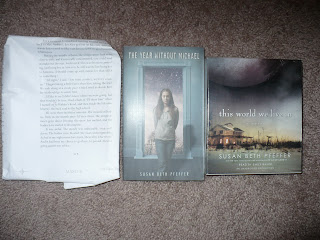 And here are the descriptions of what's in the image, from left to right (taken from Amazon or made up by me):
1. Audiobook Wrapper (in the form of an edited manuscript page from one of Ms. Pfeffer's post-apocalyptic novels from the same series as the audiobook--page 119, to be exact)
Have you discovered anything in bookstores or what not recently? Let me know about them in the comments!
The following image contains an audiobook that author Susan Beth Pfeffer gave away some time ago, but it also contains some stuff that I didn't ask for and that makes me giddy inside. Here's the image (after the fold):
 And here are the descriptions of what's in the image, from left to right (taken from Amazon or made up by me):
1. Audiobook Wrapper (in the form of an edited manuscript page from one of Ms. Pfeffer's post-apocalyptic novels from the same series as the audiobook--page 119, to be exact)
There isn't much I can say about this that the title doesn't already give away. I initially thought that it was nothing more than random paper used to wrap the audiobook, but when I saw that it was actually a page from one of her books, it made me feel like those Harry Potter fans feel when they get an autograph in an HP book.2. The Year Without Michael by Susan Beth Pfeffer (signed and personalized)
Bad things aren’t supposed to happen to good people. But somewhere between home and the softball field, 16-year-old Jody Chapman’s younger brother disappeared, and now the family is falling apart. Her parents hardly speak to each other, her younger sister is angry and bitter, and Jody’s friends, always so important to her, are slowly slipping away. It seems that all anyone can do is wait. Wait—for Michael to walk in the door. Wait—to stop missing him. Wait—to stop waiting. When a private detective can’t uncover a single clue about Michael’s disappearance, Jody’s urgent need to find him drives her to make a last desperate attempt to hold her family together.3. This World We Live In by Susan Beth Pfeffer (audiobook)
It's been a year since a meteor collided with the moon, catastrophically altering the earth's climate. For Miranda Evans, life as she knew it no longer exists. Her friends and neighbors are dead, the landscape is frozen, and food is increasingly scarce.How cool is that, eh?
The struggle to survive intensifies when Miranda's father and stepmother arrive with a baby and three strangers in tow. One of the newcomers is Alex Morales, and as Miranda's complicated feelings for him turn to love, his plans for his future thwart their relationship. Then a devastating tornado hits the town of Howell, and Miranda makes a decision that will change their lives forever.
Have you discovered anything in bookstores or what not recently? Let me know about them in the comments!
Monday, July 05, 2010
My Essay on V and District 9 Published! (Crimethink)
I think I've mentioned a number of times on my Twitter account that I have been working on an essay on the television show V (the new one) and the movie District 9. Well, that essay is now officially published and available to read online on Crimethink: Politics and Speculative Fiction.
The table of contents for the project is as follows:
Politics on the Page
"No News Is Good News: What Science Fiction Leaves Out of the Future #1" by Gary Westfahl
"War: What Is It Good For?" by Lisa Agnew
"Space Opera Rules; But By Whom?" by Ross Hamilton
Speculative Ideologies
"Reason, Sexuality, and the Self in Libertarian Science Fiction Novels" by Greg Beatty
"Speculative Fiction & Political Struggle: The 'New Wave' of the 60s & 70s" by Jordan Humphreys
Recent Media
"The Future’s Bright? A Review of Shine: An Anthology of Optimistic Science-Fiction" by Deborah Walker
"Political Allegory: Receptions and Their Implications in V and District 9" by Shaun Duke (that's me!)
Race and Gender Politics
"Engendering Utopia: From Amazons to Androgyny" by Ruth Nestvold and Jay Lake
"Aliens at the Office Christmas Party: How to Write Subtle Discrimination" by Romie Stott
"Transracial Writing for the Sincere" by Nisi Shawl
Oh, and if you have the time to read my essay, I'd appreciate thoughts and opinions. Now if you'll excuse me, I'm going to go scream and run around my apartment in a fit of excitement.
The table of contents for the project is as follows:
Politics on the Page
"No News Is Good News: What Science Fiction Leaves Out of the Future #1" by Gary Westfahl
"War: What Is It Good For?" by Lisa Agnew
"Space Opera Rules; But By Whom?" by Ross Hamilton
Speculative Ideologies
"Reason, Sexuality, and the Self in Libertarian Science Fiction Novels" by Greg Beatty
"Speculative Fiction & Political Struggle: The 'New Wave' of the 60s & 70s" by Jordan Humphreys
Recent Media
"The Future’s Bright? A Review of Shine: An Anthology of Optimistic Science-Fiction" by Deborah Walker
"Political Allegory: Receptions and Their Implications in V and District 9" by Shaun Duke (that's me!)
Race and Gender Politics
"Engendering Utopia: From Amazons to Androgyny" by Ruth Nestvold and Jay Lake
"Aliens at the Office Christmas Party: How to Write Subtle Discrimination" by Romie Stott
"Transracial Writing for the Sincere" by Nisi Shawl
That's a pretty impressive table of contents, don't you think? And, the cool thing is that this will eventually be a print publication, with all proceeds going to support Doctors Without Borders! For me, it's a win-win. I got an paper published and the publication of that essay may go towards helping people around the world, which makes me feel very good indeed. I'll let you all know when the book becomes available and I expect you all to buy it, even if you have interest in reading the essays. Heck, buy it and give it to an SF nut or something! Or, you can just give $20 to Doctors Without Borders instead, if you so choose (not sure if that's how much the book will cost, but I suspect not).
Oh, and if you have the time to read my essay, I'd appreciate thoughts and opinions. Now if you'll excuse me, I'm going to go scream and run around my apartment in a fit of excitement.
Video Found: Nosso Lar: The Astral City (Film Trailer)
I'm not sure how to describe this movie. It's a Brazilian film coming in September of this year that looks beautiful, seems to have a wonderful, heartwarming story, and a lot of deep questions about the human condition. And...it's fantasy (plus an adaptation of this). It looks amazing and I can't wait to see it.
See the trailer here (after the fold):
Thanks to SF Signal for the discovery!
See the trailer here (after the fold):
Thanks to SF Signal for the discovery!
Sunday, July 04, 2010
The Skiffy and Fanty Show #8 is Live!
Well, we've got another episode for your listening pleasure! This week we talk about mutant prehistoric whales, Doctor Who, Spiderman, libraries, and more. You can stream or download the episode here (or via iTunes).
Feel free to let us know what you think and don't forget to send us your responses to the question of the week.
Anywho!
New Poll: What should I name my fern?
I have a new poll up, and because there are quite a few choices to pick from, I could really use your help. Not too long ago I acquired a wild Boston fern, and I asked folks to suggest names, which would appear in a poll (this one!). So, now I have a list of names, and all of you get a chance to vote on which one you like best. The names are:
- Dave
- Fred
- Salvador von Cellulose
- Fern
- Kiwi
- Charlie
- Bill
- Captain Adama
To vote, just come on to the main page and find the poll on the left sidebar. Two clicks and you're done!
Thanks for the help and the suggestions, folks. Now let's name that fern!
Poll Results: What is your favorite genre?
So, a couple weeks ago I asked you to name your favorite genre, and now we have the results:
- Science Fiction -- 17.5%
- Fantasy -- 70.5%
- Horror -- 5.5%
- Other -- 5.5%
The above figures beg the question: why are you reading this blog? Since I focus primarily on science fiction (at least in my commentary), it's very interesting to see that the vast majority of you are fantasy fans. That's not a complaint, just a curiosity, and I suspect that it has to do with the fact that many of you are probably cross-genre readers who happen to like fantasy slightly more than science fiction. In that case, then, it makes sense. But, if not, then I have no clue how to account for the huge difference in genre interests.
Anywho, thanks for voting! More polls to come.
Saturday, July 03, 2010
The Altercation Decision (or How I'm Looking Towards a Productive Future)
You might remember this rather cryptic post from a few days ago in which I discussed my apprehension about engaging, once again, with a community and topic I have addressed before (don't worry, I'm going to clarify everything in the bottom of this post, but first, I want to explain my position). In that post, I commented that I thought there were really only two ways to go about it: 1) address the topic here and take apart all that happened and perhaps stir the controversy pot again and talk, yet again, about a topic I have discussed here a number of times so far this year (and all of them rather...controversial), or 2) disengage entirely from the people involved in this problem and those who use the same form of rhetoric or are at least part of the same general movement.
Both of the above options are seriously flawed. In the first case, I'll be adding fuel to a fire that I think is burning in the wrong place and needs to be seriously redirected, and that's something that, quite honestly, I'm no longer interested in--mostly because I think the rhetoric behind said discussions general runs or dissolves into something like this: "I'm right because I say so and because I disregard contrary evidence and resort to ad hominem," which is a poor argument indeed.
In the second case, I'll be punishing people who aren't responsible for the actions of others. It's a silly option the more I think about it, but the segment of that community who brought me to this decision have begun to influence how I think about the movement of which they are a part. Such influence wouldn't a problem if I disagreed with all of them, but is because I think, overall, the movement is absolutely vital. The fact that my opinions are being tainted by the more radical group is, for me, unacceptable. It's a terrible, unfair human reaction that we all have at some point or another. Pathos works in wondrous ways.
So, I have come up with a third option that is a compromise between the two. I have made the decision not to discuss certain aspects of the topic on this blog. The topic will still appear, but probably less frequently and definitely not in relation to the aspect that I disagree with. I'm also going to officially cut out and ignore the segment of the community who I feel have lost their way, rather than everyone. I'm not going to allow that segment to influence how I feel about the movement in general, because it's not fair to those who are doing good work with better arguments, better tactics, and a larger interest in open discussion with people who may be outside of their movement. I'd rather help the people I agree with and completely ignore those that I don't, than disengage entirely. And I am well aware that this is not a perfect option either, but I prefer to save my sanity and focus more on what I can actually do to make things better, rather than waste my time arguing with people who cannot think outside of their view of reality.
Having said all of that, you might be wondering what I'm actually talking about. I'm talking about the women's rights movement. There have been a number of instances this year, but the catalyst was this "argument" (for lack of a better word) over at Cheryl Morgan's blog (between Morgan and myself, and eventually between Morgan and a friend). You can read the comments if you so choose. I assume that if you read the comments (mine, Cheryl's, and my friend's) objectively, you'll see what's wrong with the whole thing (and I'm not saying that what I wrote was somehow infallible, because it wasn't).
So, that's that. The condescension, rudeness, dismissal, and so on are not effective strategies, and seem only to alienate people who might actually be willing to learn, rather than change opinions or perform a didactic role. There's a complete lack of mutual respect, and you can't foster good relations, change, and so on without that (in my opinion). So, I'm disengaging and focusing my energies on things that are either more interesting to me or might produce better results (you know, like supporting campaigns to help bring educational supplies to women in impoverished regions across the world...like the one here, which I've donated to before).
So, how are you?
Both of the above options are seriously flawed. In the first case, I'll be adding fuel to a fire that I think is burning in the wrong place and needs to be seriously redirected, and that's something that, quite honestly, I'm no longer interested in--mostly because I think the rhetoric behind said discussions general runs or dissolves into something like this: "I'm right because I say so and because I disregard contrary evidence and resort to ad hominem," which is a poor argument indeed.
In the second case, I'll be punishing people who aren't responsible for the actions of others. It's a silly option the more I think about it, but the segment of that community who brought me to this decision have begun to influence how I think about the movement of which they are a part. Such influence wouldn't a problem if I disagreed with all of them, but is because I think, overall, the movement is absolutely vital. The fact that my opinions are being tainted by the more radical group is, for me, unacceptable. It's a terrible, unfair human reaction that we all have at some point or another. Pathos works in wondrous ways.
So, I have come up with a third option that is a compromise between the two. I have made the decision not to discuss certain aspects of the topic on this blog. The topic will still appear, but probably less frequently and definitely not in relation to the aspect that I disagree with. I'm also going to officially cut out and ignore the segment of the community who I feel have lost their way, rather than everyone. I'm not going to allow that segment to influence how I feel about the movement in general, because it's not fair to those who are doing good work with better arguments, better tactics, and a larger interest in open discussion with people who may be outside of their movement. I'd rather help the people I agree with and completely ignore those that I don't, than disengage entirely. And I am well aware that this is not a perfect option either, but I prefer to save my sanity and focus more on what I can actually do to make things better, rather than waste my time arguing with people who cannot think outside of their view of reality.
Having said all of that, you might be wondering what I'm actually talking about. I'm talking about the women's rights movement. There have been a number of instances this year, but the catalyst was this "argument" (for lack of a better word) over at Cheryl Morgan's blog (between Morgan and myself, and eventually between Morgan and a friend). You can read the comments if you so choose. I assume that if you read the comments (mine, Cheryl's, and my friend's) objectively, you'll see what's wrong with the whole thing (and I'm not saying that what I wrote was somehow infallible, because it wasn't).
So, that's that. The condescension, rudeness, dismissal, and so on are not effective strategies, and seem only to alienate people who might actually be willing to learn, rather than change opinions or perform a didactic role. There's a complete lack of mutual respect, and you can't foster good relations, change, and so on without that (in my opinion). So, I'm disengaging and focusing my energies on things that are either more interesting to me or might produce better results (you know, like supporting campaigns to help bring educational supplies to women in impoverished regions across the world...like the one here, which I've donated to before).
So, how are you?
Friday, July 02, 2010
Giveaway Winners!
Guess what? I have winners for the Darren Shan contest. I apologize for the long wait, folks, but some obligations came up and stole away my time, and part of my soul. But, I have winners now, and I'm going to tell you who they are...right after this message from our sponsors.
Okay, so I don't have any sponsors, but it might be funny if I did, right?
Anywho, so there were three ways to enter the contest, as you might recall. You could leave a comment on this thread, you could send me an email, or you could leave a comment telling me the weirdest, scariest, most bizarre thing you had witnessed or had happen to you. Two winners would be picked at random, while the third (or first, depending on how you look at it) would be selected based on their little story.
So, the first two winners (chosen at random by a computer program) are (after the fold):
So, congrats to the winners (who should receive an email from me soon). Thanks to everyone who entered! I appreciate it. Stay tuned for future giveaways!
Okay, so I don't have any sponsors, but it might be funny if I did, right?
Anywho, so there were three ways to enter the contest, as you might recall. You could leave a comment on this thread, you could send me an email, or you could leave a comment telling me the weirdest, scariest, most bizarre thing you had witnessed or had happen to you. Two winners would be picked at random, while the third (or first, depending on how you look at it) would be selected based on their little story.
So, the first two winners (chosen at random by a computer program) are (after the fold):
Dave Baxter and Teresa!The winner for the scariest or creepiest story is Tina, who said the following:
The first time I went to India (in 1999), I went to Varanasi (aka Benaras) which is THE holiest of holy cities in India. It's where the living and the dead collide. It is perhaps one of the most crowded cities in all of India, yet the river is littered with dead things (dead cows, dead fish) and, because mendicants (holy men who have forsaken all worldly possessions) travel to Varanasi to die (you gain a certain amount of karma for dying in such a holy place) it is not uncommon to see vultures picking at decaying human carcasses.I'm not sure what is most terrifying about this story. Maybe it's the end with the babies or just the general feel. I have no clue if it is real, but if it is, then that's a place I don't intend to ever visit. Sounds like something out of a really terrifying horror movie.
True story--I saw it all.
Varanasi is perhaps most famous in the western world for its ghats--you've probably seen those pictures in National Geographic of way too many people crowded together on steps that go down into the water.THAT'S Varanasi). One of the most famous ghats are The Burning Ghats--the place where Hindu's cremate their dead. I was young, stupid, and totally out of line... I went as a sort of touristing expediton to the Burning Ghats.
The Burning Ghats are lifeless. Literally. Dead bodies wrapped in white sheets rest atop pyres of dull brown logs. The men of the family--sons, cousins, nephews, sometimes fathers--huddle around the bodies. Also dressed in white, they look like wraiths waiting to welcome a new soul to their ghoulish brotherhood. The ghat is devoid of color--no flags, no colorful saries, no saffron robes for the sadhus. Only the brown, gray and white of death.
Until they light the pyre and hot yellow, red, and sometimes blue flames lick up the side of the wood, devour the body.
It smells like BBQ. But that's not the worse part.
Down towards the water, a man piles something into a boat. At first, it appears as though he's stacking bundles of wood tied together by white cloth. It makes sense, but it doesn't. If it were wood, he should be unloading it at the Burning Ghat for use in the pyres, not loading it from the Ghat into his boat. I squint and peer through the smoke that fills the air. I move down the steps, closer to the water.
Babies. He's stacking babies swaddled in the same white cloth as the burning corpses above.
He rows out into the water. Solemnly, the boy that is with him lifts each white bundle, ties a weight around it and drops it into the water with a small, hollow plop.
Babies can't be burned. They have no soul.
So, congrats to the winners (who should receive an email from me soon). Thanks to everyone who entered! I appreciate it. Stay tuned for future giveaways!
Haul of Books 2010: Stuff For Me v.13
Not too long ago The Dalkey Archive was having a large sale for books and I decided to partake (because what else was I going to do? Let the books sit there, un-bought by me? Yeah right!). I'm fairly new to The Dalkey Archive, but they have published work by some very interesting international authors (who play with genre, by the way), and that's definitely something that is right up my alley.
So, the follow books were the result of my browsing at The Dalkey Archive (after the fold):
 And here are the descriptions, from left to right, top to bottom (taken from The Dalkey Archive):
1. Thank You For Not Reading by Dubravka Ugresic
What have you bought or discovered recently?
So, the follow books were the result of my browsing at The Dalkey Archive (after the fold):
 And here are the descriptions, from left to right, top to bottom (taken from The Dalkey Archive):
1. Thank You For Not Reading by Dubravka Ugresic
In this collection of acerbic essays, Ugresic dissects the nature of the contemporary book industry, which she argues is so infected with the need to create and promote literature that will appeal to the masses—literally to everyone—that if Thomas Mann were writing nowadays, his books wouldn't even be published in the U.S. because they're not sexy enough.2. The Terrible Twos by Ishmael Reed
A playful and biting critique, Ugresic's essays hit on all of the major aspects of publishing: agents, subagents, and scouts, supermarket-like bookstores, Joan Collins, book fairs that have little to do with books, authors promoted because of sex appeal instead of merit, and editors trying to look like writers by having their photograph taken against a background of bookshelves.
Thanks to cultural influences such as Oprah, The Today Show, and Kelly Ripa, best-seller lists have become just a modern form of socialist realism, a manifestation of a society that generally ignores literature in favor of the next big thing.
The Terrible Twos is a wickedly funny, sharp-edged fictional assault on all those sulky, spoiled naysayers needing instant gratification—Americans. Ishmael Reed's sixth novel depicts a zany, bizarre, and all-too believable future where mankind's fate depends upon St. Nicholas and a Risto rasta dwarf named Black Peter, who together wreak mischievous havoc on Wall Street and in the Oval Office. This offbeat, on-target social critique makes marvelous fun of everything that is American, from commercialism to Congress, Santa Claus to religions cults.3. The Terrible Threes by Ishmael Reed
With offbeat humor and on-target social criticism, Ishmael Reed presents in The Terrible Threes a vision of America in the not-too-distant future, a portrait of a fairy tale gone awry. Opening on Thanksgiving Day in the late 1990s—three years after the former fashion-model president was laughed out of office for admitting that Saint Nicholas knew more about the workings of the executive branch than he did—the White House is implicated in a plot to rid America of its surplus people and the Third World of its nuclear weapons.4. Our Circus Presents by Luscian Dan Teodorovici
Every day, the Birdman performs the same ritual: he climbs out onto his window ledge to see if he can manage to kill himself—and never does. The Birdman is a member of a loose-knit group of failed suicides, each pursuing absurd ways to end their lives: one saving up lost-dog reward money to buy enough good whiskey to drink himself to death, another hoping to contract a fatal disease by sleeping with as many women as possible. When it seems these routines will continue indefinitely, the Birdman meets a “professional” suicide: the dangerous and inscrutable “man with orange suspenders,” who makes a living by trying to hang himself whenever he sees a potential rescuer approaching. This chance encounter, which leads at last to a real death, will force the Birdman to confront the roots of his desire to escape from life, and to see first-hand that dying is more than just a rehearsal.5. Christopher Unborn by Carlos Fuentes
Conceived exactly nine months before the five-hundredth anniversary of Columbus's discovery of the New World, the narrator of Christopher Unborn spends the novel waiting to be born. But what kind of world will he be delivered into? "Makesicko City," as the punning narrator calls it, is not doing well in this alternate, worst-case-scenario 1992. Politicians are selling pieces of their country to the United States. Black acid rain falls relentlessly, forewarning of the even worse ecological catastrophes to come. Gangs of children, confined to the slums, terrorize their wealthy neighbors.6. In the Penny Arcade by Steven Millhauser
A great novel of ideas and a work of aesthetic boldness, Christopher Unborn is a unique, and quite funny, work from one of the twentieth century's most respected authors.
Winner of the 1997 Pulitzer Prize7. The Jade Cabinet by Rikki Ducornet
After the success of his first novels (Edwin Mullhouse and Portrait of a Romantic), Steven Millhauser went on to enchant critics and readers with two short story collections that captured the magic and beauty of his longer works in vivid miniature.
The seven stories of In the Penny Arcade blend the real and the fantastic in a seductive mix that illuminates the full range of the author's gifts, from the story of "August Eschenburg," the clockmaker's son whose extraordinary talent for creating animated figures is lost on a world whose taste for the perverse and crude supercedes that of the refined and beautiful, to "Cathay," a kingdom whose wonders include elaborate landscape paintings executed on the eyelids and nipples of court ladies.
National Book Critics Circle Award Finalist8. Storytown by Susan Daitch
Made speechless by her eccentric father, the beautiful Etheria is traded for a piece of precious jade. Memory, her sister, tells her story, that of a childhood enlivened by Lewis Carroll and an orangutan named Dr. Johnson, and envenomed by the pernicious courtship of Radulph Tubbs, Queen Victoria's own Dragon of Industry.
The Jade Cabinet, a finalist for the National Book Critics Circle Award, is both a riveting novel and a reflection on the nature of memory and desire, language and power.
The distinctions between art and life are blurred in this unsettling and tantalizing first collection of short fiction by novelist Susan Daitch (The Colorist, L.C.). In fifteen stories, all concerning "strange displacements of the ordinary," Daitch examines the fringes of the art world in the 20th century. Characters restore or duplicate art objects (legally and otherwise), dub dialogue for foreign films, and look to old movies for guidance.9. A Night at the Movies (or, You Must Remember This) by Robert Coover
In the title story (based upon a legendary amusement park in upstate New York), a woman works at a children's theme park, where Alice in Wonderland mourns for the Sheriff of Nottingham, who has joined the marines. Combining "downtown aesthetics" with a vivid historical imagination, Susan Daitch's stories have the same qualities that have earned her novels wide praise.
From Hollywood B-movies to Hollywood classics, A Night at the Movies invents what "might have happened" in these Saturday afternoon matinees. Mad scientists, vampires, cowboys, dance-men, Chaplin, and Bogart, all flit across Robert Coover's riotously funny screen, doing things and uttering lines that are as shocking to them as they are funny to the reader. As Coover's Program announces, you will get Coming Attractions, The Weekly Serial, Adventure, Comedy, Romance, and more, but turned upside-down and inside-out.10. Century 21 by Ewa Kuryluk
Century 21, a time machine in literary form, ignores the unity of time, space, and character. This tragicomical idyll of the future past mixes ancient and modern genres: Platonic dialogue and nineteenth-century romance, reportage and science fiction.That's the last of it. The books above are a pretty eccentric mix, don't you think? Any of them sound interesting to you?
At the book's core are two sisters, Ann Kar, a writer and survivor, and Carol, a suicidal artist. Considering herself a lunatic, Carol dreams about escaping from the earth to the moon (luna) and about the moon scholar, a lunar archaeologist, who a thousand years after her death, while reconstructing terrestrial life, discovers the traces of her existence, falls in love with her, and begins to write about her—and his—erotic adventure. The result is a novel where Anna Karenina writes about Simone Weil, where Joseph Conrad meets Malcolm Lowry in Mexico, where Goethe presides over a literary institute made up of such members as Italo Svevo and Sextus Propertius, and where Djuna Barnes, dying from AIDS, visits Moses Maimonides in Japan.
Ewa Kuryluk is fascinated by the repetition of the same situations and types, yet she's after her contemporaries who are starved for affection, lost in transit, ready to slip into somebody else's skin, and speaking English, their second language, with a heavy accent. Century 21 is a profoundly moving and original work.
What have you bought or discovered recently?
Thursday, July 01, 2010
The Caribbean, Science Fiction, and Space: Initial Thoughts
As many of you already know, I've been working on a paper on Caribbean science fiction--specifically the work of Tobias S. Buckell and Nalo Hopkinson, since my criteria is that the authors have to write about the Caribbean and be Caribbean themselves. The one thing that has stuck out to me so far--and I'll be honest in saying that this is mostly focused on Buckell, because I have yet to read the works by Hopkinson that might contribute to this theme--is the relationship between the Caribbean (people and place) and (outer) space.
I'm considering the notion that outer space for Caribbean people--particularly the colonization of other planets--is a kind of "escape" from the conditions of the postcolony. From what I'm learning about the racial, cultural, and economic conditions in many Caribbean countries, though not all, it becomes very clear that the Caribbean is never truly free from its various colonizers. The tourist industry, former colonizers, and so on have and continue to play a role in many Caribbean countries, and people within the countries themselves often fulfill the role that Frantz Fanon derided in his book Wretched of the Earth (a kind of clone-colonial, if you will).
This notion seems to work well within Tobias Buckell's work, because his three novels definitely play with space, planets, and other places in a way that, I think, defines them as implicitly "Caribbean." Other themes also play out in his work, such as that of the "out of place" Caribbean--both the colonial and "out of place" concepts function in his novels, from the controlling Satrapy to the foundations of Chilo and the various characters who "wander" from place to place. I suspect that there is a connection here to Buckell's "expat" status (if that's the right term), and I hope that when I read more of Hopkinson, I will find similar elements.
So, these are some things I'm playing around with. They're very rough at the moment, so if you have criticisms, please take that into account. I could very well be wrong, but so be it.
Interestingly enough, most of the above ideas, however rough they may be, are a testament to the value of libraries. While perusing Library West at the University of Florida, I discovered an interesting book of essays/discussions from a United Nations seminar/conference on international and national space law from the Latin and Caribbean perspective. Oddly enough, many Caribbean countries that have no space programs and no immediate connection to the space programs of other nations (some Latin countries do by providing materials that are used by the U.S. and other nations for space-based things, in case you didn't know) have participated in many of the signings and attempts to ratify various UN space legislation from the 60s on. Not something I think most people would know, even those that live in the Caribbean. I'm still looking into that, though. But that's for another time.
So, how are you?
I'm considering the notion that outer space for Caribbean people--particularly the colonization of other planets--is a kind of "escape" from the conditions of the postcolony. From what I'm learning about the racial, cultural, and economic conditions in many Caribbean countries, though not all, it becomes very clear that the Caribbean is never truly free from its various colonizers. The tourist industry, former colonizers, and so on have and continue to play a role in many Caribbean countries, and people within the countries themselves often fulfill the role that Frantz Fanon derided in his book Wretched of the Earth (a kind of clone-colonial, if you will).
This notion seems to work well within Tobias Buckell's work, because his three novels definitely play with space, planets, and other places in a way that, I think, defines them as implicitly "Caribbean." Other themes also play out in his work, such as that of the "out of place" Caribbean--both the colonial and "out of place" concepts function in his novels, from the controlling Satrapy to the foundations of Chilo and the various characters who "wander" from place to place. I suspect that there is a connection here to Buckell's "expat" status (if that's the right term), and I hope that when I read more of Hopkinson, I will find similar elements.
So, these are some things I'm playing around with. They're very rough at the moment, so if you have criticisms, please take that into account. I could very well be wrong, but so be it.
Interestingly enough, most of the above ideas, however rough they may be, are a testament to the value of libraries. While perusing Library West at the University of Florida, I discovered an interesting book of essays/discussions from a United Nations seminar/conference on international and national space law from the Latin and Caribbean perspective. Oddly enough, many Caribbean countries that have no space programs and no immediate connection to the space programs of other nations (some Latin countries do by providing materials that are used by the U.S. and other nations for space-based things, in case you didn't know) have participated in many of the signings and attempts to ratify various UN space legislation from the 60s on. Not something I think most people would know, even those that live in the Caribbean. I'm still looking into that, though. But that's for another time.
So, how are you?
Subscribe to:
Posts (Atom)