The World in the Satin Bag has moved to my new website.  If you want to see what I'm up to, head on over there!

Wednesday, September 30, 2009

Quickie Movie Reviews (2009): Volume Seven

I've been watching a lot of movies lately. I'm not a huge movie person, to be honest (at least when it comes to being at home), but the library at the University of Florida has free DVD rentals, so I'm taking advantage for the time being.

Here goes:


Europa (Trier)
A young American travels to post-war Germany to become a sleeper car conductor for the Zentropa company, and do some good in a country ravaged by war and occupation. Soon he finds himself caught in the middle of an underground militant group’s quest for revenge and the strange psychological world state of Europa.
Pros: Bizarre, beautiful, and downright creepy. This is a powerful movie that is as brilliant as it is deep and meaningful. The visuals do some brilliant adjustments between b&w and color, to great effect. This is a must see.
Cons: It might be difficult to grasp for some. If you’re a Michael Bay fan, then this is not for you. This is not action-packed, nor is it insanely suspenseful. It’s a deep, psychological film dealing, in unique ways, with the post-war condition, but in a way that never really happened (on the box it describes this as a futuristic past). This means that at times the story can drag. It is also rough around the edges as far as editing is concerned, though, perhaps, for good reason.
Rating: 4/5
Value: $8.00

Animania (the Documentary)
A brief examination of Anime culture, walking through the basic concept to costumes to the acceptance of the movement and culture by mainstream society.
Pros: It’s a geek fest for people who are already a part of the movement. Beyond that, it has nothing going for it. (Then again, it says "seriously funny" on the cover, so maybe they're trying to make a joke of things?)
Cons: This is in no way a well-thought or particularly adept attempt to document anything within Anime culture. I know; I’ve been to a couple Anime conventions myself, and this “documentary” tells us nothing that we didn’t already know about the people who go or dress up or are obsessed with Anime. It reinforces the stereotypes and fails to not only dig into actual Anime culture, both here and in Japan (and elsewhere), and completely misses the mark. Animania seems more like a media project for a convention rather than an honest attempt to actually work with the phenomenon of Anime culture. There really isn’t anything good to say about this. It’s just bad.
Rating: 0.5/5
Value: $1.00

Metropolis (Fritz Lang)
This iconic film takes place in 2026 where the world is divided between those who live above the Earth in the massive city of Metropolis and those who live below, working on the machines that keep Metropolis running. A tale of love, betrayal, revenge, and fallen utopias, this is a must see for any science fiction enthusiast.
Pros: As an astonishingly detailed film, it is no wonder why Metropolis is so influential. It has a fascinating story too.
Cons: This is a silent film and does show its age. This may be problematic for most film lovers. Also, the story is a bit disjointed, not because parts of the film are missing, but because certain aspects of the film are rushed.
Rating: 3/5
Value: $9.00 (because it’s a classic)

The Good, the Bad, and the Ugly (Extended Cut; Clint Eastwood)
Taking place in the middle of the American Civil War, this western follow three interlinked characters who discover the existence of a “treasure” buried somewhere in an unknown cemetery. What follows is a long series of tricks, betrayals, lies, deceptions, and gun battles as the Good, the Bad, and the Ugly try to secure the treasure for themselves.
Pros: A different kind of western that makes a game of creating mythological archetypes of its cast of main characters (from the Good, the Bad, and the Ugly). There is a good amount of action here, and much of what is iconic of westerns, at least as modern viewers know it today, seems to have been established here: drawn-out waits in duels, the iconic whistling music, etc. The characters are well-rounded. Quite entertaining.
Cons: The extended cut is too long. Parts of the movie drag endlessly and the entire beginning loses a lot of its power by the time you get to the meat and potatoes. That said, the length does make for a more rounded film; none of the characters are short-changed here. But two and a half hours of this style of film is a lot to take in. There were also some audio track issues, but this may be due to the time and not the filmmakers.
Rating: 3/5
Value: $6.00

Let the Right One In
The critically acclaimed vampire film that puts all others to shame. Let the Right One In is about a young boy named Oskar in 1980s Sweden who lives a troubled life amidst bullies and a broken family. When he meets Eli, a mysterious, cold girl who moves in next door, he quickly befriends her and the two of them strike up a youthful “romance.” But the more Oskar gets to know Eli, the more he realizes that she is not a normal twelve-year-old girl…
Pros: It is impossible to describe this movie in an effective way without giving away all the details. What I can say is that this is an absolute must see. Period. It is not only powerful, but brilliantly crafted, visually stunning for such a low budge film, and simply amazing. From the characters to the plot, Let the Right One in does everything a good movie should without resorting to the ridiculous nonsense of Hollywood.
Cons: If you do not like blood, don’t see this movie. Let the Right One In is not gory, but there are a few scenes where blood is present. One of the things I appreciated about this film is that it did not resort to being disgusting in order to shock you into discomfort. Those few scenes where blood or a little gore were shown were done with class. To be honest, I don’t think this movie has many problems, except a somewhat weak, though not disappointing, ending.
Rating: 4.75/5
Value: $9.50

Book Review Up: Kell's Legend by Andy Remic

You all have to check out this book if you're into action-packed, unflinchingly brutal fantasy. Remic has done one heck of a job with this one. Here's the review.

Monday, September 28, 2009

Preliminary Cyberpunk Curriculum, and Other Considerations

I mentioned somewhere (maybe Twitter, though, to be honest, my online correspondence has largely become a blur in the last few months) that I am considering developing an independent study graduate course dealing with cyberpunk and capitalism. This interest follows my attempts to conceptualize cyberpunk as a genre and the pressing curiosity as to the capitalistic claims of the genre. With that in mind, I've started putting together a preliminary "reading list." I am, of course, quite open to suggestions or modifications to this list. Your thoughts are most welcome here.

So, here goes (new additions added at 7:12 PM on Sept. 28th, 10:17 AM on Oct. 1st, and 12:34 PM on Oct. 8th -- more additions are on the way, I just haven't been able to update yet).

Novels:
Neuromancer by William Gibson
Vurt by Jeff Noon
Dead Girls, etc. by Richard Calder (love him)
Do Androids Dream of Electric Sheep? by Philip K. Dick
Crash by J. G. Ballard
The Integrated Man by Michael Berlyn
The Shockwave Rider by John Brunner
When Gravity Fails by George Alec Effinger
Memoirs Found in a Bathtub by Stanislaw Lem
Spin State/Spin Control by Chris Moriarty
Spacetime Donuts by Rudy Rucker
Snow Crash by Neil Stephenson
Mirrorshades edited by Bruce Sterling
Nova by Samuel R. Delany
Moxyland by Lauren Beukes
Babylon Babies by Maurice G. Dantec

Theory, etc.:
Postmodernism by Fredric Jameson
The Communist Manifesto by Karl Marx
Marx and Lenin (or works on them, at least)
(This section is really where I need suggestions, particularly for books that are not Marxist critiques of capitalism)

So, any thoughts?

Sunday, September 27, 2009

A Modest Proposal (For Literature Curriculum)

(This is a short "essay" I wrote for my pedagogy course. I'm putting it here because I think it might be of interest to you all. No, this is not an "academic" essay. It should be relatively accessible.)

Canonical Chronicle: Thoughts of Pop Literature and Literature Curriculum

One of the principal concerns I have with the present course of pre-college education in literature in the United States—and elsewhere—is the incessant reliance on teaching literature through the limited scope of the Western Canon. Perhaps in other parts of the world this canonical reliance shifts to accommodate different worldviews or interests, but the reliance is still there; thus, the United Kingdom, the United States, and Western Europe seemingly rely on the Western Canon, the Middle East, India, China, and other Asian nations possibly rely on the Eastern Canon, and those left out of this either have their own unique approaches to literature, no approaches whatsoever, or must adopt the educational perspective of other nations as a means of becoming part of the global atmosphere1. These narrowed approaches leave literature in a particularly nasty place: nowhere. How can literature possibly survive in our youth in such rigid, inflexible systems? True, the Western Canon does, on occasion, change, introducing new works of literature2, but these changes do not seem to have much influence on literature curriculum across the country. The same “staples” of literature—style, approved content, etc.—are invoked in these additions.

As a science fiction enthusiast, it has long been an uphill battle—in the snow, during a blizzard—to make the case for popular literature as necessary for literature curriculum in pre-college education. I don’t push for any particular kind of popular literature, even though I see science fiction as one of the most relevant and valuable genres in existence. Instead, my criticisms of modern literature curriculum are with its inability to foster proper attitudes in students towards the process of reading. Standardized education has created a system that relies on repetition, rather than on relevance. As much as Shakespeare, Dickens, Twain, and Austen are important figures in our literary history, they do not hold the same influence on students today as J. K. Rowling, Dan Brown, Stephen King, and others. This isn’t to say that students are only influenced by pop-literature icons; some of these students may find themselves attracted to writers like Salman Rushdie, Amitav Ghosh, Margaraet Atwood, and others who have stormed onto the “literary fiction” scene in recent years, and who are largely unknown to the majority of present-day readers3. The point is that literature curriculum today is, I would argue, outdated in several ways: 1) in being focused on old, classic literature to the point of excess4; 2) in being largely unwilling to shift to more relevant literatures, such as those written by emerging and powerhouse writers of today; and 3) in being unable to accommodate the incredibly short-focused nature of pre-college students in “modern” culture.

The result, based on personal experience as a former pre-college student and as the co-owner of a website for young writers, is that these rigid practices damage reading habits and perpetuate the relative assumption that literature has little meaning in our advanced, technology-driven society. Educational systems that are unable to see this are systems that fail students on a regular basis, creating learning conditions in which students do not see the value in what they are being taught. Why should a student learn about the crusades or world cultures or Charles Dickens when they fail to see the connection of that information to what matters to them now? Learning should be beneficial and self-replicating, rather than seen as a negative force or as simply a requirement that must be fulfilled because adults say so.

What can be done about this? It took Ender’s Game by Orson Scott Card almost twenty years to make its way into high school classrooms, and yet it is not as frequently taught as books like 1984 by George Orwell or Brave New World by Aldous Huxley, both science fiction texts that, while fantastic and worthy of further study, are still a part of that “old/classical” world. Will it take just as long for books like Fight Club by Chuck Palahniuk, Harry Potter by J. K. Rowling, or Midnight’s Children by Salman Rushdie to work their way into pre-college curriculum? Will there have to be a tooth-and-nail fight to get these more relevant books (from the perspective of the students) into classrooms?

Finally, there is the question of “how?” One approach, however chaotic, is the remarkably successful one adopted by Lorrie McNeill of Jonesboro, Georgia:
The approach Ms. McNeill uses, in which students choose their own books, discuss them individually with their teacher and one another, and keep detailed journals about their reading, is part of a movement to revolutionize the way literature is taught in America’s schools. While there is no clear consensus among English teachers, variations on the approach, known as reading workshop, are catching on5.
To be fair, the success is not all that surprising, particularly if you’re someone who actually went through the draining experience of high school English. I find it more surprising that schools are only now beginning to adopt such programs. Letting kids choose what they want to read, as opposed to forcing them only to read what is required by the system in place, produces results that are not only not surprising, but astonishingly obvious: kids actually want to read. Why? There are probably complicated answers to that, but the most obvious is: kids who get to make a choice have a higher likelihood of enjoying that choice.

The concern, then, is with the process of changing our methods of teaching literature, of meeting the demands of students as they change with the future. The classics should still be upheld, even revered for how they have shaped our past, but mixing the old with the new is a way of creating an amalgamated pedagogical monster that does for reading, and literature in general, what J. K. Rowling managed to do with a little boy with a lightning scar. It sounds obvious, and perhaps a tad cliché, to say: make them want to pick up a book and start reading, for the right reasons. But that is where the teaching of literature needs to be; it must move away from forcing students to read towards creating the conditions for better habits and greater interest in literature and literacy combined. How can such a thing be achieved? That’s the question that needs answering; how indeed.

Thoughts? Your opinions are welcome!

-----------------------------------------------------

Two points can be made here in regards to some omissions:
1) I intentional left Canada out of the figuration of the Western Canon as part of the educational practices of the West primarily because our northern allies have been pushing and succeeded in achieving a “Canadian standard” in literature education by instituting new requirements for students to meet a Canadian literature” requirement. While it is true that Canadian literature is as much a part of the West as anything else on the Western Canon, it is remarkably different from the principle figures of the West (the United States and the United Kingdom) in that its local literatures have yet to be adopted with any regularity, and thus does not share in the convergence of literary voices.
2) I intentionally avoided referring to colonialism here precisely because this is not an essay about colonialism. However, many of the problems with universal education in industrializing or emerging nations are connected to the process of “coming face to face with the language of the civilizing nation; that is, with the culture of the mother country” (Black Skin White Masks (Pluto Edition) 9). The colonized (or postcolonized, if you will) adopts the “culture of the mother country” in numerous ways, but none more terrifying than the adoption of, and absorption by, language.

Though, to be fair, it is uncommon, in my experience, for students in today’s classrooms to be exposed to the newer additions of the canon. There seems to be a need to teach the same thirty to forty books/plays/poems; only the lucky are exposed to newer literatures, such as those works that have yet to make it into the “esteemed” clutches of the Western Canon.
Although, to be fair, an argument could be made to suggest that this isn’t true. Rushdie and Atwood, especially, may, in fact, be quite “mainstream” “literary” authors, particularly because of their histories as writers.
To clarify: I am not suggesting that teaching the classics is inherently bad, just that teaching only the classics, with negligible amounts of variance, does students a disservice.
Motoko Rich, “A New Assigment: Pick Books You Like,” The New York Times, August 29, 2009 (http://www.nytimes.com/2009/08/30/books/30reading.html?_r=1&hp=&pagewanted=all)

Book Review Up: Unholy Domain by Dan Ronco

Not much to say. I didn't like this one. You can see my reasons here. I think I'm getting pickier and pickier with each book I read...

Saturday, September 26, 2009

Crossing Genres: Is Cross Genre SF Killing Science Fiction?

Somewhere in the genre community there is someone blaming the death of science fiction on all those bastards mixing their filthy mysteries and romances with the hardcore awesomeness of SF. I don't know where they are, but knowing the SF/F community as well as I do, I have no doubt that they exist, frothing at the mouth every time an author like Michael Chabon or Richard Morgan or *insert cross genre author here* tosses out a new, critically acclaimed book. After all, cross genre SF is a terrible amalgam that is systemically tearing down science fiction, piece by piece, right?

Hardly. Cross genre is perhaps the best thing to happen to science fiction since the golden age, at least as far as being an intentional "movement." What cross genre does is exactly what science fiction needs to convince people that it's not the same thing it always was, that it's not the spaceships and explosions and Star Wars/Star Trek rip-offs that too many people have allowed to flood their minds. It's more than that. It's complicated narratives involving anything from intense murder mysteries to complex relationships to interstellar battles. Spaceships and explosions may exist, but they are not contingent; they are probably elements of a particular brand of SF, a brand that cross genre circumvents, or, perhaps less negatively, moves around to take the genre in new directions.

SF, ultimately, is better off with these non-traditional narratives injected into it. We need the mixture in SF as much as we need ideas and strong prose, especially if SF expects to survive and continue to be relevant. SF has to be able to move around, to work its way into the cracks of other genres and remind people that it's there and ready to cause some literary damage.

What do you think of cross genre SF? Do you hate it or think it's great? Let me know!

Book Review Up: The Man Who Loved Books Too Much by Allison Hoover Bartlett

Another review up. This one you all have to read. I mean it. It's one of the most amazing books I've read in a while. Check out my review here.

Enjoy!

Friday, September 25, 2009

Curse Them All: Should You Use Them?

I have been reading an action-packed, violent book called Kell's Legend by Andy Remic recently and the author's style has brought me to this post. Those who are familiar with Remic are probably used to his unflinching desire to inject curse words liberally into his prose; they are also probably used to his rather detailed levels of violence, too. None of these things are necessarily bad, but they do make one think about the problem of cursing in fiction--or anything, for that matter.

The problem with saying "you should only do this when" is that such a phrase is inherently arbitrary. The reality is that people have varying degrees of tolerance for foul language, including myself. For example:

I typically have no issue with the f-word, s-word, b-word, crap, ass, and g-damn; however, I do have a problem with the n-word and the c-word, and more so with the latter than the former. Let me clarify before someone jumps down my throat. I can see when using the n-word might be necessary, particularly if you are trying to tell a certain kind of story about, perhaps, the civil rights movement in the United States or the Apartheid era of South Africa; it makes perfect sense that the n-word would show up in such instances. Outside of that, however, I see no use for it. The c-word, though, is, for me, pretty much intolerable; I can't stand the word for too many reasons to count, and there have been times when its use has forced me to stop reading.

That's my personal opinion. Mine is not the only one, and no one answer is any more correct than another. To illustrate this point, I asked folks on my Twitter account to respond to the question: Do you tolerate cursing in the books you read? Where are your limits, if any? Here are some of their responses (with some minor editing):

Dhympna: Yeah, I like cursing. I sometimes get annoyed by writers who use too many colloquial expressions. I get more annoyed by authors using particular vernacular and slang too much than actual cursing. In all fairness, I do tend to curse like a sailor, which is why it does not bother me.

Kaolin Fire: No limits so long as the story's interesting and it's relevant. Whatever.

GothixHalo: As long as the writing is good and the character development isn't horrible, cursing isn't a flaw. Using it as a replacement for good writing skills is a crime, though. Having to use curse words instead of competent words is pitiful.

mspuma: I only respect cursing if it seems realistic. Overuse of cursing in writing is just an old shock value trick. Cussing in and of itself doesn't offend me. They're just words. But like any emphasized phraze/cliche, it loses its punch with repetition.

Keeping all of these views in mind, it is important to note that there is no true answer to the question of cursing. What matters most is your personal taste. The market is not so black and white to make the claim for any particular level of restraint appropriate or right. In fact, because the market is so varied, it is only logical to assume that using curse words should be based on personal taste rather than anything else. Andy Remic, for example, has no qualms about using curses, and he has a market of readers who enjoy that. Other writers avoid curses entirely; they have a market two (and likely some overlap). Some people can't stand Remic, I'm sure, and others love him; Remic, I imagine, loves himself quite a lot. Remic's personal taste is clear: he likes to use curse words in his fiction. And he got published doing it.

That is not to say that you shouldn't demonstrate some restraint. Writing dialogue is not easy to do and having dialogue that is essentially a whole stream of f-words, s-words, and b-words will seem trite or perhaps unnecessarily vulgar. It all really depends on your audience. I often look at cursing as a combination of style and necessity; if the cursing is there only to be shocking or impedes the flow of the prose, then I'm out.

What about you? Where are your limits on the matter of cursing in fiction, as writers or readers?

Thursday, September 24, 2009

Quickie Movie Reviews (2009): Volume Six

Apparently I've been forgetting to toss in the "value" feature. So, it's back in this batch. There are a whole mess of Miyazaki films here, in case anyone is interested. Otherwise, there are a few other interesting films to consider. So here goes:

The Good German (George Clooney, Cate Blanchett, Tobey Maquire)
A stylistically nostalgic film that chronicles an American journalist’s attempts to solve the murder of a deceptive young corporal that nobody else seems interested in. His journey takes him through an intricate web of relationships that draw him to a Russian commander, a presumed-dead member of Hitler’s SS, and an ex-lover with her own deceptive agenda.
Pros: The Good German does an amazing job of capturing the film styles of pre-color (and post-silent) films, not only in its visuals, but also in its plot and characters. I was also surprised that Clooney and Blanchett so easily pulled off their non-English moments while on the screen. Clooney is particularly strong here.
Cons: The plot could have used some thickening to make it fit together better. Perhaps this was part of Soderbergh’s design in engaging with a nostalgic film past, but it can be a little jarring if you’re not used to the style. Tobey Maguire is not at his best in this one (thankfully his role is rather small).
Rating: 3/5
Value: $4.75

Ultraviolet (Milla Jovovich)
Based on the comic book series, this attempt at high-concept science fiction thrusts us into a future world where “pure” humans have waged a largely successful campaign to exterminate the infected hemophages. Violet, a hemophage, steals a human weapon only to discover that it is actually a boy with a mysterious origin.
Pros: The concept here is actually quite brilliant. This is a world in which weapons can be hidden is strange dimensional “pockets” on the body and where germophobia has been taken to its logical extreme. There are a lot of great science fiction concepts in this film.
Cons: The first ten minutes or so are wasted on a monologue explaining to us who the main character is. For a movie that is supposed to be rather action-packed, this is not only a drain, but exceedingly annoying. The visuals also are lacking. Whether they were going for a certain “video game” style or not, it looks amateur at best and downright awful at the worst. It’s a waste of a perfectly good concept to reduce it to fouled up visuals.
Rating: 2/5
Value: $3.00

Whisper of the Heart (Hayao Miyazaki)
Shizuku is a junior high student going through the trials and tribulations of self-discovery. During her summer vacation, she notices an ordinary-looking cat riding the train and decides to investigate. Soon she meets Seiji, a boy who is determined to follow his dreams, and soon sets out on her own journey to follow her dreams of writing, weaving a tale of magic and intrigue, using characters made familiar in The Cat Returns.
Pros: Some brilliant characterization here. Unlike other animated films I have seen, this one does not skimp on making all of its characters completely three-dimensional. One of the most interesting things about this movie is how it ties into The Cat Returns; you get the sense that The Cat Returns is more an extension of the Shizuku’s imagination and stories, a metanarrative, if you will; this adds some brilliant depth to a film about talking cats and other silliness. There’s a lot of charm here.
Cons: The story tends to drag. This is not “typical” Miyazaki. There isn’t a lot of magic and weirdness here, but more an in-depth, emotional journey through the world of Shizuku. It’s a beautiful story, but somewhat difficult to get into if you don’t go into it with the right mindset.
Rating: 3/5
Value: $5.25

My Neighbor Totoro (Hayao Miyazaki)
A unique story about a family split up by an unexpected illness and two sisters who discover the world of the mysterious Totoro. The Totoro come in all shapes in sizes, but all of them are furry, and all of them cannot be seen by adults. This heartwarming tale is a clever mixture of family drama and Alice in Wonderland style oddness.
Pros: The visuals in this are quite unique, not because this is a Miyazaki film, but because the design of the settings and characters are memorable in every way. I especially loved the detail of the cat/bus thing. My Neighbor Totoro is also quite cute and powerful for a film meant for kids. I think there’s something that had to be said about the ways that Miyazaki manages to take complicated subjects and make them work for a very young audience.
Cons: The ending feels very much incomplete. I won’t ruin the plot or what is incomplete, but just note that this doesn’t end in concrete fashion. There are still some unanswered questions. Other problems are that this one can drag just a little in the beginning, which seems typical of Miyazaki.
Rating: 3/5
Value: $6.50

Kiki’s Delivery Service (Hayao Miyazaki)
Kiki, a thirteen-year-old witch, heads out into the wide world in order to fulfill tradition and spend one year training away from home. With Jiji, a talking black cat, and her mother’s broom, she sets up a magical delivery service in a seaside town. A cute tale about a young girl discovering herself, Kiki’s Delivery Service is a fantastic film by one of the greatest animation directors of all time.
Pros: A cute story with brilliant animation (as expected) and wonderful characters. I got a kick out of Jiji and wish there had been more of him. While not my favorite of Miyazaki’s, this is certainly memorable and enjoyable. If you have kids, this is definitely one they should see. Don’t forget to watch the end credits, because there’s loads of cute stuff there.
Cons: The ending is somewhat un-fulfilling, if not incomplete. There is a resolution, but it didn’t meet what I had expected by the end. Beyond that, though, it’s hard not to love this one.
Rating: 4/5
Value: $9.50

Sunday, September 20, 2009

Brain Freeze: Where to next?

I've come to a standstill on this blog. That's not to say I don't have anything else to say, just that I'm not sure where to go next. Having now finished the cyberpunk series, I've hit a point where I can offer nothing more on punk literature, primarily because I do not know enough about the other movements. Steampunk is something I've yet to spend considerable time reading, and all the newer punks (dieselpunk, biopunk, greenpunk, etc.) are either too new to have grown into established subgenres or unfamiliar to me.

I also suspect that going on a long tear on capitalism in science fiction, particularly the critique of it, would be of little interest to all of you reading this blog. I do not want to come off as the radical Marxist science fiction guy, because I am not a Marxist by any stretch of the imagination. I simply see between the lines and readily admit that capitalism is like any other system: flawed and easily manipulated by people with "agendas." But, I like capitalism; when regulated, it is one of the best economic models in existence. Unfortunately, this is getting away from the point of this post.

In the course of writing the cyberpunk series, however, I found myself becoming remarkably out of the loop in the SF/F community. I used to have a good idea about the goings on, but it seems that has changed, or I simply find those things that are going on to be rather trite or meaningless.

So, this is where I ask all of you a few questions: what are you interested in? What do you want my opinion on, or what do you feel is a pressing issue that needs addressing? Where do you think or want me to go next? I value your opinions and thoughts, which is why I am asking.

Yes, this seems like I'm fishing for blogging ideas from all of you, but it is also to help me get a grasp on things that I otherwise would be unable to address. Graduate school and teaching, being what they are, does not lend one excessive amounts of free time for external research. That means, right now, I am focused on my studies, on what I intend to write about for my masters thesis, rather than on what is outside of that narrow world. I'd like you all to inject a bit of chaos into that mix (good chaos; I think I've had plenty of bad chaos lately, what with sick animals, broken computers, and all manner of teaching problems filling up the gaps). Push me in new directions.

Leave a comment!

Saturday, September 19, 2009

Book Review Up: Last Days by Brian Evenson

This is a twisted one, but really entertaining. My review can be found here, as usual. If you like the twisted and macabre, then this is a book for you!

Talk Like a Pirate Day: Fast Ships, Black Sails!

Avast! Today be Talk Like a Pirate Day, a day o' rejoicin' an' rum drinkin' for all pirates everywhere. On such a day we be needin' to set sail on the high seas to spread the word o' somethin' tha pulls us all together with it's piratey goodness! Cap'in's Ann and Jeff Vandermeer's anthology Fast Ships, Black Sails, published by the fine sailors at Night Shade Books and smuggled to all th' corners o' the earth by Amazon. The tome, fer those wi' the cunning t'read it, is packed like a barrel o'salt pork ready fer a month at sea wi' tales o' our fine people set in fantastical an' science fictional places.

Fast Ships, Black Sails is penned by a fine collection o' landlubberly scribes like Kage Baker, an' Elizabeth Bear. Fine tellers o' tales they be, some o' the best!

Inside this tome ye can find:
"Raising Anchor" - Ann & Jeff VanderMeer
"Boojum" - Elizabeth Bear and Sarah Monette
"Araminta, or, The Wreck of the Amphidrake" - Naomi Novik
"Avast, Abaft!" - Howard Waldrop
"I Begyn as I Mean to Go On" - Kage Baker
"Castor on Troubled Waters" - Rhys Hughes
"Elegy for Gabrielle, Patron Saint of Healers, Whores and Righteous Thieves" - Kelly Barnhill
"Skillet and Saber" - Justin Howe
"The Nymph's Child" - Carrie Vaughn
"68˚06'N, 31˚40'W" - Conrad Williams
"Pirate Solutions" - Katherine Sparrow
"We Sleep on a Thousand Waves" - Brendan Connell
"Pirates of the Suara Sea" - David Freer & Eric Flint
"Voyage of the Iguana" - Steve Aylett
"Iron Face" - Michael Moorcock
"A Cold Day in Hell" - Paul Batteiger
"Captain Blackheart Wentworth" - Rachel Swirsky
"The Whale Below" - Jayme Lynn Blaschke
"Beyond the Sea Gate of the Scholar-Pirates of Sarskoe" - Garth Nix

Fine tales, to be sure, from fine scribes, new an' old. If yer in a piratey mood, pillage yeself some dubloons and buy it. Night Shade Books has some mighty fine tales fer sale, an' they're a small press, so buyin' their tomes helps them keep their ship afloat!

So, matey, find yeself a bookseller and hand over those dubloons, or ye might find yerself walkin' the plank! Arr!

(Thank to Capt'n Bourneville fer translatin' me landlubber speak into th' true tongue!)

Friday, September 18, 2009

Punking Everything in SF/F (Part Five): The (Closer) Past (Cyberpunk C)

Now we come to the crux of the cyberpunk movement: its death. Cyberpunk was, unfortunately, always a movement that was losing momentum as it gained it. Even Gibson saw the looming death of the subgenre. He said so during a book signing some years back that I attended; he remarked that he had always considered the label "cyberpunk" to be a death note for any author, because it would be hailed almost exclusively as a label one could never escape. He was, of course, mostly right. Most of the cyberpunk voices that took up the mantle of cyber and punk are largely silent today, with exception to the greats who were able to live outside the limited scope of cyberpunk itself. Gibson, now, is a contemporary novelist who uses the furniture of cyberpunk, but does not write cyberpunk novels (though not in the same sense as Harlan Ellison and science fiction).

Why did cyberpunk die in the United States and other far west countries? To answer this we have to look at what is so terrifying about the prospect of the death of science fiction. The fear, it seems, is invoked in the terror of the encroaching future. Science fiction is presumed to be dying precisely because we are already in its propose initiating point (i.e. the originary point of all science fiction tales that forever complicates the notion that science fiction is about the future). Whatever notion of future (present and past) there may be in the science fiction landscape, proponents of its death assume that its originary point limits its relevance. As such, most science fiction would seem to have found its death in two ways: 1) where it has ceased to have relevance to the projections or speculations upon the future, effected here by the prospect of the future always moving faster towards us, exponentially with the complicating of the micro-processor and processing power (the death of near- and almost-near-future science fiction); 2) the loss of the “sensawunda” or the loss of the shock of the novum (as Darko Suvin applies it to SF). Both of these deaths, however flawed, are hailed by Deathers (to take clever liberty with the Birther movement President Obama is all too familiar with) as the definitive moments that have disrupted science fiction from the fabric of literature.

However, unlike science fiction, cyberpunk was always already dying, because it came at the dawn of its futuristic imagination. That imagination, coupling the speculative future of science fiction with the present conditions of networks, could never leap beyond, in its purest form, its originary point. Whatever lay beyond could be nothing more than an amalgam, a bastardized version of the real thing clinging like a parasite to the master beast: science fiction. Cyberpunk died because it did not contain within its structure the ability to survive the future; once its future became true, at least insofar as its key elements were concerned (primarily the adoption of the Internet on a massive level and the introduction of the hacker or socially-inept figure who resists through difference the systemic structures of corporatism), then it had nowhere else to go, except to merge with other, more adaptable forms. Cyberpunk was, and always will be, an evolutionary dead end in the face of genre.

That is not to say that cyberpunk is truly gone; no, as I have indicated here, cyberpunk was adopted, even absorbed into other forms, particularly the master narrative of science fiction and the various more prolific and profitable sub-entities (particularly military SF and space opera, two subgenres that have yet to reach their originary point). But, as a punk genre, as a genre with something to say, cyberpunk is dead, because as much as we might see its elements lingering in the bulbous mass of science fiction and even in the quasi-fictions of modern popular movies (the Bourne books, Mission Impossible, and even the new incarnations of James Bond, among other less “masculine” items), it is never a part of the critique of modern culture. Even when it is taken up again and presented in its “purest” form, it is saying nothing that has not already been uttered, and is relegated to the position of the clone with a neon sign suspended over its head saying, “Read me at your own risk. I am infected.” Cyberpunk is dead, but not buried. Whether it can ever been revitalized without being seen as the infected zombie of literature is yet to be seen.

But now we get to the question of why cyberpunk has largely been overlooked. We could easily blame Hollywood for perpetuating the idealized image of the punk: a figure who is a reluctant hero, whose fingers are sewn to the keyboard or always ready to smash the face of the unsuspecting villain with brute fury. If The Matrix had only come when cyberpunk was at its peak; then, we might have seen something new, something dreamt in the void and resistant to even the hackneyed attempts by Hollywood to appropriate the punk in cyberpunk for its ironically (for the punk) capitalist purposes (again, no offense meant to capitalists or capitalism, but blunt language is necessary here). Instead, we had Hackers, an impressive film for being so absurdly absurd that it developed its own cult movement akin to a watered down version of The Rocky Horror Picture Show, and the various other films that have long since been deleted from my memory.

We could blame Hollywood, then, for making cyberpunk into what it never was, in bringing the public to the edge and then tossing them over, telling them that the bottom of the cliff is covered in pillows, when in actuality there are stones.

Alternatively, we could blame academia for its long fight against all forms of science fiction and related genres, one it is thankfully losing piece-by-piece (hell, even Fredric Jameson has written a book on science fiction).

The reality is that there is no right reason for the avoidance of cyberpunk as a medium of study. As a genre, it was ready to take on the prospect of (post)modernity and tribal capitalism, and for the most part did. Its corporate structures were uncanny in their resemblance to the crime syndicate (the tribal capitalist structure). Now, it seems, would be a good time to take on cyberpunk, to bring it to task for what it did and did not do. Perhaps that will make up the formulations of a future post, but for now, we have this—a series of posts on the object that is punk and its various derivations in literature. Thus ends this discussion of cyberpunk. Where to next?

Comments are always welcome, particularly if you disagree with anything I have said or if you want clarification. I in no way assume I am right on any of the things I have said about cyberpunk. They are simply my attempts at conceptualizing this genre based on personal and academic study.

With that, I leave you to your thoughts!

-----------------------------------------------------------------------

Don’t forget to check out the previous editions:
--Part One (Punking)
--Part Two (Punk)
--Part Three (Cyberpunk A)
--Part Four (Cyberpunk B)

Thursday, September 17, 2009

Writing Prompt #5: LGBTQ

In honor of the Outer Alliance, here is this month's writing prompt:
Write a story of any length that involves a lesbian, gay, bisexual, transgender, or queer character or theme, in a positive light. That means don't write an anti-LGBT story, though you certainly could write a story dealing with the trails of LGBT life or the conflicts between anti-LGBT and pro-LGBT individuals.
And there you have it. Straightforward and possibly a lot of fun to do. Have at it!

Shameless Advertising

(You know, there are times when I wonder if I don't have some form of brain disease. I posted this yesterday, but didn't leave the links for any of you to click. How exactly are you supposed to be nice and friendly and vote/review WISB if you don't even know where to go? My apologies. This has been corrected!)

Because I feel like asking for a little love from you all, I'd like to point you to WISB's page at Websites For Writers and WISB's Kindle Page.

If you like my blog, pop on over to those sites and give me a vote or a review. Let everyone know how much you like WISB!

If you hate my blog, well, then I'd appreciate you telling me what you don't like, because then I can possibly address the issue. It's up to you, though.

Thanks in advance to anyone who partakes in the shamelessness of this request...

Wednesday, September 16, 2009

The Book Magnet Project: Let's Cover My Fridge

The other day I put two promotional magnets for two books I have received on my fridge. Why? Because I had them and I've always wanted to put stuff on a fridge, but I've never had one I could properly call "mine." Now that I do, I want to cover the blasted thing with promotional magnets for books. That's where this project comes in.

If you have a book (traditionally published or self-published), are a publisher, or print a magazine/journal/webmag/etc. that either fits into the SF/F genres, is related to them, or at least has elements that might be considered a part of the SF/F genres, then I want your promotional magnets. I only need one, not dozens.

What will I do in return? Well, every magnet I get will involve a free spotlight post on this blog. That means I'll tell everyone I got your magnet, what the magnet is for, what the book/mag is about, and where to find it. It's free advertising for having fun!

So, to participate, all you have to do is email me at arconna[at]yahoo[dot]com using the subject line "Book Magnet Project" or something along those lines to tell me about your book and to find out where to send the magnet. I don't care how you send the magnet, just as long as you send it to me (you can probably send it via standard letter in the U.S., for a measly 42 cents).

And to those that can't participate (because you don't have a book or a magnet), then please help me spread the word about this. I want to see how quick we can cover my fridge in magnets!

Monday, September 14, 2009

Signal Lost; Sorry For the Inconvenience

I wanted to apologize to everyone for my silence the last few days. My computer decided to cease functioning on Friday. It's currently being assessed by a technodoc and should be back to operational capacity by Tuesday or Wednesday (depending entirely upon my ability to retrieve it from the technospital). Unfortunately, this means my ability to make use of the Internet is limited. The injured computer is unfortunately the only connection I have to all of you and the rest of the net.

Regular programming shall resume when all operations are restored.

Thanks for your patience.

Transmission closed.

Friday, September 11, 2009

9/11: Thoughts

Here we are again, on this day that has shaped our lives as Americans. Anyone living today that thinks 9/11 hasn't changed the landscape has been living in a box, buried in the abyss of nonexistence. It would be safe to say that our world effectively ended when 9/11 entered the social landscape. We had to change, and some of those changes were bad.

But, we're still here. 9/11 didn't destroy America. Instead, it gave us a reason to want to exist, and made us temporarily aware of how much we rely on the kindness and sacrifice of others to keep the gears going.

Today, though, is not a day to think about how we've changed. It is a day to remember those that died and those that sacrificed their lives doing a job that we take for granted every single day. We should be ashamed of ourselves for ever forgetting how important firefighters, police officers, and even our soldiers really are in the grand scheme of things. They do for us what we can't do for ourselves.

So, today, we should remember them. We should give them some measure of thanks for their willingness to spill their blood and risk their lives on our behalf. And we should remember those innocent people who were ruthlessly murdered.

To those of you who may be in the service, or a public servant of some form, I thank you for what you do for this country, regardless of your political position or personal belief. You do a service for all of us and deserve accommodation for it.

Thank you.

Punking Everything in SF/F (Part Four): The (Closer) Past (Cyberpunk B)

(Here begins the second part of my conceptualization of cyberpunk. Expect these sorts of things to be irregular, but at the same time a part of this blog, because much of what I will be doing as a graduate student is exactly what I am doing here, but simply on different subjects. This is, for all intensive purposes, practice. Regular programming should, as always be expected.)

First, a recap of what cyberpunk is, with some inferences to what it is not:

What is it?
Cyberpunk is a genre of fiction, primarily of the science fictional vein, that attempts to merge the concept of cyber (taken broadly to mean the speculative future of technology embodied as objects such as the net, artificial intelligence, and other such items) and punk (to be taken as the resistance by a figure or figures to the dominant social paradigm of the post-industrialist complex, with reasonable removal of the unfortunate hypocrisy that eventually took over the punk movement and established its resistance as moot; one can look at Istvan Csicsery-Ronay’s concept of “No Future” in his essay “Cyberpunk and Empire” to get an idea of the nature of the gray that is the punk; and, of course, reading that essay can offer some unusually powerful insights into some of the aspects I glossed over in the first post for this series). Typical elements include: noir imagery, excessive representations of urbanity (to the extent that the urban is typically the central scenic POV and the corporate/industrial complex is instead removed or seemingly nonexistent, and thus is present more as a disembodied head than anything else), urban decay, hacker culture, and the introduction and general adoption of some form of social resistance through the technological (enhanced drugs, code manipulation, use of online-as-real environments, rogue AIs, etc.). It would be fair to say, then, that cyberpunk has already happened, insofar as certain aspects (such as artificial intelligent at the human level) have yet to happen, but other elements (the dominance of the web, the use of networks to mount resistance, both locally and internationally, etc.) have certainly occurred or are occurring.

Example: Neuromancer by William Gibson and “Cyberpunk” by Bruce Bethke.

What it isn’t?
Cyberpunk is not a grand, ridiculously Hollywood-ized foray of random technological gadgets and faux-hacker-culture obscenities that have been so readily adopted by the reading/viewing public as definitively “cyberpunk.” While cyberpunk certainly includes those elements found so grandly exposed in The Matrix and various other films and novels that have been applauded as cyberpunk, it is not so much a genre of visual or technological appeal as a genre of deeper, grander meanings and statuses of resistance. So, while one might say “that guy has a bionic eye and a talking computer” and think “it must be cyberpunk,” we can automatically dig deeper to find where its cyberpunk-ness ceases to be anything but visual aesthetics. We cannot, for example, call such a tale “cyberpunk” simply because of a bionic eye and a talking computer, but precisely because the bionic eye and the talking computer are part of a grand resistance as per the “punk” suffix, demonstrated as such through the interaction of said subjects, willingly or otherwise, with a social paradigm that is radically corporate and radically homogenized as such.

Example: The Matrix is arguable, because one could argue that the robots, intelligent and sadistic, in a way, are simply an allegorical representation of an economic model of social structure, precisely because the use of humans as commodities (i.e. the use of people as objects rather than as subjects) is so obvious. But, one would have to see the Animatrix to understand that The Matrix and its sequels are not about commodity so much as about revenge and survival. A grey area still exists; perhaps further attention to such a thing may be elemental to a broader conceptualization of cyberpunk.

Now, having said the above, I think it is fair to resume the discussion of cyberpunk as a genre.

Cyberpunk is comprised of three movements, though not, by any stretch of the imagination, linear movements, but movements equally as resistant to standards as the punk in cyberpunk. It should be noted, too, that these movements are not definitive categories in the sense that they exist independent of one another, though it is true that they are in genres other than cyberpunk. These movements can be imagined as follows:
--Post-humanism
--Post-industrialism
--Post-nationalism

I will only briefly discuss these, because their broader contexts are not necessarily needed here, though certainly worthy of exploration outside of this attempt at literary criticism.

Neither of the above categories are necessarily extreme in representation when seemingly adopted by an author, nor are they categories that should be ignored simply because they have been given a weaker role than others (literary critics would tell you that it is possible that those elements which are so hard to discern in relation to other elements are probably the ones most worth paying attention to). But to the descriptions:

Post-humanism, in the sense of science fiction, is quite literally what the name seems to imply: post (after) the human. In cyberpunk, and most of science fiction, post-humanism takes the shape, primarily, of the technological: artificial intelligence, robots, cybernetics, bionics, and other forms of prosthetics, whether for the outward body (a robotic arm) or for the internal body (a chip in the brain). Post-humanism, however, should not, in this broad definition, be confused with the alien, and if further explanation is needed for this point, then feel free to tell me in the comments.

Post-industrialism we have discussed before. It is the switch from super economies to service economies. Taken literally, again, it means the reduction of manufacturing and the production of service. Post-industrialism is not the end of manufacturing, since no society can possibly survive without the ability to create the goods that thus enable service, but there is simply less emphasis on the creation of objects, and more emphasis on what those objects do for us. For example, one might think about the iPod, which provides a portable way to listen to music (the service); we know that the iPod is built by Apple (the manufacturer), but most of us know nothing else beyond that. We are more interested in what the iPod does for us as individuals and a culture than we are in how it is put together.

Post-nationalism is somewhat more difficult to simplify, but in its relationship to cyberpunk, it is rather easy to grasp. It is the questioning of the nation state, of its values and properties and existence. Within cyberpunk, this concept is seen as the abolishment, or the thinning of, the lines that draw our nations. A prime example would be the presence of orbital colonies, such as the Rastafarians of Neruomancer. How does one figure the nation state out of something that is not only mobile, but inevitably resistant to the drawing of lines? Theoretically, you can’t. The nation state is a fixed object, something that must have definitions to its shape and design, whereas the orbital complex that is space and the various human endeavors into it are entirely resistant to any notion of nationalism; they are always mobile and always untouchable. The same is true of the net, a structure that cannot logically be figured as nation, because its lines are always shifting and no single entity can say “the net is mine.” Dominance of these spaces--temporal or mutable spaces--is, thus, impossible so long as what attempts to grasp them is owned by the social structures of nationalism.

Other, and more elaborate, definitions of the above exist, but, again, they don’t necessarily have a place in this discussion of a particularly narrow subject.

Again, it seems, I have been overly long-winded and am forced to once again split my conceptualization of this concept. The good news is that the final installment will be just that, because there I will be discussing some short, but important aspects of cyberpunk, particularly its “demise” and an understanding of where cyberpunk went, why it has largely been overlooked as a medium for the study of (post)modernity and the advancement of tribal capitalism, and other such things. There will not be a recap there, so study up (or don’t, because this is not a classroom, nor a space for you to assume the role of student; I readily accept criticism and deconstruction of my arguments here and elsewhere and expect them).

That is all!

-------------------------------------

Here are the others posts in this series: Part One (Punking), Part Two (Punk), Part Three (Cyberpunk A), and Part Five (Cyberpunk C).

Wednesday, September 09, 2009

Publication Against LGBT Content: Writers Be Aware

(LGBT = Lesbian, Gay, Bisexual, and Transgender)

Notice I said "be aware" in the title. I am not saying you should avoid the publisher mentioned as unfriendly to LGBT in this post over at Crossed Genres. Rather, I'm telling you to be aware of it. What you choose to do with the information presented in the Crossed Genre post is entirely up to you.

However, I will offer my personal perspective on this. Flash Fiction Online, while not a market I can recall submitting to, has made a decision to enact an editorial policy without making such information available to you. Why is this a problem? Well, when you go to a publisher and you look at their guidelines, you get a good sense of what they are looking for and what they are not looking for. Strange Horizons, for example, publishes science fiction and fantasy, not hard cut literary fiction about old people. Likewise, Analog is very specifically a science fiction market, while F&SF is both fantasy and science fiction. None of these magazines, as far as I know, have a policy against certain kinds of literature that is not stated, especially not in the form of a bigoted viewpoint.

But Flash Fiction Online has such a policy that is not indicated to all of you. This is not a publication that says "we do not take stories about LGBT characters," but one that says "submit anything that fits into this (a vague series of non-controversial categories), but secretly we'll reject anything that doesn't fit our narrow and biased view of the world, specifically because we have a religious, fundamentalist, and negative view of LGBT issues." Now, this isn't to say that everyone who works at FFO is necessarily anti-LGBT, but the fellow mentioned in Crossed Genres is.

So, for me, this information tells me that I cannot, in good faith, support such a magazine, not even with a direct link, when its editor so clearly holds a negative, and ignorant, view of LGBT people and issues. Period. There is no negotiation for me. As I wrote in the Outer Alliance when this issue came up:
I will not, under any circumstances, submit my work to or send money to, or read, any magazine or other publication which so obviously disapproves and holds biases against LGBT authors and subject matter. This is my personal bias, and a publication that is so willing to hide such information from the general public is, in my opinion, being disingenuous. They are, as I perceive it, hiding that information from people who might actually act upon such knowledge, precisely because they know, whether consciously or not, that to be forward with an anti-LGBT stance would constitute a loss of a share of their reading market.
I encourage you to read the Crossed Genres post linked above to get a clear picture of what this is all about. This is where I stand. Now it's time for you to decide where you stand.

That is all.

Quickie Movie Reviews (2009): Volume Five

Here we are with another edition of my quickie movie reviews. Since it has been a while since I've done these, and there are new readers seeing this, I want to reiterate what they are about. Any time I watch something that has either been out on DVD for an extended period of time or is no longer in theaters, I do a quickie review rather than a longer review, because, when it comes down to it, nobody really wants a long, drawn-out review for a movie they can pick up for dirt cheap through Netflix or some other service. They want a quick review to get right to the point (is it good or does it blow). That's what this is all about. The only thing that has changed since the last edition is that I now include a brief synopsis.

Without further delay, here we go:

Slipstream (Sean Astin and Vinnie Jones)
A physics genius working on a temporal displacement device for the government decides to test it out in public, but when the device falls into the hands of a bank robber, he has to get it back before it’s too late.
Pros: A great concept with an interesting soundtrack and a superb grasp of low-budget graphics. Big filmmakers would do well to pay attention to how this practically unknown film managed to make its concept visually stimulating without resorting to excessive computer graphics.
Cons: The acting is weak; Sean Astin is not at his best here and the rest of the cast either were given poor direction or have issues making their lines feel believable. The plot is, unfortunately, overdone, and any complexity within it feels force.
Rating: 2/5

Howl’s Moving Castle (English Dubbed)
Set in a bizarre steampunk-esque fantasy world, this brilliant animated piece by legendary animation guru Hiyao Miyazaki follows Sophie, a young girl who is transformed into an old woman, on a magical adventure. She joins Howl’s parade of unusual characters and what follows is a unique and powerful love story amidst the growing tensions of a war.
Pros: Beautifully crafted, from in all aspects, with some of the most original and powerful visuals I have seen. The story can be difficult to follow if you are not familiar with Japanese animation styles, but that makes for a deeper, more profound story. The cast is well chosen too, including Billy Crystal as the voice of Calciver!
Cons: Suffers from being too clearly Miyazaki. But for those that love his work, this is a meaningless criticism. Beyond that? Maybe the plot can be difficult to follow, but, as I said before, if you like Miyazaki, you already know what kinds of plots he works with.
Rating: 4.5/5

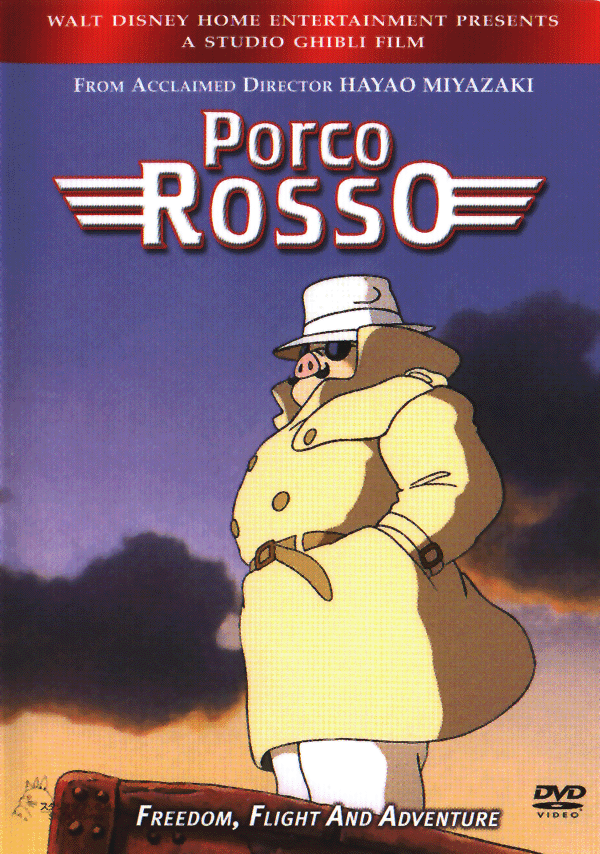
Porko Rosso (English Dubbed)
Another Miyazaki flick, this tale follows Porko Rosso, a seaplane pilot with the face of a pig, as he combats glory-hungry Americans, idiot pirates, and a wartime Italy bent on locking him up for abandoning them in a time of war.
Pros: The visuals are pretty decent and the story is relatively easy to follow.
Cons: The story lacks depth and no explanation is given for why he is the only one who looks like a pig until fifteen minutes or so into the movie--and even that explanation is rather weak. Other issues include weak characterization, a dragging plot, some poor dubbing, and other issues that come with translation, particularly in films like Miyazaki’s. In my opinion, this is one of the weakest of Miyazaki’s films, if not the worst.
Rating: 2/5

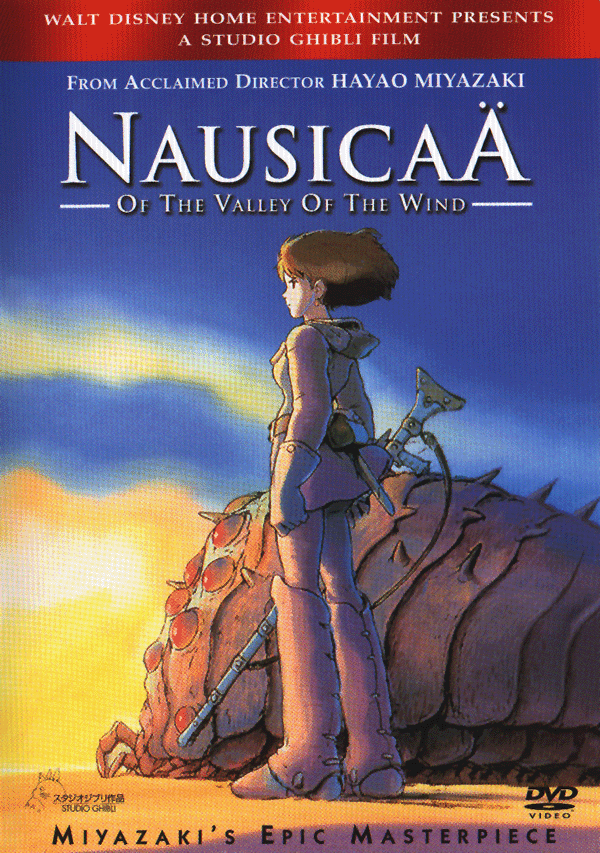
Nausicaä of the Valley of the Wind (English Dubbed)
Based on the manga series of the same name, Nausicaä is an epic science fantasy tale set in a post-apocalyptic Earth. Mankind has largely destroyed the planet, creating an entirely new ecosystem where giant insects and deadly plants devastate human populations wherever they meet. Nausicaä, and her various companions along the way, finds herself caught in the middle of a feud between two human factions and the rage-filled insects that dominate her world.
Pros: Truly an epic story, with some amazing imagery, unique characters, and a brilliant vision. Miyazaki, while not the creator of Nausicaä, certainly tried to capture the stimulating visuals of the manga series to create this story.
Cons: The story itself is very much the hit-you-over-the-head kind in regards to its environmental message. I found it somewhat annoying, but did my best to get past it to enjoy the rest of the movie.
Rating: 3/5

The Fall
An injured stuntman manipulates a young girl with a broken arm into helping him try to commit suicide by telling her a story of adventure and intrigue. But with each passing moment, the story becomes more real, and the line between real and imagined fades. A richly detailed and unforgettably unique movie, The Fall is one of those films we wish had been in theatres everywhere.
Pros: The Fall is absolutely gorgeous, utilizing various locales across the world to create an astonishing array of visual flavors. The story itself is quite powerful, too, which may be something lacking in films of this vein, especially today. It’s not every day that a film can successfully stick together pulp-era adventure with a deep and compelling narrative of depression and the power of imagination.
Cons: It is unclear what sort of style the directors were attempting to create in the relationship between the stuntman and the young girl. Most of her screen time is spent either seemingly ad-libbing or speaking softly with a thick accent, making her difficult to understand. This style of acting clashes heavily with that of the stuntman. Thankfully, it is bearable.
Rating: 3/5

And there you have it. If any of the above movies interest you, go rent them or buy them on DVD! Or not, it's up to you...

Tuesday, September 08, 2009

Punking Everything in SF/F (Part Three): The (Closer) Past (Cyberpunk A)

To define cyberpunk is to literally take up the foundations of science fiction and say, "this is it, and there are no other options." Anyone who attempts a definitive definition to science fiction will know how ridiculous this is to accomplish, particularly because no two individuals will agree. Cyberpunk is to punk what science fiction is to itself. Any attempt to define cyberpunk will be either heavily contested, patently wrong, or shortsighted. I expect here, in this brief forum, that I will have approached some semblance of all three categories.

Cyberpunk began, at least in its most recognizable form, with Bruce Bethke, a fellow most of you have never heard of precisely because another fellow by the name of William Gibson stormed onto the scene and stole the limelight from our little Bethke. You see, Bethke was a visionary who unfortunately was rather shortsighted in his presentation of what we now know to be "hacker culture." His story, aptly named "Cyberpunk," was quite literally the embodiment of punk in the narrowed vision of the future, a molding, literally, even, of cyber (to mean future technology) and punk (to mean what I attempted to utter here). Fitting how the term came together, don't you think?

Then there was Gibson, and Bruce Sterling, and Pat Cadigan, and even a few friends from the past who, for better or worse, were adopted into the fray by enthusiasts of the genre, even though they were not, by any stretch of the imagination, attempting to toss their names into the cyberpunk hat (how could they when they had no idea that cyberpunk would exist in another decade or two, the Philip K. Dicks and Stanislaw Lems, with all their proto-cyberpunk tales that were either ignored or acknowledged as wonderfully complicated).

And what were they writing? Future punk, to be rather brutally simplistic about it. They were extrapolating upon the present by imagining a future that punk had yet to conceive: one in which globalization had been taken to the extreme, so much so that corporations took that final step to being more than just entities with a voice, but true powers, global entities with desires, wills, and superiority over the then-present (future-present) society. Here is when punk met cyber, because as society in the 1980s was gearing up for the incredible shift in economic priorities, cyberpunk writers, whether announced or silent, were imagining the decay of cities and neobarbarism (an examination of extremist urbanity), and envisioning the future of post-industrialization. Super economies were becoming service economies (Fordism vs. Toyotaism) and the entire structure of society, as envisioned by the league of cyberpunks themselves, was shifting from that in which the individual fit into one of two categories: 1) the hapless victim of social and economic change, unwilling or unskilled to mount any sort of resistance, except to adopt the new cultural paradigm and become "citizens" of the post-industrial, corporation-as-self structure; and 2) the "punk" as embodied in he/she who resists, who mounts some form of opposition and bleeds into the structure of society as one who is not supportive in action (though in mind they were not necessarily aware of said resistance) of the dominant social structures.

And so, cyberpunk became a way of envisioning the future as always already screwed up, as filled with all that was wrong with the present amplified, but all that was right with the future. There was the net, a force of both social cohesion and discord, and even such wonders as quasi-noir imagery (a la old detective novels), cybernetics, bionics, excessive reference to new or improved drugs, and hacking. Much of cyberpunk, thus, saw the net as coming alive, becoming, as it were, a being-to-itself, with artificial intelligence and pre-visualized navigation structures that allowed it to be more than just a place of numbers and code. Here you should think about the nature of video games and how the Internet has change how we play them; cyberpunk saw that coming from a mile away, but yet was so clearly wrong in some respects, because we have yet to devise a game world that is a world experienced as such.

This post, unfortunately, has grown too long, and must be split. Here I have conceptualized a relationship to punk itself and given a brief idea of what cyberpunk is, though rather haphazardly. There is more to say, but for now we have the above. There are movements to be discussed, within cyberpunk, and other elements that have largely been forgotten, including the interesting nature of merger and collaboration amongst the various other genres, and even the supposed death of cyberpunk. Those are forthcoming.

But, for now, if you have thoughts, disagreements, or downright hatreds for what I have uttered here, please use the comments below to relay them in the manner you deem appropriate. And that concludes my rather formal, somewhat critical language. Have at it!

---------------------------------------

Read Part One (Punking), Part Two (Punk), Part Four (Cyberpunk B), and Part Five (Cyberpunk C).

Monday, September 07, 2009

World Building: Thoughts and Practices

World building is one of those things you have to do, even if you don't want to. Whether you write fantasy, science fiction, or something else entirely, you'll always find yourself attempting to build your world, whether at the micro or macro levels. Creating characters is a form of world building, and if all you do is create unique characters for your novels, then you are as much a part of the process as someone who builds entire worlds (they just have to spend more time creating things from scratch, while you, perhaps, can sit around in the comfort of the world you know).

I've often approached world building from a relatively minimalist position. While I enjoy fantasy worlds with richly developed worlds, sometimes such things can get in the way and what should be a riveting novel can turn into a foray into the author's world building practices. Nobody wants that. Tolkien, for all his brilliance in creating the most fully-realized fantasy world in the history of the genre, was occupied by unfortunate flaws in style and character development, some of which were a product of the times. I prefer to keep things localized. Whether it is the most efficient method, I don't know, but it seems to work well enough for me. I don't occupy myself with excessive amounts of ancient history, because, as much as that might be interesting, it is not relevant to whatever story I am writing at that moment.

When I build worlds, I start with names and general ideas, work my way to a map, and then go wild until I feel that I know enough about the world to be able to write in it. Sometimes it works well, depending on how interested I am in a particular world, and sometimes it doesn't. But when it works, it really works. I have three fantasy worlds that I developed this way (Traea, the world in which The World in the Satin Bag is set, a world where I've set many of my "quirky" fantasy stories, and the Mundoscurad, the most recent, in which The Watchtower is set.

There are an absurd amount of different methods for world building, from genre specific to author specific. Writers of all genres, particularly newer writers, are always looking for the "best way," not realizing that the "best way" is really non-existent. Reality dictates that what might work for some, may not work for you, and vice versa. Ken McConnell, for example, said via his Twitter that, "sometimes it's the little things, like word choice that can set the tone and enrich your world building."

So what do you do when it comes to world building? How do you find the right method for you?

Trial and error. Not the answer you were looking for, were you? Tough. So much of writing involves trying something to see if it works for you. If it doesn't, you drop it and try something else. Trial and error is a writer's third or fourth, or maybe tenth, best friend (no doubt writers have a lot of best friends).

But that's neither here nor there. I want to hear about your world building methods. How do you approach creating new worlds? What works for you?

Sunday, September 06, 2009

First Time Novels: Small Press or the Big Boys?

An interesting thought occurred to me only moments ago: when it comes to considering publishing your first novel, how do you decide on what kind of publisher to select? It would seem, at least to me, that many automatically send their work to the big boys, get rejected, and then sit around bitter, or self-publish, due to some unfortunate ignorance on their part of all the wonderful small presses out there. But then there are others, like Paul Genesse and other talented writers, who opted for a small press from the start, for reasons that I have either forgotten or simply do not know.

I suppose my curiosity on this arises because I am considering my own path, considering the future from a point far removed from that would-be point. Are certain novels more fitting for small presses than the big ones? How does one see that in a novel? And do writers who select small presses first ever consider whether it would have been better to go with one of the big boys? Or is that so far removed from an author's mind because, hey, they're published, even if it is by a press that will only print a thousand copies of their book?

I don't know. It seems to me that if you could define a small press novel as a particular brand, then you could easily say "this would be good for them." But novels don't seem to be so easily defined, and I find it difficult to believe that the many authors snatched up by small presses went there as a last resort.

What about all of you? What would you say to all of this? How would you decide to choose a small press?

P.S.: This is not meant as a slight to small presses in any way. I have read many great works from small presses and believe them to be a valuable asset in a difficult field to break into. I do, however, recognize that many authors do not have the sort of relationship I do with small presses, a relationship that recognizes their value and has seen the quality of work they produce. Some still perceive the small press as too close to self-publishing for comfort. It's an unfortunate stigma, but one that small presses must combat, day in and day out.

Book Review Up: Night of Knives by Ian C. Esslemont

Another review! This book is actually a sort of prequel to Erikson's Malazan Book of the Fallen series, so it might be of interest to some of you Malazan fans. Check it out here.

Saturday, September 05, 2009

Fantasy Essentials: What Should I Have Read?

Somewhere along the line I began getting criticized for not being all that great at writing fantasy because I had not read enough in the genre. Maybe this is true, and if so, I would like to rectify that, to the best of my ability.

So, to all those reading this, I’m calling on you for help. In the comments, let me know which five fantasy novels you think I absolutely must read. They can be any fantasy novel except the following: The Lord of the Rings, Eragon, Harry Potter, and George R. R. Martin. I’ve either already read those or tried to read them, so including them here would be meaningless at the moment.

Have at it. Tell me which five you think I should read and why!

Book Review Up: Mind Over Ship by David Marusek

Well, another book review done and up! You all should check out Mind Over Ship for sure. High-concept science fiction with a kick. Here's my review.

And that is all!

Thursday, September 03, 2009

Interview w/ David Bryan Russell

David Bryan Russell is the author of Enchanters, which I reviewed here. Appreciation goes to Mr. Russell for agreeing to do this interview. Here goes:

First, can you tell us a bit about yourself? What drew you into authorhood, and why fantasy?

I refer to myself as a 'professional dreamer.' My creative journey began in early childhood, inspired by adventure stories and mythology, especially the Norse sagas. I began writing around age 12, and concurrently started drawing about the same time. The visual arts eventually dominated my creative output, but my interest in literature never flagged.

Regarding my preference for fantasy...well, the colourful Norse sagas lit the initial fire, followed by the body of fantasy literature that fortuitously began to re-emerge in the popular press during my late adolescence. In any case, I have always found the genre full of depth and meaning. In a sense, fantasy constantly seeks to re-imagine the spirit world, and in the process can provide insights to humankind's most perplexing issues.

What have been some of your influences as a writer?

I've mentioned mythology and fantasy literature, to which I should add the imaginative output of such diverse artists as Caravaggio, Rubens, Jack Kirby, Frank Frazetta, NC Wyeth, Gaugin, Lautrec, and select Pre-Raphaelites, all of whom were excellent visual storytellers.

What are some of your favorite books, whether fantasy or otherwise?

Hmm.....an abbreviated list must include The Three Musketeers, Huckleberry Finn, David Copperfield, Wind in the Willows, The Time Machine, Treasure Island, Walden, Women in Love, The Jungle, The Grapes of Wrath, 1984, Invisible Man: A Novel, Fritz Lieber's Fafhrd and Gray Mouser stories, The Martian Chronicles, and the following books by Jack Vance: Tschai, Demon Princes, Durdane, and Dying Earth series, and Emphyrio.

Could you tell everyone a bit about your novel, Enchanters?

It's a contemporary fantasy adventure, powered by love. I enjoyed writing the book, which allowed me to distill a number of concepts about magic, and of humanity's relationship to the natural world.

It’s clear from Enchanters that you have a vested interest in the state of the environment.

True. This forms part of the motivation of the principal character, but Enchanters is no environmental polemic.

What drew you to translate this into the world of fiction?

It seemed logical for the character, and the hidden world of magic to which she belongs.

Enchanters is a curious novel that tackles the issue of human pollution from a unique angle. What prompted you to create this side world, where the Enchanters exist as a sort of oppositional force to humanity’s lesser qualities?

I would not view the Enchanters as oppositional; in fact, it's clearly stated that they were once bound quite closely to humans. However, circumstances altered over time.

In essence, Enchanters charts the personal journey of Glys Erlendsen into a heretofore unseen world, one in which the goals of humanity and those of the Enchanters are often at odds. How she deals with these dilemmas provides the basis of the adventure.

Set in Norway , Enchanters seems relatively steeped in regional folklore. What about the country's mythology that so fascinates you?

As I mentioned, Norwegian cosmology stirred my imagination from an early age. The country is almost unique in Europe, in the sense that it never accepted the Christian concept of duality--that is, the existence of an absolute right, and absolute wrong. In simplistic Christian terms, god on one hand, the devil on the other. This flexible thinking--despite the brutal aspects of the Viking period--allowed for the eventual development of a rather egalitarian culture. Most importantly, however, Norwegians successfully held onto their beliefs in the spirit world, and to this day recognise the presence of fairies, elves, trolls, and other magical beings. In part because of these beliefs, Norwegians have an intense reverence for the natural world. I observed these singular traits during my first visit to Norway in 2002, and thereafter decided to set the Enchanters storyline in the country.

Do you see fantasy as a great genre through which to examine the human condition as you have in Enchanters?

Beyond question it is a supple medium for the exploration of the deeper issues of life. Alas, few authors recognise this potential.

What drew you to publish with a small press, and how has your experience been with them?

As you have observed, Enchanters is a unique novel. I felt that a small press would be more likely to recognise its potential than a globalist publishing house, where editorial departments routinely favour non-original (and non-controversial) material.

What are some advantages, in your opinion, of being published with a small press?

Personal attention, editorial and marketing support, and (most importantly) the gift of time to develop one's ideas.

What other projects do you have coming up, and can you tell us a little about them?

The sequel to Enchanters, entitled A Shining Realm, will be released in Fall 2010. I am also currently outlining a new series of fantasy novels set in a fully-imagined world.

What unusual piece of writing advice would you give to budding writers?

Ignore contemporary trends, and develop the most original work you can manage. Be mindful that most writers are seeking to emulate film and television writing, which is inappropriate for the development of potent fantasy literature. Study the great books of the past, and of the present, especially those outside of one's preferred genres.

Now for a random question: If you could be the King (or Queen) of any country during medieval times, which country and why?

I presume you refer to the European medieval period...It's an odd question, since the era was miserable for rich and poor alike, primarily due to the cultural death grip of the region's vile religious institutions. In any case, I myself am quite egalitarian, and would thus never consider occupying a position of life and death over my fellow human beings.

And there you go!