The wonderful folks at Tachyon Publications are up to mischief again with a new anthology called Kafkaesque, edited by John Kessel and James Patrick Kelly. I'm letting you all know about this book because I want it, and one of you is going to buy it for me for my Birthday, which is on the 6th of October. Seriously. You are. Or we're not friends anymore, you hear? And I don't care that the book doesn't come out until November 2011. You can pre-order it. Or steal an ARC from a reviewer. It's only wrong if you get caught...
Anywho. Enough of that. Here's the back cover blurb (ToC to follow):

Wednesday, August 31, 2011


The Science Fiction Renaissance: Who is Our Messiah?
I had a rather strange and characteristically "me" conversation with my friend Adam the other day about the state of science fiction as a genre. One thing that keeps coming up in our conversations is how fantasy has seemingly abandoned the trappings of respectability for the more lucrative pursuit of market share, while science fiction has done the exact opposite. I'm not sure why science fiction lovers (not all, but a good enough chunk) have doomed themselves to respectability at the sake of readership, nor am I altogether certain that SF is weakened by its bid for respect (in part, yes).
But it does make me wonder why there are so many fantasy authors that fans can't stop talking about, while there are so few science fiction authors who seem to have the same impact. Adam often brings up The Quantum Thief by Hannu Rajaniemi as an example of SF that could revitalize the genre. But are people paying attention, or are the only ones looking at The Quantum Thief the same people who were looking at SF before? I'd guess the latter, as sad as that makes me about the state of the genre I love so dearly.
Perhaps the problem stems from the absence of SF in YA and children's lit circles. There are hardly any SF novels in those categories, and the few that exist are more often of the dystopian variety than the space opera kind (which seems silly to me when you consider how much space opera is like the epic fantasies that dominate the YA shelves).
The question becomes: who is our new SF messiah? Who can revitalize the genre by bringing in new readers and give back to the reading world all that glory and sensawunda that made the genre what it is/was? Or will SF sink into a smaller market share and stay there?
I'm not saying that SF is dying. It's not. It can't die. Not while a huge chunk of the most successful movies these days are SF. Not while Star Wars and other franchises are doing just dandy. But I do get the sense that SF has become almost elitist in its pursuits. That there aren't many gateway tales anymore (those we point to as gateway tales are often old, stuffy, and not exactly on the advertising list for publishers). I suppose I'm just worrying that we're shooting ourselves in the foot here. Maybe this has something to do with what Damien G. Walter said about critics and the Hugos.
Or maybe it just has to do with being embedded in academia. I think SF has its respectability. We just don't need it. We don't need to keep looking for it and trying to get more of it. What SF needs, it seems to me, is an awakening. A new renaissance.
Tuesday, August 30, 2011
The Sexy Geek Ideal Imaginary: Do We Have a Problem?
I'm going to direct you all to read Geek Feminism's post entitled "'Geek Girls' and the Problem of Objectification" as a starter, because much of what I'm going to say below stems from the fascinating discussion taking place there. But to start, I'll offer the following quote:
There’s nothing wrong with wanting attention and approval in one’s community. What cosplayer and geek wouldn’t want those things? What female geek doesn’t want to be welcomed into the community with enthusiasm and excitement (instead of derided as a harpy feminist or annoying squeeing fangirl)? The problem, then, isn’t what women do, but a culture in which the only way that women can be recognized as a desirable part of the culture is when they participate by making themselves consumable sexy objects for geek men.One of the problems with geek culture is how readily it has moved to adopt the paradigms of the cultures that exist outside of it (the very cultures which at one point looked down at geeks for being, well, geeky). I don't have a problem with sexy geeks, or sexy geek clothing. In fact, most people don't, in principle. There's nothing wrong with looking sexy, or wanting to look that way. The problems arise when the sexy geek becomes the image we hope to attain (or, rather, that women hope to attain, since men, by and large, are not compelled to fulfill particular and very
Monday, August 29, 2011
Lambda Literary Award: Celebrating the LG, Kicking the BT in the Ass
I won't profess to understand the full history of the Lambda Literary Foundation (to which the award belongs). As a Foundation that has in recent years honored lesbian, gay, bisexual, transexual, and other-sexuals (genderqueer, etc.) writers, the place is near and dear to my heart. But then they announced this:
LGBT authors will be recognized with three awards marking stages of a writer's career: the Betty Berzon Debut Fiction Award (to one gay man and one lesbian), the Jim Duggins Outstanding Mid-Career Novelist Prize (to one male-identified and one female-identified author), and the Pioneer Award (to one male-identified and one female-identified individual or group) - Awards for the remaining Lambda Literary Award categories will be based on literary merit and significant content relevant to LGBT lives. These awards will be open to all authors regardless of their sexual identity - All book award judges will be self-identified LGBTThe above is the result of a lot of discussion and arguing among differing camps of the LGBT community (supposedly, though I've yet to hang out with any LGBT people who disagree so much as to make a concession like the above remotely rational). But it is also the third major response to criticism about how the awards are structured. According to their 20+ year history, the award went from accepting submissions "based solely on a book's LGBT subject matter" to being restrict to self-identified lesbian, gay, bisexual, transgender and queer authors" in 2009. This, apparently, is what has created the divide. Some believe the award should go only to writers of the LGBT persuasion (broadly defined), while others think that the awards should reflect LLF's function to promote positive LGBT images, as their mission statement makes clear:
SandF Episode 5.1 (Torture Cinema Meets Mansquito) is live!
Our listeners were kind enough to select Mansquito for our Torture Cinema feature this week (which might include some of you). If you don't know anything about the movie, that's probably a good thing. I strongly suggest listening to our humorous and slightly angry review instead. It'll save at least 60 minutes of your day (seeing how the movie is about an hour and a half, and our review is 1/3rd of that).
In any case, here's the episode!
Now if you'll excuse me, I'm going to go edit something, and then blog about something else...

In any case, here's the episode!
Now if you'll excuse me, I'm going to go edit something, and then blog about something else...
Saturday, August 27, 2011
What Are You Reading? Inquiring Minds Want to Know
In the interest of giving all of you the floor to talk about books, I'd like to know what you all are reading and what you think of it (anything counts, from articles to audiobooks).
I am currently smack dab in the middle of the following:
I am currently smack dab in the middle of the following:
- Down the Mysterly River by Bill Willingham (and Mark Buckingham)
- Loving it!
- The Uncertain Places by Lisa Goldstein
- Interesting, but I need to get deeper before I can make a valid judgment.
- Gateways edited by Elizabeth Anne Hull
- Some really smart stories in here!
- Future Media edited by Rick Wilbur
- Just started!
- When the Great Days Come by Gardner Dozois
- So far: loving it!
- Imperial Eyes: Travel Writing and Transculturation by Louise Pratt
- Just started! But I've read it before, and it's an interesting text.
- Maps of Englishness by Simon Gikandi
- Just started!
- The English in the West Indies by Froude (can't remember the the first name)
- Just started!
- The Portable Harlem Renaissance Reader
- Just started!
- The New Negro: Voices of the Harlem Renaissance
- Just started!
I also finished a few short stories by Mary Robinette Kowal ("Clockwork Chickadee" and For Want of a Nail -- the latter won the Hugo and is quite good). And yes, I realize that is a lot of reading. I'm a grad student. So sue me...
So what are you reading?
Friday, August 26, 2011
Book Review: Hexed by Kevin Hearne
Finally we have an urban fantasy author writing about something other than werewolves and vampires devoid of their mythological undercurrents. Kevin Hearne's Hexed takes us back to the roots of all the mythological creatures which have dominated much of fantasy for hundreds of years, but with a welcome change of scenery.
Hexed follows Atticus O'Sullivan, one of the last remaining Druids in a world in which all of our myths and religions are "true." Gods roam the Earth, the Virgin Mary sometimes shows up to help the homeless, and witches wreak havoc. It's that last group which has caused Atticus a lot of grief. He and a local coven of witches have crossed paths before, and people have died as a result -- mostly the witches. But all that is over with now, because a new threat, the Bacchants, has shown up in Arizona to take the city of Tempe for themselves by crashing it deep into the worst of human
Thursday, August 25, 2011
Writing: It's Really About Winging It
I've been following Mark Charan Newton's blog for some time now. He's the author of Nights of Villjamur, City of Ruin, and Book of Transformations, an environmental activist, reviewer, and too many other things to put in a post without wandering into random topics. He recently posted an interesting response to a Guardian article about Tobias Wolff, from which I draw the following quote:
The interesting thing about writing is how muddled the field has become. There are so many classes and workshops and books about the process of writing that the reality of the writing process seems to have gotten lost. Everything about writing is about "faking it" or "winging it." Fiction is always already a symptom of overactive imaginations, its very formation founded in
While I’m in no way intending to put myself anywhere near Wolff on an achievement level, I can really agree with his statement about faking it. Every single time I sit down to write, I feel like I’m winging it. From all the research I do to watching all the reviews come in, it still doesn’t feel real. Those poor Amazon reviews seem like a plot to expose me by those who know the Truth.I should be just as humble about what I will write below, as I am even less accomplished than Newton in my writing career (a couple of short fiction sales, no novels with agents, and a long list of rejects for stories I am told are quite good -- thanks Adam).
The interesting thing about writing is how muddled the field has become. There are so many classes and workshops and books about the process of writing that the reality of the writing process seems to have gotten lost. Everything about writing is about "faking it" or "winging it." Fiction is always already a symptom of overactive imaginations, its very formation founded in
Wednesday, August 24, 2011
Book Review: Sword of Fire and Sea by Erin Hoffman
Erin Hoffman's debut novel is a traditional high fantasy romp formed from the ashes of a collaborative project. It's origins are a bit unusual in a field of secondary world fantasies created by individuals with Tolkien on the mind, and the effort to move beyond the collaboration shows in the development of the world's magic system, mechanics and all. As a novel, Sword of Fire and Sea leaves something to be desired, but as a fantasy adventure, it hits all the right marks.
Vidarian, a reputable ship captain, gets caught up in a complex web of magic-wielding priestesses when he reluctantly agrees to ferry fire priestess Ariadel to a safe haven. There, the priestesses hope, the Vkortha, their mortal enemies, will not be able to find Ariadel, whose abilities might threaten Vkorthan power. But the journey takes Vidarian and his crew through dangerous waters, where pirates and sorceresses await. Yet more shockingly, the journey reveals a destiny that Vidarian never knew he had, one which puts the fate of the world in his hands: in the end, he will
Vidarian, a reputable ship captain, gets caught up in a complex web of magic-wielding priestesses when he reluctantly agrees to ferry fire priestess Ariadel to a safe haven. There, the priestesses hope, the Vkortha, their mortal enemies, will not be able to find Ariadel, whose abilities might threaten Vkorthan power. But the journey takes Vidarian and his crew through dangerous waters, where pirates and sorceresses await. Yet more shockingly, the journey reveals a destiny that Vidarian never knew he had, one which puts the fate of the world in his hands: in the end, he will
Weird Tales: The Editorial Fiasco
There's something troublesome about what is going on with Weird Tales. Yesterday, Ann VanderMeer, the current-(no-longer)-editor of the magazine posted an announcement that she would not longer be editor. More disturbing was the news that Weird Tales had been sold to another editor who seems to have purchased it in order to edit it himself (this fellow being Marvin Kaye). The entire staff has been dropped, without much in the way of warning or transition. Poof. Done. Over. I'm sure there was something going on behind the scenes that we don't know, but it doesn't seem all that relevant when you consider the lack of professionalism going on here.
To add insult to injury, apparently the first thing Kaye intends to do is launch a Cthulu-themed issue of Weird Tales, taking the magazine backwards many decades. It's almost as if they don't care what Ann did for Weird Tales -- dragging it out of the shadows of its past. To be honest, I find myself agreeing with much of what Jason Sanford has already said on this issue:
Tuesday, August 23, 2011
WISB Podcast: Triple My Embarrassment By Picking a Third Dance
I've already apologized for putting off a lot of things I promised. One of those things was the dance(s) I said I'd do if I reached my funding goal (over a month ago). Since I met that goal, I'm required to provide a video of me performing Peanut Butter Jelly Time and the Truffle Shuffle. But then my laptop died, taking with it my webcam and my only method for making those videos...
That barrier has now been solved. I went ahead and bought one from the store. It's a pretty good one, too (for the money). Which leads me to the point of this post:
In order to "pay you all back" for making you wait so extraordinarily long for an embarrassing video, I've decided to let you all select a third dance for me to do on camera. It can be anything, so long as I can reasonably do it (or look funny trying) and it's not vulgar (sorry, I'm not taking my pants off or anything like that).
What would you have me do?
That barrier has now been solved. I went ahead and bought one from the store. It's a pretty good one, too (for the money). Which leads me to the point of this post:
In order to "pay you all back" for making you wait so extraordinarily long for an embarrassing video, I've decided to let you all select a third dance for me to do on camera. It can be anything, so long as I can reasonably do it (or look funny trying) and it's not vulgar (sorry, I'm not taking my pants off or anything like that).
What would you have me do?
Video Found: "The Doctor and I" w/ John Barrowman (Wicked)
I'm stealing this from SF Signal because I know my sister needs to see it. She's not a Doctor Who fan (in part because she's a mutant from another galaxy), but if this doesn't convince her that Doctor Who is the greatest science fiction TV show still running (poor BSG is no longer with us, after all), then I don't know what will.
Enjoy!
P.S.: To my sister -- if you don't enjoy this, we will no longer be siblings. I will disown you like an evil overlord disowns his henchmen. That means I'll send you to your untimely death knowing full well you can't defeat the good guy. Or something like that...
Enjoy!
Monday, August 22, 2011
SandF Episode 5.0 (Interview w/ Erin Hoffman) is Live!
The title says it all. Erin Hoffman, author of Sword of Fire and Sea, joins Jen and I for an interview. We talk about her debut novel, video games, and even gryphon rights (sort of).

Here's the episode. Thanks for listening!

An Addendum: The 2011 Hugos
Eileen Gunn was kind enough to put me in my place on Google+ last night. And let's face it, after a lot of what I said about categories I know nothing about, nor, obviously, have any connection to, I really should have taken my shoe out of my mouth and found a better place for it (or found a better use for my mouth?). Ms. Gunn noted that I could bypass those categories rather than (and I'm paraphrasing and adding extra words here) malign them because of my lack of interest.
And that's what I'm going to do, because it's really not all that fair to the folks who are nominated in those categories. In fact, I have nothing against fan artists or anything of the sort. I don't really have anything against fanzines in the old PDF format either. I just don't "get" them, which seems to me to be a problem I should try to understand.
Why don't I "get" fanzines and why do I feel like I'm so out of touch with whatever is going on in these various categories? Is it because I can't attend many of the major conventions in my field (though I've been to small ones and anime conventions in the past; I simply can't afford to attend Worldcon, and it would be a stretch to afford Dragoncon and maintain my academic "career")?
I don't know who reads this blog in terms of fan engagement. Maybe most of you are of the more "academic" side of things, for lack of a better word. But I would like to know how people come to love fanzines or fan artists (or discover them before they show up on a Hugo nominee list). Are there forums I don't hang out in? Are these things discovered at conventions or through secret club meetings in a dungeon? And why do you love them? What about The Drink Tank or File 770 or what have you compels you to read?
I'll shut up now, foot covered in drool...
And that's what I'm going to do, because it's really not all that fair to the folks who are nominated in those categories. In fact, I have nothing against fan artists or anything of the sort. I don't really have anything against fanzines in the old PDF format either. I just don't "get" them, which seems to me to be a problem I should try to understand.
Why don't I "get" fanzines and why do I feel like I'm so out of touch with whatever is going on in these various categories? Is it because I can't attend many of the major conventions in my field (though I've been to small ones and anime conventions in the past; I simply can't afford to attend Worldcon, and it would be a stretch to afford Dragoncon and maintain my academic "career")?
I don't know who reads this blog in terms of fan engagement. Maybe most of you are of the more "academic" side of things, for lack of a better word. But I would like to know how people come to love fanzines or fan artists (or discover them before they show up on a Hugo nominee list). Are there forums I don't hang out in? Are these things discovered at conventions or through secret club meetings in a dungeon? And why do you love them? What about The Drink Tank or File 770 or what have you compels you to read?
I'll shut up now, foot covered in drool...
Sunday, August 21, 2011
The Haul of Books 2.0: Books Received Vol. 4
Time for another edition of the Haul of Books! I'm almost caught up now, but will have to do another edition soon to account for all the books that magically showed up on my door recently.
Feel free to let me know what books you got in the mail in the comments.
Here goes (after the fold):
Feel free to let me know what books you got in the mail in the comments.
Here goes (after the fold):
2011 Hugo Awards: My Thoughts
(I've added an addendum to this post in order to pull my foot out of my mouth. Feel free to read it after you read everything below.)
I stayed up nice and late in order to watch the event live, which may or may not have been a mistake. Now that I'm wide-eyed and bushy-tailed, I feel up to giving my thoughts about the Hugo Awards Ceremony and the winners in the various categories. Hopefully my attempt at organizing these thoughts won't deter you from reading them. (Some of these are probably going to get me in trouble...)
Hosting Matters
I don't think I've ever seen these awards before, so I assume having hosts in Academy Awards fashion has been a staple of the Hugos for a while. For 2011, Jay Lake and Ken Scholes hosted the events, following a scripted set of jokes and jibes in order to keep the audience amused between awards. It's hard for me to fault them for what turned out to be a not-very-funny event; Lake, after all, has been battling cancer for so long now I can't remember when it all began -- as a cancer survivor, I sympathize and feel it's fair to indulge him in whatever he is interested in doing, even if he's not terribly good at it.
But mostly the jokes and constant references to singing and self-deprecating humor were forced and excessive. The ceremony is exceedingly long anyway, and it seems to me they could have cut down on the jokes to save a good 45 minutes. Or instead of following a script, they might have provided more natural discussion points, with some humorous anecdotes from actual interactions they've had (at the Hugos or elsewhere). Folks seemed to enjoy them, though, so I suppose I'm out of place on this.
Now on to the individual awards:
The John W. Campbell Award for Best New Writer
I stayed up nice and late in order to watch the event live, which may or may not have been a mistake. Now that I'm wide-eyed and bushy-tailed, I feel up to giving my thoughts about the Hugo Awards Ceremony and the winners in the various categories. Hopefully my attempt at organizing these thoughts won't deter you from reading them. (Some of these are probably going to get me in trouble...)
Hosting Matters
I don't think I've ever seen these awards before, so I assume having hosts in Academy Awards fashion has been a staple of the Hugos for a while. For 2011, Jay Lake and Ken Scholes hosted the events, following a scripted set of jokes and jibes in order to keep the audience amused between awards. It's hard for me to fault them for what turned out to be a not-very-funny event; Lake, after all, has been battling cancer for so long now I can't remember when it all began -- as a cancer survivor, I sympathize and feel it's fair to indulge him in whatever he is interested in doing, even if he's not terribly good at it.
But mostly the jokes and constant references to singing and self-deprecating humor were forced and excessive. The ceremony is exceedingly long anyway, and it seems to me they could have cut down on the jokes to save a good 45 minutes. Or instead of following a script, they might have provided more natural discussion points, with some humorous anecdotes from actual interactions they've had (at the Hugos or elsewhere). Folks seemed to enjoy them, though, so I suppose I'm out of place on this.
Now on to the individual awards:
The John W. Campbell Award for Best New Writer
2011 Hugo Winners: The Full List
I will have extended thoughts later today. It's 1:32 AM for me, which is a little late to be coherent...
Here is the list (winners in bold):
The John W. Campbell Award for Best New Writer
Presented by Stanley Schimdt and Seana McGuire
- Lev Grossman
- Saladin Ahmed
- Lauren Beukes
- Larry Correia
- Dan Wells
Presented by Stu Shiffman
- Brad W. Foster
- Randall Munroe
- Maurine Starkey
- Steve Stiles
- Taral Wayne
Best Fanzine
Presented by David Cake
Presented by David Cake
- The Drink Tank, edited by Christopher J. Garcia and James Bacon
- Banana Wings, edited by Claire Brialey and Mark Plummer
- Challenger, edited by Guy H. Lillian III
- File 770, edited by Mike Glyer
- StarShipSofa, edited by Tony C. Smith
Best Fan Writer
Presented by John Coxon
Presented by John Coxon
- Claire Brialey
- James Bacon
- Christopher J. Garcia
- James Nicoll
- Steven H. Silver
Best Semiprozine
Presented by David G. Hartwell
Presented by David G. Hartwell
- Clarkesworld, edited by Neil Clarke, Cheryl Morgan, Sean Wallace; podcast directed by Kate Baker
- Interzone, edited by Andy Cox
- Lightspeed, edited by John Joseph Adams
- Locus, edited by Liza Groen Trombi and Kirsten Gong-Wong
- Weird Tales, edited by Ann VanderMeer and Stephen H. Segal
Best Professional Artist
Presented by Boris Vallejo
Presented by Boris Vallejo
- Shaun Tan
- Daniel Dos Santos
- Bob Eggleton
- Stephan Martiniere
- John Picacio
Best Editor, Short Form
Presented by Ellen Datlow
Presented by Ellen Datlow
- Sheila Williams
- John Joseph Adams
- Stanley Schmidt
- Jonathan Strahan
- Gordon Van Gelder
Best Editor, Long Form
Presented by Ellen Asher
Presented by Ellen Asher
- Lou Anders
- Ginjer Buchanan
- Moshe Feder
- Liz Gorinsky
- Nick Mamatas
- Beth Meacham
- Juliet Ulman
Best Dramatic Presentation, Short Form
Presented by George R. R. Martin
Presented by George R. R. Martin
- Doctor Who: “The Pandorica Opens/The Big Bang,” written by Steven Moffat; directed by Toby Haynes (BBC Wales)
- Doctor Who: “A Christmas Carol,” written by Steven Moffat; directed by Toby Haynes (BBC Wales)
- Doctor Who: “Vincent and the Doctor,” written by Richard Curtis; directed by Jonny Campbell (BBC Wales)
- Fuck Me, Ray Bradbury, written by Rachel Bloom; directed by Paul Briganti
- The Lost Thing, written by Shaun Tan; directed by Andrew Ruhemann and Shaun Tan (Passion Pictures)
Best Dramatic Presentation, Long Form
Presented by Bill Willingham
Presented by Bill Willingham
- Inception, written and directed by Christopher Nolan (Warner)
- Harry Potter and the Deathly Hallows: Part 1, screenplay by Steve Kloves; directed by David Yates (Warner)
- How to Train Your Dragon, screenplay by William Davies, Dean DeBlois & Chris Sanders; directed by Dean DeBlois & Chris Sanders (DreamWorks)
- Scott Pilgrim vs. the World, screenplay by Michael Bacall & Edgar Wright; directed by Edgar Wright (Universal)
- Toy Story 3, screenplay by Michael Arndt; story by John Lasseter, Andrew Stanton & Lee Unkrich; directed by Lee Unkrich (Pixar/Disney)
Best Graphic Story
Presented by Trixe Pixie: Alexander James Adams, Betsy Tinney, S. J. Tucker
Presented by Trixe Pixie: Alexander James Adams, Betsy Tinney, S. J. Tucker
- Girl Genius, Volume 10: Agatha Heterodyne and the Guardian Muse, written by Phil and Kaja Foglio; art by Phil Foglio; colors by Cheyenne Wright (Airship Entertainment)
- Fables: Witches, written by Bill Willingham; illustrated by Mark Buckingham (Vertigo)
- Grandville Mon Amour, by Bryan Talbot (Dark Horse)
- Schlock Mercenary: Massively Parallel, written and illustrated by Howard Tayler; colors by Howard Tayler and Travis Walton (Hypernode)
- The Unwritten, Volume 2: Inside Man, written by Mike Carey; illustrated by Peter Gross (Vertigo)
Best Related Book
Presented by Farah Mendlesohn
Presented by Farah Mendlesohn
- Chicks Dig Time Lords: A Celebration of Doctor Who by the Women Who Love It, edited by Lynne M. Thomas and Tara O’Shea (Mad Norwegian)
- Bearings: Reviews 1997-2001, by Gary K. Wolfe (Beccon)
- The Business of Science Fiction: Two Insiders Discuss Writing and Publishing, by Mike Resnick and Barry N. Malzberg (McFarland)
- Robert A. Heinlein: In Dialogue with His Century, Volume 1: (1907–1948): Learning Curve, by William H. Patterson, Jr. (Tor)
- Writing Excuses, Season 4, by Brandon Sanderson, Jordan Sanderson, Howard Tayler, Dan Wells
Best Short Story
Presented by David D. Levine
Presented by David D. Levine
- “For Want of a Nail” by Mary Robinette Kowal (Asimov’s, September 2010)
- “Amaryllis” by Carrie Vaughn (Lightspeed, June 2010)
- “Ponies” by Kij Johnson (Tor.com, November 17, 2010)
- “The Things” by Peter Watts (Clarkesworld, January 2010)
Best Novelette
Presented by Nancy Kress
Presented by Nancy Kress
- “The Emperor of Mars” by Allen M. Steele (Asimov’s, June 2010)
- “Eight Miles” by Sean McMullen (Analog, September 2010)
- “The Jaguar House, in Shadow” by Aliette de Bodard (Asimov’s, July 2010)
- “Plus or Minus” by James Patrick Kelly (Asimov’s, December 2010)
- “That Leviathan, Whom Thou Hast Made” by Eric James Stone(Analog, September 2010)
Best Novella
Presented by Robert Silverberg
Presented by Robert Silverberg
- “The Lifecycle of Software Objects” by Ted Chiang (Subterranean)
- “The Lady Who Plucked Red Flowers beneath the Queen’s Window” by Rachel Swirsky (Subterranean Magazine, Summer 2010)
- “The Maiden Flight of McCauley’s Bellerophon” by Elizabeth Hand(Stories: All New Tales, William Morrow)
- “The Sultan of the Clouds” by Geoffrey A. Landis (Asimov’s,September 2010)
- “Troika” by Alastair Reynolds (Godlike Machines, Science Fiction Book Club)
Best Novel
Presented by Tim Powers
Presented by Tim Powers
- Blackout/All Clear by Connie Willis (Ballantine Spectra)
- Cryoburn by Lois McMaster Bujold (Baen)
- The Dervish House by Ian McDonald (Gollancz; Pyr)
- Feed by Mira Grant (Orbit)
- The Hundred Thousand Kingdoms by N.K. Jemisin (Orbit)
Saturday, August 20, 2011
A Short Story Wants to Get Away From Me
Earlier this week, I started writing a short story entitled "The Girl Who Flew on a Whale" as part of my WISB Podcast project. The story, as my friend Adam Callaway remarked, is a whimsical fantasy for young readers (chapbook level). I've always wanted to write a story like this. They're fun to read and the current venture has been fun to write. But one of the issues I've had is the tug in my mind to turn this short story into a much larger project.
"The Girl Who Flew on a Whale" is about a young girl who lives in a semi-Victorian-era town on the continent of Traea (many centuries after the events of The World in the Satin Bag). Her mother wants to prune her for the aristocracy, while the little girl, affectionately called the Dreamer, wants nothing to do with that world -- rather, as her name implies, she dreams of the legends and myths of her world, wondering and wishing some of them are true. The conflict is one that I'm sure has been seen many times before, but it is also a conflict that is close to my heart. I don't have children, but know that when I have them, I'll do everything I can to foster their creativity.
"The Girl Who Flew on a Whale" is about a young girl who lives in a semi-Victorian-era town on the continent of Traea (many centuries after the events of The World in the Satin Bag). Her mother wants to prune her for the aristocracy, while the little girl, affectionately called the Dreamer, wants nothing to do with that world -- rather, as her name implies, she dreams of the legends and myths of her world, wondering and wishing some of them are true. The conflict is one that I'm sure has been seen many times before, but it is also a conflict that is close to my heart. I don't have children, but know that when I have them, I'll do everything I can to foster their creativity.
Book Review: "Gates (Variations)" by Larry Niven (from Gateways)
I'm sensing a pattern in Gateways. One really good story, followed by a bad one, followed by a good one, and so on and so forth. Larry Niven's "Gates" is one of those bad ones. Split between two perspectives -- a science fiction writer talking about the singularity/Bill Gates and Bill Gates making the decision to create a virtual world in which he is filthy rich -- "Gates" lacks anything resembling plot or character development. In fact, beyond presenting a gimmick, I'm not sure if the story has a point.
Is it a story that wants us to buy its premise that the world we live in is a virtual world a la Second Life in which all but Bill Gates and his friends are intelligent programs? If so, Niven has failed to provide a coherent "world" within which we can come to that conclusion. Or is the singularity / Bill Gates section a fictionalized account of the tech icon's rise to "power" written by the science fiction writer of that previous section? That might be interesting, but beyond the fact that the
Is it a story that wants us to buy its premise that the world we live in is a virtual world a la Second Life in which all but Bill Gates and his friends are intelligent programs? If so, Niven has failed to provide a coherent "world" within which we can come to that conclusion. Or is the singularity / Bill Gates section a fictionalized account of the tech icon's rise to "power" written by the science fiction writer of that previous section? That might be interesting, but beyond the fact that the
Friday, August 19, 2011
Video Found: Schools Kill Creativity (Ken Robinson)
I thought you all would be interested in this February 2006 talk by Ken Robinson about how schools destroy our creativity. As someone who teaches at the university level, and someone who loves the "what if" aspect of science fiction, I think there is a lot to be said about the way we teach our students. The sad truth is that people who study pedagogy know that our public schools are (at least partially) a failure. They've been saying it for decades. But the people who run our schools are, more often than not, people who either don't have degrees or didn't get them in professions which required them to learn how to teach.
That's not the case with myself. Part of my educational requirements here at the University of Florida is to teach undergraduate composition and (now) literature courses. We're still teaching formulaic writing at the university level, something which I've tried to go against in my courses. The result of working in opposition to formula has been eye-opening. Many students simply don't know how to be creative. Some of those students, when challenged to think for themselves and to use their critical thinking skills (what little they have) to move beyond the "right way of thinking and writing" often get flustered, because they haven't a clue what to do, how to do it, and so on.
We're not teaching our young people how to be the builders of tomorrow. We're teaching them how to fit into a society which works like a repetitive machine. And as we've seen in the last few years, that machine is running out of oil. It's breaking down.
Here's the video (after the fold):
That's not the case with myself. Part of my educational requirements here at the University of Florida is to teach undergraduate composition and (now) literature courses. We're still teaching formulaic writing at the university level, something which I've tried to go against in my courses. The result of working in opposition to formula has been eye-opening. Many students simply don't know how to be creative. Some of those students, when challenged to think for themselves and to use their critical thinking skills (what little they have) to move beyond the "right way of thinking and writing" often get flustered, because they haven't a clue what to do, how to do it, and so on.
We're not teaching our young people how to be the builders of tomorrow. We're teaching them how to fit into a society which works like a repetitive machine. And as we've seen in the last few years, that machine is running out of oil. It's breaking down.
Here's the video (after the fold):
Thursday, August 18, 2011
Book Review: "Sleeping Dogs" by Joe Haldeman (from Gateways)
Haldeman's addition to Gateways is, thus far, one of the best stories in the lot (granted, by this point, I've only read three). "Sleeping Dogs" is another military-related science fiction story set some time after an interstellar war. Flann Spivey is an ex-soldier-turned-futuristic-psychiatrist whose job is to aid people who have essentially become immortal on their journey towards ending life. In particular, he serves other ex-military by helping them recover lost memories -- memories, we learn, that were taken away from them at the end of the war. Spivey, however, has also lost memories, and has decided to return to a mining world on which he believes he once fought in order to recover them.
I don't want to say anything else about the story, because, in true Haldeman fashion, nothing is as it seems when it comes to the military. I have long since been a fan of The Forever War, having just taught it in my first college-level literature course, but "Sleeping Dogs" makes clear that Haldeman has a heck of a lot more to say about the military, soldiers, and militarized society -- even in his ripe old age. In many ways, I see "Sleeping Dogs" as a mixture of The Forever War and
Wednesday, August 17, 2011
Book Review: "Von Neumann's Bug" by Phyllis and Alex Eisenstein (from Gateways)
"Von Neumann's Bug" (VNB) is occupied with a trope familiar to science fiction fans: the self-replicating machine. In this case, the machine is an alien search drone named Bert who terrorizes a small, middle-class family in an attempt to rebuild itself and escape Earth's gravity to resume its mission. And it does so by inconspicuously tearing apart a man's most prized possession: his car.
In all honesty, I didn't much care for VNB. As a humorous take on the Von Neumann concept, it lacked a certain kick that Brin's preceding story, "Shoresteading," brought to the anthology. The problem, I think, stems from the fact that the story offers no surprises. Everything the main character doesn't know are things we do know because we are also presented with Bert's perspective (and a third character -- a military super computer). Even the attempts to paint the main character as mad fall short since nothing of note happens to him; in the end, Bert gets the
Tuesday, August 16, 2011
Life Update #1001093838199392: Computer Woes
Some things are going to be put on hold for a week. Why? Because my laptop decided it wanted to die yesterday, leaving some edited work unavailable to me on my other systems (I hadn't made a backup for all the work done over the weekend, which was quite stupid of me). This means some things will have to wait:
- New audio chapters of The World in the Satin Bag
- A story I was working on for Bryan Thomas Schmidt's Space Battles anthology
- Other writing projects I was in the middle of (since the tech people have my external hard drive so they can save the data on the dead computer).
I am still able to write and what not, but the absence of a computer will make my life very difficult over the next few months, in part because I need a portable computing device for taking notes in my classes and what not. Sadly, I do not make enough money to afford a new computer outright and every time I apply for credit, I get denied, despite the fact that far less responsible individuals who make the same as I do and have ten times the financial burdens are wandering around with five credit cards in their pockets. I just want one...for a computer I plan to pay off in 6 months.
I apologize for all the personal posts as of late. The last 5 days have been pretty much garbage, with the A/C and hot water heater breaking, the laptop dying, and the passing of Noodles. It's not the most exciting vacation time I've ever had, that's for sure...
Maybe I need to do one of those "help Shaun get a new computer" donation drives. But that seems enormously unfair. So instead of that, you should all donate food to the homeless.
Monday, August 15, 2011
SandF Episode 4.9 (Interview w/ Daniel Polansky) is Live!
I'll let our humorous introduction to the episode post do the talking for me:

Daniel Polansky, author of Low Town, joins us for a riveting interview about his life in the Reformed Farm Animal Circus, in which he was known as the Great Fiddlestick. Okay, so that's not really true. Rather, in this episode, Daniel talks to us about his debut novel, a dark genre-bending noir monstrosity we could best describe as awesome, and other fun things, such as how his book can save the World Economy. If you haven't read Low Town, we highly recommend it. It's noir. It's New Weirdy. It's dark. And it's amazing. (Plus: Daniel is a hoot.)Hopefully you all enjoy the interview. We had a blast!

Video Found: The Right Car For the Zombie Apocalypse
Apparently one car company is already thinking about the future, in which zombies take over the forest and force wannabe baseball players to run for their lives.
Can you guess which company?
I'd buy a car from them, that's for sure...
(Thanks to Grasping for the Wind for the original discovery.)
I'd buy a car from them, that's for sure...
(Thanks to Grasping for the Wind for the original discovery.)
Sunday, August 14, 2011
Politics: I Bid Thee Farewell
I posted a bunch of tweets about why I'm giving up talking about politics (or dealing with it), but the Google+ version more effectively says what I want to say here:
Now it's time to write...
I'm going to give politics a rest for as long as I can. That doesn't mean I won't talk about issues of gender or sexuality or race, because those are things that I am not willing to bend on when it comes to fair treatment, but I'm not going to play the Democrat vs. GOP vs. Tea Party vs. Socialists vs. Whatever Stupid Political Party B.S. that has been going on. Conversations among such groups are repetitive, pointless, mindless, and generally serve no function other than to make me angry. Intelligent conversation is dead in the realm of politics. I'm not wasting anymore energy on it.
What I am going to do is write more, blog more, talk about things that don't make me angry, do things that make me happy, and do everything I can to make my life as good as I can without screwing someone else over (on purpose). I've got science fiction and fantasy to write. I've got votes to cast. I've got a life to live. I've got children to have and a family to raise and lizards to tend to.
Which means, from this point on, I won't be following people who serve no purpose other than to babble about which GOP candidate is being a dumbass or which Democrat got his wang shot on camera or why Nancy Pelosi sold her womb to harbor the devil's mutant offspring or why John Boehner is orange and smells suspiciously like Cheetoh's. I'm not interested in politics as usual, because it's infuriating what such things have done to this country, to the dialogue, to our ability to talk to one another about anything, to make REAL compromises on REAL issues that matter to REAL people. It's time for a better world, and I'm going start making it better by not playing the Political Mambo anymore. You're free to join me if you so choose.That's basically where I'm at right now. With all that garbage going on in my life, I need relief, and I'm not getting it by participating in the world of politics as it currently stands. And so, I'm taking a break, if not forever, then at least indefinitely.
Now it's time to write...
Book Review: "Shoresteading" by David Brin (from Gateways)
(I've decided to review each of the stories in Gateways -- a collection edited by Elizabeth Anne Hull in honor of Frederik Pohl -- individually. I will collect my thoughts about the anthology as a whole later. I'm doing this as a kind of experiment, as I find reviewing collections enormously difficult.)
David Brin's contribution to Gateways is an amusing 90+ page novella set in a post-global-warming China. Wer is a poor man trying to make a life for his wife and child by salvaging "valuable items" from the submerged ruins of old Shanghai in order to build a suitable habitat on the carcass of an old mansion. Understandably, things haven't been going so well -- that is until Wer discovers a secret basement full of unusual stones, one of which turns out to be an alien artifact sent thousands of years ago as part of an endless chain message to the stars. And Wer isn't the only one surprised by the find: soon private groups intrude upon his life, pulling him away
David Brin's contribution to Gateways is an amusing 90+ page novella set in a post-global-warming China. Wer is a poor man trying to make a life for his wife and child by salvaging "valuable items" from the submerged ruins of old Shanghai in order to build a suitable habitat on the carcass of an old mansion. Understandably, things haven't been going so well -- that is until Wer discovers a secret basement full of unusual stones, one of which turns out to be an alien artifact sent thousands of years ago as part of an endless chain message to the stars. And Wer isn't the only one surprised by the find: soon private groups intrude upon his life, pulling him away
Saturday, August 13, 2011
WIP: "A Winter in Starlight" (An Excerpt)
I've been working on a post-cyberpunk space battle type story for Bryan Schmidt, who has an anthology coming out soon called Space Battles (presumably that's the final title). The following is connected, distantly, to a cyberpunk universe I've been semi-developing via short stories. Those of you who have read my short fiction will know that "Once a Dream Did Weave a Shade," "The Decisions of Gods" (which is supposed to be published at some point), and a few incomplete stories are all part of the same universe as "A Winter in Starlight." The current project, however, is set several hundred years after the events in "Once a Dream Did Weave a Shade" (and even further distant than "The Decisions of Gods," which is the more fantasy-oriented of all the stories). I should note that not all of the stories in this universe are cyberpunk. Many use features common to cyberpunk, but they lack the internal elements which make cyberpunk a politically-oriented subgenre.
Anywho. I'll shut up now.
Feel free to let me know what you think:
Anywho. I'll shut up now.
Feel free to let me know what you think:
Forming up, she follows the other symbio-soldiers around Earth's wide belly, admiring the wide green patches of forest, and the enormous, multi-colored oblong farmlands with their genetic stock. Fifteen billion mouths to feed. Twenty-two star systems to run.
And then it happens: the lights flicker in her mind, warnings building up the tension in her muscles and stims filling her tongue with the faint taste of sugar. Two dots appear in her vision, red against a sea of greens and blues, closing in on her position. She flinches, pulling Castor into a wide arc, rolling her down and under to avoid the other symbio-soldiers engaged in similar evasive maneuvers. Castor's external cameras track the energy blasts until one of the blue bulges crashes into a symbio-soldier, collapsing the inner chamber and ejecting part of a leg and entire walls of organic sinew. Ashland can feel it. Bright hot paint ripping into her spinal cord. A whimper sounding her mind, in all of their minds at once. And then Castor cuts it off with a jolt of stims. She licks her teeth and flicks to the subchannels.
RIP: Noodles "Odin" Duke
Yesterday was a shit day, to put it bluntly. Most of you know that one of my leopard geckos has been suffering from an eye infection for a long time (the better part of three years, if not longer). He's been to the veterinarian so many times since I moved to Gainesville that almost everyone at the office knows me, if not by name, then at least by face or through Noodles. A couple weeks ago, things took a turn for the semi-worst and he had to have his eye removed. The surgery seemed to make things better. The scar was healing well enough, the bad eye was gone, and he started becoming a little more active after he went off the pain meds.
Then things went south, and fast. Earlier in the week, he had several muscle tremors -- tail twitches and lower body convulsions. I took him to the vet, they weren't sure what was going on because he didn't display the twitching there, and I went home with the order to watch for more activity and to record everything if I could. Then on Friday (yesterday) morning, he had a massive seizure (or something that looked like it). His tail and head went back and forth
Thursday, August 11, 2011
WISB Podcast: Chapter Fifteen (The Golden Path and Silhouettes)
The next chapter is finally up. "The Golden Path and Silhouettes" continues James' journey to Arnur as he and his companions attempt to escape Luthien's forces and survive the unexpected terrors of a world gone mad. Now they have to find the Golden Path, which will lead them safely to Arnur. Some things, however, aren't easily found...
Chapter Fourteen -- Download (MP3)
Thanks for listening. Please give WISB a review on iTunes!
There's an extended apology at the end of the episode (in case you're wondering why it is so late). The short of it is: school (as expected), more surgery (unexpected), and...yeah.
(Don't forget to check out what I've done to sweeten the pot for anyone who donates to the project. Plenty of free things are available, from ebooks, paperbacks, random letters from me, and even a character written about you into the world of WISB. Please consider donating!)
(All podcast chapters will be listed on the Podcast page.)
Chapter Fourteen -- Download (MP3)
Thanks for listening. Please give WISB a review on iTunes!
There's an extended apology at the end of the episode (in case you're wondering why it is so late). The short of it is: school (as expected), more surgery (unexpected), and...yeah.
(All podcast chapters will be listed on the Podcast page.)
Wednesday, August 10, 2011
Cyberpunk ≠ An Aesthetic/Visual Movement
Follow science fiction long enough and you'll notice a trend: most people, by default, associate the various generic traditions of SF with aesthetic or visual qualities. We see a spaceship or a robot or an alien species or a ray gun or whatever and immediately think "this is clearly science fiction." In many respects, this is how fantasy with spaceships comes to be placed within the genre, despite lacking all the formal qualities of SF. No subgenre suffers this fate more so than cyberpunk.
I've often wondered why cyberpunk gets dumbed down so excessively. Much of the genre's history (where it came from, what its authors were responding to, and so on) is not exactly hidden from the public eye. Yet we can talk about the formation of SF in the early 1900s and its immediate precursors in the late 1800s more accurately than we can the formation of cyberpunk -- this despite having far less information about those periods than we do about the late 70s and the 80s (that's not to say we don't have a lot about the early 1900s and late 1800s). The latest example of this dumbing down hails from two episodes of Writing Excuses (w/ Brandon Sanderson, Dan Well, Mary Robinette Kowal, and Howard Taylor). The first
Tuesday, August 09, 2011
The Haul of Books 2.0: Books Received Vol. 3
It's time for yet another edition of the Haul of Books! I'll have one more edition after this (and more in the future). I'm still playing catch-up. The last few weeks have been busy busy with school and teaching American Lit (and lots and lots of science fiction), so the pages on this blog have been relatively quiet. But no more! I've got two weeks off, lots of books to talk about, and lots of rants to assault your eyes with.
Now I'll shut up and get to the books:
Now I'll shut up and get to the books:
An Addendum: Categorizing Fiction
One of the things I wanted to talk about in yesterday's post on why the best fiction fits somewhere was my personal take on dividing books by generic category (in bookshops and elsewhere). But then I thought: why not offer my brief take and then see what you all think about the issue in general. And that's what I'm going to do.
What do you think about the way in which books are divided in most bookstores? Do you like that there is a YA section, a science fiction and fantasy section, a general fiction section, a mystery section, and so on? Do you find them useful as a book shopper? Do you find them inadequate? Let me know in the comments.
As for me, I find the categories in bookstores useful, but inadequate. One of the things I think publishers should do is label books by their most obvious categories, which bookstores would then use to place books which clearly cross generic lines in multiple places. I don't see the point in saying a book like 1984 by George Orwell or Cloud Atlas by David Mitchell or July's People by Nadine Gordimer (etc. etc. etc.) shouldn't be placed in both the general/literary fiction section and the science fiction section. Likewise, a
What do you think about the way in which books are divided in most bookstores? Do you like that there is a YA section, a science fiction and fantasy section, a general fiction section, a mystery section, and so on? Do you find them useful as a book shopper? Do you find them inadequate? Let me know in the comments.
As for me, I find the categories in bookstores useful, but inadequate. One of the things I think publishers should do is label books by their most obvious categories, which bookstores would then use to place books which clearly cross generic lines in multiple places. I don't see the point in saying a book like 1984 by George Orwell or Cloud Atlas by David Mitchell or July's People by Nadine Gordimer (etc. etc. etc.) shouldn't be placed in both the general/literary fiction section and the science fiction section. Likewise, a
Monday, August 08, 2011
SandF Podcast #4.8 (Interview w/ Philippa Ballantine) is Live!
The newest episode of The Skiffy and Fanty Show is up. Jen and I are really getting into our interviews these days, and we're loving it. This week we talk to Philippa Ballantine, who started her young, vibrant life back when podcasting was still the semi-new kid on the block. Now she's one of those evil published authors with multiple books to her name. This is a good thing, because the world has needed a Kiwi takeover since, well, forever.
Oh! And there's something very special in episode 4.8. Something involving music, a classic 80s SF/F flick, and Jen singing. Don't miss it!
I hope you all enjoy the interview. Thanks for listening!
Oh! And there's something very special in episode 4.8. Something involving music, a classic 80s SF/F flick, and Jen singing. Don't miss it!
I hope you all enjoy the interview. Thanks for listening!
Categorizing Fiction: The Best Fiction Always Fits Somewhere
In the last three weeks I've noticed a number of different kinds of discussions about the issue of categories for fiction. One of the lesser known instances was Paul Jessup's public announcement that he was leaving genre fiction. It's not clear why he made the announcement, except some vague claim about the stifling-ness and argumentative nature of genre fiction (which, I might add, is no less existent in non-genre circles), but I found myself amused by his unwillingness to talk about it in any form. The result of Jessup's rejection of genre is Coffinmouth, a magazine headed by Jessup which explicitly rejects category fiction (science fiction, fantasy, etc.) in exchange for things that are, apparently, non-categorical.
Readers of this blog will likely notice the irony of the concept of non-categorical fiction, which is, in and of itself, a category. Fiction can't avoid categories. It's impossible. This is in part because human beings are, by default, differentiators. We look for differences, put things in mental boxes, and use those boxes to identify things, compare them to other things, and so on. This is why so many early scientists spent so much time trying to come up with systems of categorization and why scientists today still argue about where to place species, old and new, in the animal kingdom. It's the same logic that explains why babies can differentiate skin color at an early age,
Readers of this blog will likely notice the irony of the concept of non-categorical fiction, which is, in and of itself, a category. Fiction can't avoid categories. It's impossible. This is in part because human beings are, by default, differentiators. We look for differences, put things in mental boxes, and use those boxes to identify things, compare them to other things, and so on. This is why so many early scientists spent so much time trying to come up with systems of categorization and why scientists today still argue about where to place species, old and new, in the animal kingdom. It's the same logic that explains why babies can differentiate skin color at an early age,
Sunday, August 07, 2011
Question: What do you want to read about on WISB?
I'd really like to know what kinds of things you enjoy about WISB (when it's in full swing, of course) and what kind of stuff I don't do that you'd be interested in. I was thinking, for example, of blogging about my first teaching experience in literature, since I taught a lot of stuff outside of my field. But would you all be interested in such things?
Let me know! Feedback is always much loved around here.
Anywho!
P.S.: If there's anything you dislike, let me know that too.
Let me know! Feedback is always much loved around here.
Anywho!
P.S.: If there's anything you dislike, let me know that too.
Homophobia: A Straight Male's Experience
(I mentioned on Twitter that I was going to write a post on my personal experiences with homophobia. And so...here it is. Don't expect too many of these kinds of posts, though. I want to get back to books and science fiction and fantasy and other such things.)
I've made fun of gay people in my life. True, much of the fun-making was done when I was an ignorant, culturally-conditioned young person who didn't understand that, well, gay people are just people. But I don't think that excuses me in full. I contributed to homophobic bigotry in my youth. I still sometimes say things like "that's gay" or "you're gay," though I have thankfully removed the word "faggot" from my vocabulary (except when I jokingly call someone a "faggot" and then remind them that it means a "cigarette"). Change didn't really come for me until my mother came out to us (my sister, my brother, and myself). I don't really remember that moment, to be honest, but I recall kind of shrugging about it (internally more than externally). My mother is gay. So what?
And then the gay rights movement got in full swing. Maybe it had always been in full swing and we just hadn't noticed it in the small town of Placerville, California (where we all eventually moved a year or so after my mother "came out"). I don't know. But once I knew that my mother was gay, I also knew that a lot of the things I had done in my younger years (and was still doing at that time) were, at the very least, problematic (and, at the worst, offensive). I never hurt any gay people physically, because I have never been one for violence, but I know I hurt
I've made fun of gay people in my life. True, much of the fun-making was done when I was an ignorant, culturally-conditioned young person who didn't understand that, well, gay people are just people. But I don't think that excuses me in full. I contributed to homophobic bigotry in my youth. I still sometimes say things like "that's gay" or "you're gay," though I have thankfully removed the word "faggot" from my vocabulary (except when I jokingly call someone a "faggot" and then remind them that it means a "cigarette"). Change didn't really come for me until my mother came out to us (my sister, my brother, and myself). I don't really remember that moment, to be honest, but I recall kind of shrugging about it (internally more than externally). My mother is gay. So what?
And then the gay rights movement got in full swing. Maybe it had always been in full swing and we just hadn't noticed it in the small town of Placerville, California (where we all eventually moved a year or so after my mother "came out"). I don't know. But once I knew that my mother was gay, I also knew that a lot of the things I had done in my younger years (and was still doing at that time) were, at the very least, problematic (and, at the worst, offensive). I never hurt any gay people physically, because I have never been one for violence, but I know I hurt
Saturday, August 06, 2011
Promo Bit: Department of Time Travel (A Kickstarter Project)
The fine folks behind Department of Time Travel asked if I could spread the word about their fundraising attempts. They want to product a 50-minute film and need to raise $15,000 to do it.
Here's the description:
If you'd like to support them with a donation, see their Kickstarter page. There are fifteen days left as of this post!
P.S.: There are all kinds of cool incentives, by the way. If I had $10 I'd swing for one of those DOTT badges...
P.S.S.: Here's a video thing related to DOTT (after the fold):
Here's the description:
Time travel has been theorized by authors and scientists since before time travel was even possible. Now, with the emerging business of chronosportation, the cosmos are all aflutter with chrononauts. Many of these travelers are simply peaceful tourists but there are others who intend to use the delinearization of time as a method for devious purposes.Sounds cool, doesn't it?
Cue the DOTT : the American Department Of Time Travel with operations and offices all across the cosmos and chronos. One of the offices is right here in your time and they're looking to hire a new agent for operations!
Characterized as The Office meets Dr. Who meet The X-Files, DOTT promises to be a new and exciting addition to the science fiction genre. But, DOTT is not JUST another science fiction show. It promises to get back to the majesty of shows like Star Trek, that not only entertained but highlighted and addressed many of the social and political issues of it's day. A trait lost with many modern scifi series and films that attempt to wow their audiences with special effects and neat gadgets, but sadly fall short of a good story.
With your donation, a fifty minute long episode of DOTT will be shot. Donations will pay for Actors, Crew, Props and Rentals.
DOTT will not only entertain, but it will make a difference. How will your donation make a difference?
If you'd like to support them with a donation, see their Kickstarter page. There are fifteen days left as of this post!
P.S.: There are all kinds of cool incentives, by the way. If I had $10 I'd swing for one of those DOTT badges...
P.S.S.: Here's a video thing related to DOTT (after the fold):
Friday, August 05, 2011
Promo Bits: Arctic Rising by Tobias S. Buckell
Buckell has hit the Internet with news about his latest book, Arctic Rising. Set to hit shelves in Feb. 2012, it's certainly one of the few books I am eagerly anticipating. I suspect I'll be in line (in costume) when my local B&N or indie store gets it in stock.
In any case, here's some cool stuff about the book. First, the back cover blurb:
In any case, here's some cool stuff about the book. First, the back cover blurb:
Global warming has transformed the Earth, and it’s about to get even hotter. The Arctic ice cap has all but melted, and the international community is racing desperately to claim theAnd the cover image:
massive amounts of oil beneath the newly accessible ocean.
Enter the Gaia Corporation. Its two founders have come up with a plan to roll back global warming. They plan to terraform Earth to save it from itself—but in doing so, they have created a superweapon the likes of which the world has never seen.
Anika Duncan is an airship pilot for the underfunded United Nations Polar Guard. She’s intent on capturing a smuggled nuclear weapon that has made it into the Polar Circle and bringing the smugglers to justice.
Anika finds herself caught up in a plot by a cabal of military agencies and corporations who want Gaia Corporation stopped. But when Gaia loses control of their superweapon, it will be Anika who has to decide the future of the world.
Thursday, August 04, 2011
Chalkboard Wonders: Philip K. Dick, Joe Haldeman, Octavia Butler, and Everyone Else!
If you've been stalking me on Google+, then you've likely already seen the newest additions. If not, then these should be of interest to you (unless you don't care about literature classes which include liberal doses of science fiction and related genres). The following are the last two weeks or so worth of chalkboards. I'll mark them based on the text; you can click the images for larger versions. Some of the chalkboards contain historical or genre-based information. They aren't in the order in which the texts were taught, though, which probably won't change how you interpret the boards anyway.
Here goes (warning: lots of pictures after the fold):
Monday, August 01, 2011
The Skiffy and Fanty Show #4.7 is Live! (Science Fiction is Science Fiction)
The intro text for the latest episode of SandF is amusing enough to post here instead of coming up with something new to say. So, here you go:
Let us know what you think of everything if you have the time. iTunes reviews are always welcome!
Our first proper episode of August is part squee, part bitter rant, and part cringe-inducing horror. It's like a Shaun and Jen cocktail laced with acid inside a Philip K. Dick pie...topped with whip cream, of course. (Don't try to imagine what that would look like...)You might also like to know that our newest feature, Monthly Movie Madness, had its second episode today.
In 4.7, we talk about why Another Earth is science fiction (and why the person who says it isn't is a moron), Adam's nifty news, the SF Gateway, and a few other fun things, such as how scientists are ruining science fiction and Jen's slurpie habit. Tune in and enjoy!
Let us know what you think of everything if you have the time. iTunes reviews are always welcome!
American Lit Chalkboard Wonders: Flannery O'Conner and W.E.B. Du Bois
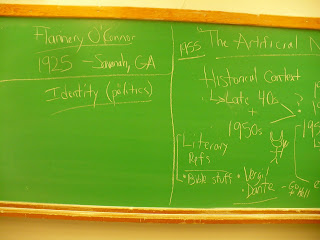
What's more awesome than more chalkboards from my American lit class? A lot of things, I suppose, but so be it.
The following are the boards for Flannery O'Connor's "The Artificial Nigger" and W.E.B. Du Bois' "The Comet" (a science fiction story). Hopefully they are as interesting as the Vonnegut boards from the last few weeks.

 What do you think?
The following are the boards for Flannery O'Connor's "The Artificial Nigger" and W.E.B. Du Bois' "The Comet" (a science fiction story). Hopefully they are as interesting as the Vonnegut boards from the last few weeks.


Subscribe to:
Posts (Atom)