There are a lot of things writers shouldn't do, but there are some things that a writer really shouldn't do. Here is a list of ten things no writer should ever do:
Send a long-winded biography not limited to your writing career.
Not only do we (editors) not give a crap, but your query letter or cover letter should be short and sweet, telling us only the things we need to know to assess your manuscript. Most editors don’t even need a cover letter, but a good story is a good story, regardless of where someone was published or not published before. Sometimes a quirky fact about yourself is cute, but beyond that, we just don’t care about your life story!
Send files in formats not specified.
If the guidelines say send your submission in .doc or .rtf form, then send it in .doc or .rtf form. More than likely, the editors can’t open other file types, or have no clue what those others are. I’ve received everything from .docx to .odt to .pages, the latter two of which are for programs I don’t even have on my computer. If it can’t be opened, it can’t be read!
Demand to be paid in a form that isn’t specified in the guidelines.
Generally speaking, if the guidelines say “paypal only,” that means “paypal only.” But sure, demand to be paid by Western Union (or whatever it’s called now). Coincidentally, the person who demanded this also told us she was a forty plus year old woman, and our guidelines specifically stated that twenty-five was the cap. What can you do?
Argue about a decision.
If we don’t want your submission, arguing with us about it isn’t going to change our minds. In fact, it might make us turn to disliking you. Take a rejection like a man…or a woman. It’s part of the writing life.
Forget to attach your submission.
Okay, so this one isn’t as bad as the others, but it’s a silly mistake that you really shouldn’t do, for obvious reasons. Usually we laugh about it, but after a while it gets tiresome to send the same email out over and over.
Send an insulting email.
Something about someone emailing you to tell you that you’re a scumbag for rejecting their submission and that you should burn in hell forever is truly uplifting. People still do this, and it puzzles me why. I thought the object of submitting was to get published. How does one expect to do that if he or she insults everyone who rejects them?
Stalk someone and post hateful comments on their email.
Remember that Cole A. Adams incident? Don’t do that. Seriously. It’s bad news for you and anyone around you. It's also a good example of career suicide, and if you can't help yourself, then seek psychiatric help. They have pills for that kind of thing.
Send dead animals to a publisher or editor.
According to a rather epic story, Harlan Ellison did something like this. But Harlan Ellison got away with it because he was/is Harlan Ellison. Nowadays, I don’t think even J. K. Rowling could get away with that. This applies to any sort of shipment of illegal or unorthodox items to a publisher or editor, including, but not limited to, razor blades, pipe bombs, letter bombs, bricks, cocaine, marijuana, poison food items, anthrax, and rotten fruit.
Tell someone about your criminal convictions or crimes you've committed and have yet to get caught for.
I suppose this one would fit on a list of stupid things people do in general, but there's really nothing stupider than admitting to someone who might be inclined to publish your story for kids that you are a convicted pedophile. Honestly. It's also not a good idea to tell an editor that you killed a man once and never served any time. That's not information editors want to be burdened with. If you must confess, do so with a police officer. I'm sure they'd be more than happy to help relieve your burden.
Plagiarize.
This is the big no-no, and no matter how many times people say don’t do it, there is always someone willing to take the risk. Sometimes they can get away with it, and others times not, but when you consider what happens to you if you don’t get away with it, why would you ever take the risk? I don’t know about you, but I’m not particularly fond of hefty fees or jail time. I like eating and my apartment is cozy…
What about you? What do you think are some things that writers shouldn’t do? Let me know in the comments!

Saturday, October 31, 2009


Friday, October 30, 2009
Survival By Storytelling, Issue One for sale!
 Well, I know you've all been waiting for this for quite a while, and it's finally here. Survival By Storytelling Magazine, Issue One is up for sale at Lulu for a mere $9.00 in print and $5.00 in electronic format! You can purchase it here.
The magazine will also be appearing on Createspace and Amazon in time, but the process for those two is different from Lulu, and longer, but you'll hear from me as soon as it happens. For now, you can get your copy of SBS from Lulu.
And in case you wanted to know why you should purchase the issue, here's some incentive:
--We have some amazing fiction and poetry from writers new and old, all twenty-five and under, many of them members of YWO (Diocletian, Mercy, Adri, Nyx, Tegzz, and Crocolyle, unless I'm missing anyone).
--We have an interview with author Paul Genesse (The Golden Cord and The Dragon Hunters; he has also written many short stories for collections published by DAW). He also wrote us a fine article about writing.
--There is also an article by author T. M. Hunter in here, author of Heroes Die Young.
--Every sale of SBS pays our authors. Since we pay by royalties, every sale is directly helping the contributors, and that's a good thing, right?
--Every sale also helps Young Writers Online, which is also good. Mostly the money goes to contributors, but YWO gets a little bit out of it too, and that goes to making sure we can have more contests in the future!
--It'll make you feel good inside. Trust me. SBS is like chocolate, only better.
So go out and get your copy now! As for the contributors: you'll be getting an email from me shortly in regards to free copies for you, which wasn't in the contract, but, hey, I feel that you deserve something for your patience. Plus, it's standard practice anyway!
Lastly, please advertise about SBS. I'll try to get some promotional images together, but if you could blog about us, that would be great. Spread the word and let everyone know what you think about the magazine!
Thanks to everyone who has been supportive of this endeavor over the last year+. It's been a lot of work and we're glad to be done, if not a little misty-eyed about it. Thanks to all who contributed, and here's to a good opening run!
Thursday, October 29, 2009
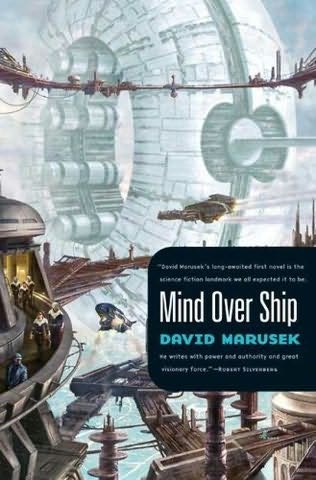
Interview w/ David Marusek
David Marusek is the author of Counting Heads and Mind Over Ship, the latter of which I reviewed here. You can also find Mr. Marusek at his website.
On with the interview:
Thank you very much for doing this interview. First things first, can you tell us a little bit about yourself? What got you into writing in the first place, and why science fiction?
I'm a middle-aged man living in a cabin in Interior Alaska. I'm single (attention, ladies), love dogs, love to chainsaw firewood, dip for salmon, and spend time in the bush. I always wanted to write, but I only got started seriously in 1986. I thought I would write about a million books, but as it turns out, I'm a very slow writer (my editor says deliberate, not slow). I started out trying to write literary fiction, but I couldn't get the hang of it. Then someone told me about the Clarion workshops, and I attended Clarion West in Seattle. I sold my first fiction to Gardner Dozois at Asimov's during the workshop and have been publishing ever since. I seem to have a crazy inventive mind that feels at home with SF, and I love the SF community of writers and fans.
Who are some of your favorite authors? Books?
I don't read as much fiction as I used to. Recently, the writer who wows me the most is Jim Crace, a Brit, and two of his books I highly rec are The Pesthouse and Being Dead. He's not a genre writer, but The Pesthouse is a post-apocalyptic tale much better than Cormac McCarthy's much-hyped The Road.
 Mind Over Ship is, in my opinion, a fairly unique novel because it incorporates a plethora of high-concept ideas (such as your fascinating take on the future of human cloning). What was your inspiration for Mind Over Ship (and obviously its predecessor, Counting Heads)?
I had two images stuck in my mind that, when combined, was the genesis of Counting Heads. One was of two parents holding a baby that they "retro-conceived." That is, their own DNA was overwriting the baby's own genes. In my mind I saw the baby in an in-between state. The other was of a wife abandoning her husband on a busy street when he is captured by a mechanical security device.
That's pretty much how my stories get started, with a compelling image or idea that persists sometimes for years until I do something with it.
 Since your novel deals extensively with the issue of cloning, do you see human cloning becoming a reality in our near future (not just cloning cells or eggs, but cloning actual people)? Do you think our response to that will be a good one or a bad one?
Yes, I see cloning whole humans happening in the near future. At first it will probably be done by unscrupulous people just to see if it can be done. World reaction will be overwhelmingly negative. All world religions will condemn the practice. Even secular humanists will be outraged. I'm not sure if cloning will ever become a standard practice. In other SF stories, the basis for cloning humans has been to raise great armies of superior soldiers or as living tissue banks for wealthy persons, but I don't see that happening. Other technologies will fill those needs. In my own books, the labor force is made up of specialized, contented clones. This presumes that personality is tied to DNA, probably more-so that it actually is, but it makes a dandy conceit for fiction. (I have recently learned about epigenetics, which probably plays a major role in this.)
Which if your clone models in Mind Over Ship is your favorite? Why?
The Lulus, because they're hot!
Do you plan to write new stories in the universe of Mind Over Ship?
Yes, installment #3 is bubbling in the back of my head. I've been moiling in the CH and MOS universe for about 15 years, though, and I need a break from it. My current novel project is completely unrelated. In fact, it's set in contemporary America. It's all very hush-hush, and I can't say anything about it.
 What other projects do you have coming up and can you tell us a little about them?
Besides the novel, I'm doing a fantasy story, my first effort in that genre. It's called "Modern Parenting--Circa 2006," and it makes me smile every time I think about it. It's about a father with a very special ability, and a daughter addicted to danger.
Switching gears, what do you think about the present state of the book industry, both on the selling end and on the making end? What about eBooks/readers?
Publishing seems to be buffeted by the economy and technological advances. No one knows what it'll look like in five or ten years, but I think authors may become empowered through POD and ebook tech. I bought a Kindle, and I'm trying to figure out what to do with it.
What unusual piece of writing advice would you give to a budding writer? (Emphasis on unusual)
See a doctor. No matter how pretty the bloom may be, budding is not usually healthy for humans.
And now for a silly question: If you could be any animal on the planet, which animal would you be and why?
A dodo, to mess with biologists' minds.
On with the interview:
Thank you very much for doing this interview. First things first, can you tell us a little bit about yourself? What got you into writing in the first place, and why science fiction?
I'm a middle-aged man living in a cabin in Interior Alaska. I'm single (attention, ladies), love dogs, love to chainsaw firewood, dip for salmon, and spend time in the bush. I always wanted to write, but I only got started seriously in 1986. I thought I would write about a million books, but as it turns out, I'm a very slow writer (my editor says deliberate, not slow). I started out trying to write literary fiction, but I couldn't get the hang of it. Then someone told me about the Clarion workshops, and I attended Clarion West in Seattle. I sold my first fiction to Gardner Dozois at Asimov's during the workshop and have been publishing ever since. I seem to have a crazy inventive mind that feels at home with SF, and I love the SF community of writers and fans.
Who are some of your favorite authors? Books?
I don't read as much fiction as I used to. Recently, the writer who wows me the most is Jim Crace, a Brit, and two of his books I highly rec are The Pesthouse and Being Dead. He's not a genre writer, but The Pesthouse is a post-apocalyptic tale much better than Cormac McCarthy's much-hyped The Road.
Mind Over Ship is, in my opinion, a fairly unique novel because it incorporates a plethora of high-concept ideas (such as your fascinating take on the future of human cloning). What was your inspiration for Mind Over Ship (and obviously its predecessor, Counting Heads)?I had two images stuck in my mind that, when combined, was the genesis of Counting Heads. One was of two parents holding a baby that they "retro-conceived." That is, their own DNA was overwriting the baby's own genes. In my mind I saw the baby in an in-between state. The other was of a wife abandoning her husband on a busy street when he is captured by a mechanical security device.
That's pretty much how my stories get started, with a compelling image or idea that persists sometimes for years until I do something with it.
Since your novel deals extensively with the issue of cloning, do you see human cloning becoming a reality in our near future (not just cloning cells or eggs, but cloning actual people)? Do you think our response to that will be a good one or a bad one?Yes, I see cloning whole humans happening in the near future. At first it will probably be done by unscrupulous people just to see if it can be done. World reaction will be overwhelmingly negative. All world religions will condemn the practice. Even secular humanists will be outraged. I'm not sure if cloning will ever become a standard practice. In other SF stories, the basis for cloning humans has been to raise great armies of superior soldiers or as living tissue banks for wealthy persons, but I don't see that happening. Other technologies will fill those needs. In my own books, the labor force is made up of specialized, contented clones. This presumes that personality is tied to DNA, probably more-so that it actually is, but it makes a dandy conceit for fiction. (I have recently learned about epigenetics, which probably plays a major role in this.)
Which if your clone models in Mind Over Ship is your favorite? Why?
The Lulus, because they're hot!
Do you plan to write new stories in the universe of Mind Over Ship?
Yes, installment #3 is bubbling in the back of my head. I've been moiling in the CH and MOS universe for about 15 years, though, and I need a break from it. My current novel project is completely unrelated. In fact, it's set in contemporary America. It's all very hush-hush, and I can't say anything about it.
What other projects do you have coming up and can you tell us a little about them?Besides the novel, I'm doing a fantasy story, my first effort in that genre. It's called "Modern Parenting--Circa 2006," and it makes me smile every time I think about it. It's about a father with a very special ability, and a daughter addicted to danger.
Switching gears, what do you think about the present state of the book industry, both on the selling end and on the making end? What about eBooks/readers?
Publishing seems to be buffeted by the economy and technological advances. No one knows what it'll look like in five or ten years, but I think authors may become empowered through POD and ebook tech. I bought a Kindle, and I'm trying to figure out what to do with it.
What unusual piece of writing advice would you give to a budding writer? (Emphasis on unusual)
See a doctor. No matter how pretty the bloom may be, budding is not usually healthy for humans.
And now for a silly question: If you could be any animal on the planet, which animal would you be and why?
A dodo, to mess with biologists' minds.
Comic Review: Aetheric Mechanics by Warren Ellis
Well, I have another review up. I borrowed this graphic novel from a friend and liked it enough that I decided I should write a review for it. You can find the review here.
Have any of you read any comics or graphic novels of note lately? Let me know in the comments!
Have any of you read any comics or graphic novels of note lately? Let me know in the comments!
Wednesday, October 28, 2009
Haul of Books: Friends of the Library Edition
There was an enormous book sale here in Gainesville over the last few days and I thought I’d let you all know what I got (a lot of stuff, actually). Next time, in April, I don’t think I will be going quite as all out, mostly because I don’t have as much need for a lot of books anymore. I intentionally went this year trying to find things to use for my research, and now I’m only missing a few things.
If you’ve bought any new books in the last few days, let me know in the comments. Here goes (sorry, no pictures; there’s just too much):
Science Fiction and Fantasy
--The Once and Future King by T. H. White
--Snow Crash by Neal Stephenson
--Forest Mage by Robin Hobb
--Crossfire by Nancy Kress
--Alastair Reynolds by Redemption Ark
--A War of Shadows by Jack L. Chalker
--The Pscyhotechnic League by Poul Anderson
--The Continent of Lies by James Morrow
--Land of Unreason by L. Sprague de Camp and Fletcher Pratt
--A Day For Damnation by David Gerrold
--Other Americas by Norman Spinrad
--The Face of Chaos edited by Robert Lynn Asprin and Lynn Abbey
--New Writings in SF8 edited by John Carnell
--The Web of the Chozen by Jack L. Chalker
--Nightwings by Robert Silverberg
--Heads by Greg Bear
--Molt Brother by Jacqueline Lichtenberg
--Mahogany Trinrose by Jacqueline Lichtenberg
--Shardik by Richard Adams
--Continuum 2 edited by Roger Elwood
--The Four Lords of the Diamon by Jack L. Chalker
--Danger Human by Gordon R. Dickson
--The Book of Skaith by Leigh Brackett
--Worlds of Maybe edited by Robert Silverberg
--Threads of Time edited by Robert Silverberg
--The Children of Men by P. D. James
--The Book of the Dun Cow by Walter Wangerin, Jr.
--The Anubis Gates by Tim Powers
--The State of the Art by Iain M. Banks
--The Player of Games by Iain M. Banks
--Use of Weapons by Iain M. Banks
--Peace on Earth by Stanislaw Lem
--Helliconia Spring by Brian W. Aldiss
--Helliconia Winter by Brian W. Aldiss
--Becoming Alien by Rebecca Ore
--Quicksand by John Brunner
--An Exaltation of Stars edited by Terry Carr
--The Final Planet by Andrew M. Greeley
--Saturn’s Children by Charles Stross
--The Urth of the New Sun by Gene Wolfe
--The Android’s Dream by John Scalzi
--Gateway by Frederik Pohl
--Magic Study by Maria V. Snyder
--Child of the River by Paul J. McAuley
--The Man Who Folded Himself by David Gerrold
--Brothers of Earth by C. J. Cherryh
--The Sentimental Agents (A Canopus in Argos novel) by Doris Lessing
--Shikasta (A Canopus in Argos novel) by Doris Lessing
--The Fringe of the Unknown by L. Sprague de Camp
Other Fiction (including magical realism, etc.)
--Invisible Man by Ralph Ellison
--Middlemarch by George Eliot
--Uncle Tom’s Cabin by Harriet Beecher Stowe
--The Rise of Silas Lapham by William Dean Howells
--The Physick Book of Deliverance Dane by Katherine Howe
--World Without End by Ken Follett
--Love, Again by Doris Lessing
--The Island of the Day Before by Umberto Eco
--Baudolino by Umberto Eco
--The Mysterious Flame of Queen Loana by Umberto Eco
--Labyrinths by Jorge Luis Borges
--Love in the Time of Cholera by Gabriel Garcia Marques
--Concrete Island by J. G. Ballard
--The Alchemist by Paulo Coelho
--On the Road by Jack Kerouac
--
Non-fiction
--At the Edge of History by William Irwin Thompson
--The Machine in the Garden by Leo Marx
--African Studies Review, Volume 47, Number 3
--History and Memory, Volume 19, Number 2, Fall/Winter 2007
--Nationalism by Eli Kedourie
I also got a book called Religion in Colonial America by William Warren Sweet
And that's all I got, without paying a whole lot of money at all. Today was 10 cent day, by the way. I got a box of books for $3.60. Now that's a steal!
If you’ve bought any new books in the last few days, let me know in the comments. Here goes (sorry, no pictures; there’s just too much):
Science Fiction and Fantasy
--The Once and Future King by T. H. White
--Snow Crash by Neal Stephenson
--Forest Mage by Robin Hobb
--Crossfire by Nancy Kress
--Alastair Reynolds by Redemption Ark
--A War of Shadows by Jack L. Chalker
--The Pscyhotechnic League by Poul Anderson
--The Continent of Lies by James Morrow
--Land of Unreason by L. Sprague de Camp and Fletcher Pratt
--A Day For Damnation by David Gerrold
--Other Americas by Norman Spinrad
--The Face of Chaos edited by Robert Lynn Asprin and Lynn Abbey
--New Writings in SF8 edited by John Carnell
--The Web of the Chozen by Jack L. Chalker
--Nightwings by Robert Silverberg
--Heads by Greg Bear
--Molt Brother by Jacqueline Lichtenberg
--Mahogany Trinrose by Jacqueline Lichtenberg
--Shardik by Richard Adams
--Continuum 2 edited by Roger Elwood
--The Four Lords of the Diamon by Jack L. Chalker
--Danger Human by Gordon R. Dickson
--The Book of Skaith by Leigh Brackett
--Worlds of Maybe edited by Robert Silverberg
--Threads of Time edited by Robert Silverberg
--The Children of Men by P. D. James
--The Book of the Dun Cow by Walter Wangerin, Jr.
--The Anubis Gates by Tim Powers
--The State of the Art by Iain M. Banks
--The Player of Games by Iain M. Banks
--Use of Weapons by Iain M. Banks
--Peace on Earth by Stanislaw Lem
--Helliconia Spring by Brian W. Aldiss
--Helliconia Winter by Brian W. Aldiss
--Becoming Alien by Rebecca Ore
--Quicksand by John Brunner
--An Exaltation of Stars edited by Terry Carr
--The Final Planet by Andrew M. Greeley
--Saturn’s Children by Charles Stross
--The Urth of the New Sun by Gene Wolfe
--The Android’s Dream by John Scalzi
--Gateway by Frederik Pohl
--Magic Study by Maria V. Snyder
--Child of the River by Paul J. McAuley
--The Man Who Folded Himself by David Gerrold
--Brothers of Earth by C. J. Cherryh
--The Sentimental Agents (A Canopus in Argos novel) by Doris Lessing
--Shikasta (A Canopus in Argos novel) by Doris Lessing
--The Fringe of the Unknown by L. Sprague de Camp
Other Fiction (including magical realism, etc.)
--Invisible Man by Ralph Ellison
--Middlemarch by George Eliot
--Uncle Tom’s Cabin by Harriet Beecher Stowe
--The Rise of Silas Lapham by William Dean Howells
--The Physick Book of Deliverance Dane by Katherine Howe
--World Without End by Ken Follett
--Love, Again by Doris Lessing
--The Island of the Day Before by Umberto Eco
--Baudolino by Umberto Eco
--The Mysterious Flame of Queen Loana by Umberto Eco
--Labyrinths by Jorge Luis Borges
--Love in the Time of Cholera by Gabriel Garcia Marques
--Concrete Island by J. G. Ballard
--The Alchemist by Paulo Coelho
--On the Road by Jack Kerouac
--
Non-fiction
--At the Edge of History by William Irwin Thompson
--The Machine in the Garden by Leo Marx
--African Studies Review, Volume 47, Number 3
--History and Memory, Volume 19, Number 2, Fall/Winter 2007
--Nationalism by Eli Kedourie
I also got a book called Religion in Colonial America by William Warren Sweet
And that's all I got, without paying a whole lot of money at all. Today was 10 cent day, by the way. I got a box of books for $3.60. Now that's a steal!
Tuesday, October 27, 2009
Why I’m Sick of the Term “Race”
To get into this discussion, I’m going to have to toss out all of my beliefs that there is no such thing as race (a belief Edward James Olmos not only agrees with, but managed to have changed in the United Nations, adding weight to the importance of science fiction in the world of today). The reason is that my disbelief in the entity of race is irrelevant: I and Edward James Olmos, and a handful of others, are a minority; as much as we might tell ourselves and others that the very concept and belief in race is ridiculous and detrimental to society, people still cling to the prospect of race and divisional lines and all those things that operate as othering mechanisms, turning one type of person into “bad” and another into “good.” That is the problem I want to talk about here.
I am sick of the term “race” because it is one of the most terrifying forms of multidirectional cultural violence currently in existence that is not only clung to by people who sit in the majority, but by people in the minority as well, in any space on the planet (yes, that means even places where White is not the dominant skin tone). Race is like an infection, and the fact that mankind has struggled so hard to maintain it and use it as a basis for everything, either (perceived) good or bad, is absurd on so many fronts that for someone who tries so hard not to think in terms of race, there is nothing but an impenetrable barbwire-covered wall spanning the great distance between reality and perception.
I am sick of the term “race” because of the reality that we cannot think about anything in society without also thinking about race, about othering others, on both sides of the spectrum. “Race” is so much like a virus that it has infected even those who have, in the West, at least, been most affected by the inception of the term. All arguments against the idea of “reverse racism” are veiled attempts to ignore a certain humanistic reality: we all harbor within us the possibility of othering. And that othering is wrong, regardless of the justification. It is no more right to assume another to be “racist” based on their skin tone than it is for another to treat someone of a historically discriminated position poorly (even horrendously) for the same reason. It matters not what reason one chooses to turn another into the other; the very act of doing so is cultural violence, it is the sacrificing of a part of our humanity for the preservation of a systemic knowledge-base that we can only combat by fighting to stop using it.
I am sick of the term “race” because the people who have pioneered it as a system, a term, and an institution, and those that followed in the near past, present, and, no doubt, the future, have infected everyone else with “race” and othering and all the terrible things that come with constantly having to think and engage with others based on the idiocy that is “race.” The fact that I have to know how to deal with African American students at a public university tells me that “race” is always waiting to indoctrinate, to feed and attach itself to you, because you cannot escape it, no matter what you do; it is always there, always ready to go.
I am sick of the term “race” because it is not only a basis for the unfair treatment of others, but also the basis for forced non-racism: the very accusation of being “racist” causes a stir in most individuals, and, regardless of whether or not one is actually “racist,” their consequential action from accusation is a desperate attempt to prove oneself non-racist, to accommodate the other. But even that, that accommodation, is exactly what is wrong with “race” in the first place, because what you are doing is acknowledging that race is important, that some races are “special” (for good or for bad) and deserve special treatment (again, for good or for bad). You are complicit in the perpetuation of “race” without even knowing it; a good deed, thus, can become yet another factor of “racist” pathology.
And I am sick of the term “race” because for all that I have spoken of here, I still have to talk in some format that accommodates the term “race,” that lets it feed like a parasite on my thoughts and on you who are reading this. No matter what we do, we are stuck with the cultural violence of “race,” and to escape that would require an astonishing amount of effort on the part of all people to abolish it from our thinking processes and our vocabularies.
In the end, “race” is stupid. It shouldn’t exist. The fact that it still does, not just in the form of “racism,” but in how we engage with other members of the same species, makes me question the value of mankind. And so long as it does exist, it will change and shape how we act with one another, not just in white vs. black, but in all combinations and cross-relationships. There’s a saying from a relatively famous Broadway musical called Avenue Q. It goes something like this: everyone’s a little bit racist, sometimes.
The question is, if that is true, where do we go from here?
I am sick of the term “race” because it is one of the most terrifying forms of multidirectional cultural violence currently in existence that is not only clung to by people who sit in the majority, but by people in the minority as well, in any space on the planet (yes, that means even places where White is not the dominant skin tone). Race is like an infection, and the fact that mankind has struggled so hard to maintain it and use it as a basis for everything, either (perceived) good or bad, is absurd on so many fronts that for someone who tries so hard not to think in terms of race, there is nothing but an impenetrable barbwire-covered wall spanning the great distance between reality and perception.
I am sick of the term “race” because of the reality that we cannot think about anything in society without also thinking about race, about othering others, on both sides of the spectrum. “Race” is so much like a virus that it has infected even those who have, in the West, at least, been most affected by the inception of the term. All arguments against the idea of “reverse racism” are veiled attempts to ignore a certain humanistic reality: we all harbor within us the possibility of othering. And that othering is wrong, regardless of the justification. It is no more right to assume another to be “racist” based on their skin tone than it is for another to treat someone of a historically discriminated position poorly (even horrendously) for the same reason. It matters not what reason one chooses to turn another into the other; the very act of doing so is cultural violence, it is the sacrificing of a part of our humanity for the preservation of a systemic knowledge-base that we can only combat by fighting to stop using it.
I am sick of the term “race” because the people who have pioneered it as a system, a term, and an institution, and those that followed in the near past, present, and, no doubt, the future, have infected everyone else with “race” and othering and all the terrible things that come with constantly having to think and engage with others based on the idiocy that is “race.” The fact that I have to know how to deal with African American students at a public university tells me that “race” is always waiting to indoctrinate, to feed and attach itself to you, because you cannot escape it, no matter what you do; it is always there, always ready to go.
I am sick of the term “race” because it is not only a basis for the unfair treatment of others, but also the basis for forced non-racism: the very accusation of being “racist” causes a stir in most individuals, and, regardless of whether or not one is actually “racist,” their consequential action from accusation is a desperate attempt to prove oneself non-racist, to accommodate the other. But even that, that accommodation, is exactly what is wrong with “race” in the first place, because what you are doing is acknowledging that race is important, that some races are “special” (for good or for bad) and deserve special treatment (again, for good or for bad). You are complicit in the perpetuation of “race” without even knowing it; a good deed, thus, can become yet another factor of “racist” pathology.
And I am sick of the term “race” because for all that I have spoken of here, I still have to talk in some format that accommodates the term “race,” that lets it feed like a parasite on my thoughts and on you who are reading this. No matter what we do, we are stuck with the cultural violence of “race,” and to escape that would require an astonishing amount of effort on the part of all people to abolish it from our thinking processes and our vocabularies.
In the end, “race” is stupid. It shouldn’t exist. The fact that it still does, not just in the form of “racism,” but in how we engage with other members of the same species, makes me question the value of mankind. And so long as it does exist, it will change and shape how we act with one another, not just in white vs. black, but in all combinations and cross-relationships. There’s a saying from a relatively famous Broadway musical called Avenue Q. It goes something like this: everyone’s a little bit racist, sometimes.
The question is, if that is true, where do we go from here?
Monday, October 26, 2009
Her Fearful Symmetry Giveaway
I thought you'd all love to hear about this: the Regal Literary Agency is having another giveaway of Audrey Niffenegger's newest hit, Her Fearful Symmetry. If you don't know who that is, she's the wonderful writer who brought us The Time Traveler's Wife, which was recently turned into a major motion picture featuring Rachael McAdams.
If you decide to enter, please let them know that you heard about it from me (Shaun Duke). Pretty please!
Thanks and good luck!
If you decide to enter, please let them know that you heard about it from me (Shaun Duke). Pretty please!
Thanks and good luck!
Sunday, October 25, 2009
Pointless Plot Elements, Convenience, and Fantasy
I was reading something the other day and one of the things that I disliked about it was how the author had gone about plotting his or her novel. Each element to the plot (each action and reaction) seemed too convenient, as if the author had intentionally done those things just so he or she would have an excuse to put two characters together by chapter four. While this may occur quite often in fantasy or any sort of fiction with a discernible plot, what bothered me the most was how obvious the story was about its convenience. This seems like a problem that is very common in fantasy (and, to a lesser extent, science fiction). Too many writers seem to rely on convenience rather than logic or intelligent plotting. For the record, I do not profess to be an expert on how to plot, but am speaking here primarily as a reader; and, as a writer, it is making me very aware of my own novels and stories, so much so that I have started to wonder whether or not there are elements of convenience in my own work (there are).
I can't say I know how to deal with such issues, but it seems to me that the reasonable thing to do is to avoid moments where it is obvious that you are plotting by convenience. If you say "Oh, well if I just do this, then I can put these characters together, and then everything I want to do can be done," then it seems to me that you're dealing with convenience. Worst yet, it makes no sense to a reader why you wouldn't just put those characters together in the first place if you wanted them there anyway. There are factors that make all this obvious; rapidity is one of them. The quicker you try to make your plot happen, the more clear it is to the reader that that is what you are trying to do. The nasty critical side of me wants to point out that this is amateurish; I've done it, and where I see it I know that I have done something terrible.
Having said all of this, I have no advice whatsoever on how to avoid it. Like I said, I still do it from time to time. The only thing I can think to do is to ask yourself at every plot turn if you're using convenience rather than logic. If you are, then you probably should think of something else. If you know that someone is going to say "this is terribly convenient," then it doesn't make sense to continue going in that direction.
But, I want your opinions on this. How many of you have experience this either in your reading or your writing? Let me know in the comments!
I can't say I know how to deal with such issues, but it seems to me that the reasonable thing to do is to avoid moments where it is obvious that you are plotting by convenience. If you say "Oh, well if I just do this, then I can put these characters together, and then everything I want to do can be done," then it seems to me that you're dealing with convenience. Worst yet, it makes no sense to a reader why you wouldn't just put those characters together in the first place if you wanted them there anyway. There are factors that make all this obvious; rapidity is one of them. The quicker you try to make your plot happen, the more clear it is to the reader that that is what you are trying to do. The nasty critical side of me wants to point out that this is amateurish; I've done it, and where I see it I know that I have done something terrible.
Having said all of this, I have no advice whatsoever on how to avoid it. Like I said, I still do it from time to time. The only thing I can think to do is to ask yourself at every plot turn if you're using convenience rather than logic. If you are, then you probably should think of something else. If you know that someone is going to say "this is terribly convenient," then it doesn't make sense to continue going in that direction.
But, I want your opinions on this. How many of you have experience this either in your reading or your writing? Let me know in the comments!
Video Found: Ray Bradbury on Writing
While this is a short video, he offers some amazing advice, not just about writing persistently, but about what makes for a great story, in his opinion. You also get to see him in his boxer shorts, which, for anyone obsessed with his work, is probably a wonderful experience indeed (click the read more to see the video):
Teens Read and Write MegaBook Giveaway!
I just thought you all would be interested in this huge giveaway over at Teens Read and Write. They're adding new books for each follower milestone, and you all should join in!
And that's enough from me!
Saturday, October 24, 2009
Book Shopping Etiquette
I recently returned from an enormous book sale in the Gainesville area and have a few thoughts on the issue of book shopping etiquette, since clearly nobody at the sale had any idea what etiquette was. So, I have compiled this list of good book shopping etiquette in crowded browsing situations:
1. Form a directional order to sectional browsing. Everyone should go the same direction, aisle by aisle, to facilitate proper browsing for multiple people. Having twelve people coming from all directions doesn't help.
2. Don't push, crowd, or rush past people who are clearly waiting politely for someone else to move. Honestly.
3. Say "excuse me" if you need to get by for some reason. It's common decency. We used to have that once, when we were still British and knew how to queue.
4. Allow people to switch places with you if you are going particularly slow so that they can get to look at the stuff on the other side of you. Snails gum up the works.
5. Don't sit down in the middle of an aisle or near a shelf and start looking through the books you've already picked, especially when it's clear that other people want to browse there. Jackass.
6. Don't take other people's books. You'd think this would go without saying, but apparently people do this, and I'll have you know that I will carry a fork from this day on especially for those folks.
7. Let the folks who are trying to rapidly restock the shelves do exactly that. At a big sale like the one I went to, where things aren't alphabetical, those folks rushing in with new boxes of books are just trying to keep the stock fresh. That's good for everyone, including you, Mr. Book Fanatic.
8. Do not bring your infant child to a book sale that you know is going to be crowded and full of boxes with sharp corners. While I may be more than willing to give you leeway, others with more rabid book buying tastes have no qualms bashing your kid in the face with a box or an elbow.
9. Let old people go first. They're likely not looking for what you want anyway, and they're old.
10. Wear deodorant. Seriously.
11. Brush your teeth. Other people have to smell your breath in cramped quarters, and someone might kill you as a result...
I'm sure there are other good rules, but I'll let you all think of them. For now, that's what I've got!
1. Form a directional order to sectional browsing. Everyone should go the same direction, aisle by aisle, to facilitate proper browsing for multiple people. Having twelve people coming from all directions doesn't help.
2. Don't push, crowd, or rush past people who are clearly waiting politely for someone else to move. Honestly.
3. Say "excuse me" if you need to get by for some reason. It's common decency. We used to have that once, when we were still British and knew how to queue.
4. Allow people to switch places with you if you are going particularly slow so that they can get to look at the stuff on the other side of you. Snails gum up the works.
5. Don't sit down in the middle of an aisle or near a shelf and start looking through the books you've already picked, especially when it's clear that other people want to browse there. Jackass.
6. Don't take other people's books. You'd think this would go without saying, but apparently people do this, and I'll have you know that I will carry a fork from this day on especially for those folks.
7. Let the folks who are trying to rapidly restock the shelves do exactly that. At a big sale like the one I went to, where things aren't alphabetical, those folks rushing in with new boxes of books are just trying to keep the stock fresh. That's good for everyone, including you, Mr. Book Fanatic.
8. Do not bring your infant child to a book sale that you know is going to be crowded and full of boxes with sharp corners. While I may be more than willing to give you leeway, others with more rabid book buying tastes have no qualms bashing your kid in the face with a box or an elbow.
9. Let old people go first. They're likely not looking for what you want anyway, and they're old.
10. Wear deodorant. Seriously.
11. Brush your teeth. Other people have to smell your breath in cramped quarters, and someone might kill you as a result...
I'm sure there are other good rules, but I'll let you all think of them. For now, that's what I've got!
Friday, October 23, 2009
I Know What Un-American Is
Do you? Well, if you don’t, maybe you should consider the following:
1. Sending U.S. soldiers into Iraq to die under the spoken claim that a) Iraq was a direct threat to the United States (false) and b) Iraq had weapons of mass destruction (also false). What exactly are they defending in Iraq? You should also consider whether or not there is such a thing as freedom in the forceful overthrow of an oppressive government and the forced installation of a supposedly free democracy, but, hey,
no need to think back to the history of colonialism and imperialism.
2. Worse still is the fact that injured Iraq and Afghanistan vets return home to find themselves deprived of what should be excellent and necessary medical aid to get them back on their feet so they can at least become productive members of society, rather than dissolve into the den of homelessness and internalized terror. Heaven forbid that our soldiers might want a little gratitude from us for not dying in battle.
3. Disenfranchising tens of thousands of voters, over and over, who were either predominately black or Democrat by using illegal methods such as caging voters and the like, and then refusing to prosecute people caught doing such things, time and time again.
4. Stopping the recount of votes some 170,000 short and ceasing all investigation into serious issues of voter fraud and illegal activities in key states, despite realistic concerns from voters and representatives about the vote itself.
5. Stopping independent investigative committees from looking into the 9/11 terrorist attacks.
6. Illegally wire-tapping hundreds, if not thousands, of Americans.
7. Taking days to get significant quantities of support into New Orleans to evacuate thousands of people, some of which died of dehydration or other ailments as a result of being exposed to sewage, etc.
8. Imprisoning hundreds of people in Guantanamo Bay for years, without being charged for any crimes or given trials.
9. Torturing said people and then lying about doing it, and then, when the truth comes out, saying that it was for the best, despite being against the Geneva Convention, which we signed, and our own laws about the treatment of POWs, without any conscious thought about how such action might affect the treatment of our own soldiers in the future.
10. Denying someone the right to be with their dying loved ones based on a prejudiced (and illegal) belief.
11. Denying people of "opposite" races to marry because it might cause problems for their future children (also illegal, by the way).
12. Denying people the right to marry someone of the same sex based on an unconstitutional inclusion of Biblical law. (To those five states with marriage for homosexuals: may you forever prosper above those states that trade in hatred.)
13. Killing people based on a) sexual orientation, b) race, or c) political orientation.
And that's just a few of the un-american things that have happened in the last ten years. Imagine what this list would look like if I included the previous thirty...
That is all.
1. Sending U.S. soldiers into Iraq to die under the spoken claim that a) Iraq was a direct threat to the United States (false) and b) Iraq had weapons of mass destruction (also false). What exactly are they defending in Iraq? You should also consider whether or not there is such a thing as freedom in the forceful overthrow of an oppressive government and the forced installation of a supposedly free democracy, but, hey,
no need to think back to the history of colonialism and imperialism.
2. Worse still is the fact that injured Iraq and Afghanistan vets return home to find themselves deprived of what should be excellent and necessary medical aid to get them back on their feet so they can at least become productive members of society, rather than dissolve into the den of homelessness and internalized terror. Heaven forbid that our soldiers might want a little gratitude from us for not dying in battle.
3. Disenfranchising tens of thousands of voters, over and over, who were either predominately black or Democrat by using illegal methods such as caging voters and the like, and then refusing to prosecute people caught doing such things, time and time again.
4. Stopping the recount of votes some 170,000 short and ceasing all investigation into serious issues of voter fraud and illegal activities in key states, despite realistic concerns from voters and representatives about the vote itself.
5. Stopping independent investigative committees from looking into the 9/11 terrorist attacks.
6. Illegally wire-tapping hundreds, if not thousands, of Americans.
7. Taking days to get significant quantities of support into New Orleans to evacuate thousands of people, some of which died of dehydration or other ailments as a result of being exposed to sewage, etc.
8. Imprisoning hundreds of people in Guantanamo Bay for years, without being charged for any crimes or given trials.
9. Torturing said people and then lying about doing it, and then, when the truth comes out, saying that it was for the best, despite being against the Geneva Convention, which we signed, and our own laws about the treatment of POWs, without any conscious thought about how such action might affect the treatment of our own soldiers in the future.
10. Denying someone the right to be with their dying loved ones based on a prejudiced (and illegal) belief.
11. Denying people of "opposite" races to marry because it might cause problems for their future children (also illegal, by the way).
12. Denying people the right to marry someone of the same sex based on an unconstitutional inclusion of Biblical law. (To those five states with marriage for homosexuals: may you forever prosper above those states that trade in hatred.)
13. Killing people based on a) sexual orientation, b) race, or c) political orientation.
And that's just a few of the un-american things that have happened in the last ten years. Imagine what this list would look like if I included the previous thirty...
That is all.
Thursday, October 22, 2009
Science Fiction is Not Immortal
Having spoken of the non-death of science fiction, it occurs to me that I should also talk about the would-be-death of the genre. Because, unlike general fiction (or “literary” fiction, if you want to call it that, though that would be unfair), science fiction does have a limited lifespan. To be fair to SF, that lifespan is a long one, since the inevitable death of SF cannot occur until one of two things becomes true (and I have mentioned these before): a) we are incapable of imagining the future any longer; or b) the future ceases to exist.
I don’t know how either of these possibilities will ever worm their way into existence short of the apocalypse descending upon us, since, after all, the physical end of human history as we know it would constitute a complete absence of the future. But then, SF wouldn’t exist because there would be nobody there to think about it. So that is not a possible solution to the problematic nature of SF’s mortality.
Instead, and I think I have touched on this at some previous point, science fiction will cease to exist in the first instance when some measure of hope (or the utopian ideal of such a thing) no longer occupies us as a bulk entity of fleshy masses, when we literally cease concerning ourselves with the present’s pursuit of the future. How? Perhaps through the creation of a utopian state, as much as one can exist, in which the needs of each man and woman are attended to, in some fashion or another. It’s hard to say what could produce the incapability of imagining the future, but when that occurs, SF dies.
In the second instance, however, the future must cease to exist because the limitations of the future itself are as mortal as science fiction. The future is not indefinite, but is replaceable, recycling itself over and over, in a cycle that is finite. It is not a perpetual motion machine, but a machine with a long, slow, drawn out cease-ment-of-living. The future, thus, ends for mankind when there is nowhere else to go. Perhaps that is at the end of life as we know it, or at the end of the universe (the collapsing of the energy that created us all, which would then restart the cycle, restart time like a battery). More than likely, it is at the point in humanity’s inevitably long existence in which we simply have nowhere else to go. Imagine that, if you will: after all those centuries, we come to a point where technology cannot progress, where what is around the corner is little more than the same thing that we saw yesterday, and nothing we do changes anything in a significant manner whatsoever (on a global or galactic scale). That is where science fiction dies.
But, a simpler approach, one that is less “philosophical,” if you will, is to try to think about the place we will eventually be in, where science fiction cannot possibly offer us anything else. If we already have space ships and aliens and AI and robots and all of those imaginative constructs, then, really, where else is there to go? Science fiction simply cannot exist in that sort of environment. It will cease to be speculative and forever become the present, the every-day. We'll stop calling it "science fiction" and, instead, shove it in with all those mainstream and "literary" novels. That is, of course, if literature can survive the distant future.
And that’s all I have to say on that. What do you think?
I don’t know how either of these possibilities will ever worm their way into existence short of the apocalypse descending upon us, since, after all, the physical end of human history as we know it would constitute a complete absence of the future. But then, SF wouldn’t exist because there would be nobody there to think about it. So that is not a possible solution to the problematic nature of SF’s mortality.
Instead, and I think I have touched on this at some previous point, science fiction will cease to exist in the first instance when some measure of hope (or the utopian ideal of such a thing) no longer occupies us as a bulk entity of fleshy masses, when we literally cease concerning ourselves with the present’s pursuit of the future. How? Perhaps through the creation of a utopian state, as much as one can exist, in which the needs of each man and woman are attended to, in some fashion or another. It’s hard to say what could produce the incapability of imagining the future, but when that occurs, SF dies.
In the second instance, however, the future must cease to exist because the limitations of the future itself are as mortal as science fiction. The future is not indefinite, but is replaceable, recycling itself over and over, in a cycle that is finite. It is not a perpetual motion machine, but a machine with a long, slow, drawn out cease-ment-of-living. The future, thus, ends for mankind when there is nowhere else to go. Perhaps that is at the end of life as we know it, or at the end of the universe (the collapsing of the energy that created us all, which would then restart the cycle, restart time like a battery). More than likely, it is at the point in humanity’s inevitably long existence in which we simply have nowhere else to go. Imagine that, if you will: after all those centuries, we come to a point where technology cannot progress, where what is around the corner is little more than the same thing that we saw yesterday, and nothing we do changes anything in a significant manner whatsoever (on a global or galactic scale). That is where science fiction dies.
But, a simpler approach, one that is less “philosophical,” if you will, is to try to think about the place we will eventually be in, where science fiction cannot possibly offer us anything else. If we already have space ships and aliens and AI and robots and all of those imaginative constructs, then, really, where else is there to go? Science fiction simply cannot exist in that sort of environment. It will cease to be speculative and forever become the present, the every-day. We'll stop calling it "science fiction" and, instead, shove it in with all those mainstream and "literary" novels. That is, of course, if literature can survive the distant future.
And that’s all I have to say on that. What do you think?
Wednesday, October 21, 2009
Barnes and Noble's Nook: A New Wave in eReaders?
B&N isn't the only one announcing new eReaders. Apple is rumored to have one coming up and Amazon has released the international version of the Kindle 2. But I think this is the first time I have found myself excited about the prospect of an eReader.
 B&N's Nook is a sleek looking device with a heck of a lot of functionality, including the self-declared ability to read multiple formats adequately. While the Nook uses AT&T's 3G network, which is not covered in all areas, it does allow you to use your USB port on your computer, which makes folks like me, who download loads of essays in PDF form quite frequently, happy because it allows for the possibility of making those reading experiences more enjoyable.
So, my initial impression is that of excitement. I admit that I am not a big B&N fan (I prefer Borders only because their club card thing is free), but this might make me a regular B&N user over Amazon.
But enough about what I think, what about you? Do you think it looks good? Are you reserving judgment? Or do you hate it? Let me know and tell me why!
B&N's Nook is a sleek looking device with a heck of a lot of functionality, including the self-declared ability to read multiple formats adequately. While the Nook uses AT&T's 3G network, which is not covered in all areas, it does allow you to use your USB port on your computer, which makes folks like me, who download loads of essays in PDF form quite frequently, happy because it allows for the possibility of making those reading experiences more enjoyable.So, my initial impression is that of excitement. I admit that I am not a big B&N fan (I prefer Borders only because their club card thing is free), but this might make me a regular B&N user over Amazon.
But enough about what I think, what about you? Do you think it looks good? Are you reserving judgment? Or do you hate it? Let me know and tell me why!
Tuesday, October 20, 2009
Out of Body Experiences...With Characters?
I had the most bizarre experience the other day. While doing homework I found myself suddenly speaking as one of the characters in a new project I've been working on. I started walking around the house, talking as though I was telling the story, albeit rather quietly. Then, it stopped. There must have been five minutes of this, and when I tried to write it all down, I found that I couldn't, as if that part of me had simply been shut off.
I've never had that happen to me. I don't know if I'm insane or simply so fascinated by this character than talking as though I am that character is simply the way of the game.
So, to determine whether my sanity has been compromised, I'd like to ask all of you whether you've ever had this kind of experience. Let me know in the comments! You can also tell me I'm nuts and should seek medical attention, if you so desire.
I've never had that happen to me. I don't know if I'm insane or simply so fascinated by this character than talking as though I am that character is simply the way of the game.
So, to determine whether my sanity has been compromised, I'd like to ask all of you whether you've ever had this kind of experience. Let me know in the comments! You can also tell me I'm nuts and should seek medical attention, if you so desire.
Sci-fi Film Festival (Saturday, Oct. 24th)!
It figures that the year I move away from California all the cool things I had always wanted to happen there began to occur: all my favorite writers paid a visit and now a sci-fi film festival! But, if you're in California, and particularly the L.A. area, you should check this festival out:
Who: Trade&Row - a Los Angeles based 501c3 nonprofit organization established to develop and support community-oriented programs that engage current issues through the visual, performing and literary arts. For more information about Trade&Row, please visit: www.tradeandrow.org
What: Trade&Row, a nonprofit community organization, is happy to present its second annual Saturday Fantasy Film Festival Fundraiser. Independent short films from around the world and discussions will address the role of science fiction, fantasy and horror in examining social issues. Amazing donated items such as a one night stay at the Standard Hotel (Downtown) as well as items from feature films will be raffled off throughout the day. All proceeds will be used to develop and support local community-oriented programs that engage current issues through the visual, performing and literary arts.
Film screenings will be hosted by producers/writers Grant Rosenberg & Garner Simmons. The festival will also feature presentations, including a discussion moderated by Dr. Joan Wines, Professor of Literature at California Lutheran University and member of the Aldous Huxley Society, with panelists:
* Sheila Finch, science fiction author
* Joshua Dysart, comic book author/graphic novelist
* Joshua Hale Fialkov, comic book author/graphic novelist
* Marc Zicree, science fiction television and film producer
* Dan Goods, Visual Strategist for NASA’s Jet Propulsion Laboratory at the California Institute of Technology, will also give a presentation on the link between science and art.
When: Saturday, October 24, 2009 from 12:00 p.m. to 5:00 p.m.
Where:
Rec Center Studio
1161 Logan St
Los Angeles, CA 90026
Tickets: Tickets are available online at www.saturdayfantasy.com as well as at the door. Admission is $10.
For more information about the festival please visit: http://www.saturdayfantasy.com
-------------------------------------------
If you go to the festival, please pop buy and let me know how it went!
Who: Trade&Row - a Los Angeles based 501c3 nonprofit organization established to develop and support community-oriented programs that engage current issues through the visual, performing and literary arts. For more information about Trade&Row, please visit: www.tradeandrow.org
What: Trade&Row, a nonprofit community organization, is happy to present its second annual Saturday Fantasy Film Festival Fundraiser. Independent short films from around the world and discussions will address the role of science fiction, fantasy and horror in examining social issues. Amazing donated items such as a one night stay at the Standard Hotel (Downtown) as well as items from feature films will be raffled off throughout the day. All proceeds will be used to develop and support local community-oriented programs that engage current issues through the visual, performing and literary arts.
Film screenings will be hosted by producers/writers Grant Rosenberg & Garner Simmons. The festival will also feature presentations, including a discussion moderated by Dr. Joan Wines, Professor of Literature at California Lutheran University and member of the Aldous Huxley Society, with panelists:
* Sheila Finch, science fiction author
* Joshua Dysart, comic book author/graphic novelist
* Joshua Hale Fialkov, comic book author/graphic novelist
* Marc Zicree, science fiction television and film producer
* Dan Goods, Visual Strategist for NASA’s Jet Propulsion Laboratory at the California Institute of Technology, will also give a presentation on the link between science and art.
When: Saturday, October 24, 2009 from 12:00 p.m. to 5:00 p.m.
Where:
Rec Center Studio
1161 Logan St
Los Angeles, CA 90026
Tickets: Tickets are available online at www.saturdayfantasy.com as well as at the door. Admission is $10.
For more information about the festival please visit: http://www.saturdayfantasy.com
-------------------------------------------
If you go to the festival, please pop buy and let me know how it went!
Monday, October 19, 2009
Science Fiction's Not Dead, Fantasy is in the Golden Age
People are talking about the death of science fiction again. It's not actually dead, far from it, but as soon as someone says "it's dead" someone else goes crazy (either because they believe SF has long been dead or because they're tired of hearing the argument). Apparently the genre has a few dozen lives and manages to die and be resurrected ten or so times a year. The End of the Universe said science fiction has nine lives, but I think that's too conservative of an estimate. It's died at least that many times in this year alone...
The problem with science fiction isn't that it's dead. To be fair to the genre, it's never actually died, but it has been overshadowed to varying degrees in history. Even in its supposed "Golden Age" science fiction was not exactly as popular people seem to remember. Yes, it was popular, but science fiction never had the popularity of mainstream pop-fiction. That's not to say it was irrelevant or that no science fiction books sold well enough to make it to the bestseller's list; quite a few actually did, but in comparison to traditionally larger genres (romance and quasi-mysteries), it really didn't make the crossover into market dominance at any point in its multi-century lifespan.
Fantasy, on the other hand, has, and not because the genre is necessarily better (and neither is it worse). Fantasy is doing well because it got lucky. Now, to be fair to fantasy, it has always done rather well ever since Tolkien became a persistent model for other fantasy writers. As a genre, fantasy had a lot of uphill battles to fight to get to a point where it had a secure market, but once it got there it never let it go. Now, however, fantasy has exploded. Some have said that fantasy is experiencing a "Golden Age" of its own--and I would have to agree. Why?
Well, as unpredictable as the market often is in regards to what will be the hot item of the year, I would say that fantasy simply got lucky. The publishers had no way of knowing that urban fantasy would plow through the roof like it did, or that other forms of fantasy (more traditional forms, if you will, and even the exceedingly non-traditional--literary, ultra-weird, etc.) would grow moderately over the last couple decades. It just happened.
Now, if I were to argue for a reason, I would say that the last eight years have had a lot to do with the rise of fantasy. Publisher Weekly almost acknowledged as much in the last year when the recession hit and sales of escapist titles (science fiction and fantasy) actually rose (it was temporary in the sense that, while people were going to SF/F for a presumed escape from the present, the downturn of the economy eventually led to an almost universal drop in sales in almost all markets, some of which have yet to fully recover). The reality seems to be that when the proverbial crap hits the fan, readers flock to literature that is less likely to make matters worse. They want heroes and adventures, of a sort. I don't know if this is true for everyone, but sales seem to reflect that. I am unsure how urban fantasy fits into this assessment--UF tends to be somewhat dark in nature. Either we have to accept that people are somewhat darker at heart than we ever anticipated, or urban fantasy offers a bit of harmless, well, fantasy.
I don't know how long fantasy's "Golden Age" will last. As with all booms in literature, there are limits, and I suspect that urban fantasy, which seems to be the genre largely pulling fantasy up out of the pool, will eventually wear out its welcome--fantasy, as a whole, will not. For now, we can sleep soundly knowing that science fiction isn't dead and fantasy is doing quite well. That's good news.
The problem with science fiction isn't that it's dead. To be fair to the genre, it's never actually died, but it has been overshadowed to varying degrees in history. Even in its supposed "Golden Age" science fiction was not exactly as popular people seem to remember. Yes, it was popular, but science fiction never had the popularity of mainstream pop-fiction. That's not to say it was irrelevant or that no science fiction books sold well enough to make it to the bestseller's list; quite a few actually did, but in comparison to traditionally larger genres (romance and quasi-mysteries), it really didn't make the crossover into market dominance at any point in its multi-century lifespan.
Fantasy, on the other hand, has, and not because the genre is necessarily better (and neither is it worse). Fantasy is doing well because it got lucky. Now, to be fair to fantasy, it has always done rather well ever since Tolkien became a persistent model for other fantasy writers. As a genre, fantasy had a lot of uphill battles to fight to get to a point where it had a secure market, but once it got there it never let it go. Now, however, fantasy has exploded. Some have said that fantasy is experiencing a "Golden Age" of its own--and I would have to agree. Why?
Well, as unpredictable as the market often is in regards to what will be the hot item of the year, I would say that fantasy simply got lucky. The publishers had no way of knowing that urban fantasy would plow through the roof like it did, or that other forms of fantasy (more traditional forms, if you will, and even the exceedingly non-traditional--literary, ultra-weird, etc.) would grow moderately over the last couple decades. It just happened.
Now, if I were to argue for a reason, I would say that the last eight years have had a lot to do with the rise of fantasy. Publisher Weekly almost acknowledged as much in the last year when the recession hit and sales of escapist titles (science fiction and fantasy) actually rose (it was temporary in the sense that, while people were going to SF/F for a presumed escape from the present, the downturn of the economy eventually led to an almost universal drop in sales in almost all markets, some of which have yet to fully recover). The reality seems to be that when the proverbial crap hits the fan, readers flock to literature that is less likely to make matters worse. They want heroes and adventures, of a sort. I don't know if this is true for everyone, but sales seem to reflect that. I am unsure how urban fantasy fits into this assessment--UF tends to be somewhat dark in nature. Either we have to accept that people are somewhat darker at heart than we ever anticipated, or urban fantasy offers a bit of harmless, well, fantasy.
I don't know how long fantasy's "Golden Age" will last. As with all booms in literature, there are limits, and I suspect that urban fantasy, which seems to be the genre largely pulling fantasy up out of the pool, will eventually wear out its welcome--fantasy, as a whole, will not. For now, we can sleep soundly knowing that science fiction isn't dead and fantasy is doing quite well. That's good news.
Comment Policy Change
I have made some changes to how comments will work on this site. All comments will now be sent for approval by me. Why? Because I have been getting an inordinate amount of spam posts and I'm tired of deleting them. To those that might be concerned that I'll prevent your comment from showing up because you disagree with me or some such, you have nothing to worry about. I'm only stopping comments that are clearly peddling something or leaving pointless words in order to post a link to some scam site.
I'm just tired of it...
Thanks for understanding.
I'm just tired of it...
Thanks for understanding.
Sunday, October 18, 2009
Rewatching My Shelf: Volume One
I'm starting a new feature called Rewatching My Shelf. I own quite a few DVDs and have started rewatching some of them. In doing so, I've found myself either disliking films I previously loved, or enjoying, yet again, those classics that made me clamber to buy them on DVD in the first place. So here is the first batch:
 The Mothman Prophecies (Richard Gere)
A Washington D.C. journalist mysteriously ends up in a small town where people have reported seeing a bizarre mothman creature…the same creature his wife drew before dying of a brain tumor…
Pros: I’ve always loved this movie. It’s not a horror movie; it’s just damn creepy. The acting is decent, the story is good enough, and overall I just find this one enjoyable. I think it’s the creepy-factor that gets me; every time I see it I am overcome by creepiness.
Cons: It’s not a perfect movie. You never find out what the heck the mothman really is, and a lot of strange stuff happens, but only a few people seem to take notice of what lies underneath. Still, it’s a good one, I think.
Rating: 3.5/5
Value: $7.50
 The 13th Warrior (Antonio Banderas)
Antonio Banderas plays an emissary on a mission to open communication with the barbarian peoples of the north. But strange things are happening in the far north and an unexpected roll of fate calls thirteen warriors (one of them the emissary) into action to battle an ancient foe. Based on Eaters of the Dead by Michael Crichton.
Pros: Probably my favorite Banderas film next to Assassins. A lot of fantastic action, a decent enough story, and a lot of clever dialogue.
Cons: The ending is incomplete and I am not entirely sure how accurate the film in regards to its Viking-like northmen.
Rating: 4/5
Value: $8.50
 Pirates of the Caribbean: The Curse of the Black Pearl (Johnny Depp, Orlando Bloom, Kiera Knightly, and Geoffrey Rush)
Honestly, I have no idea how to describe this movie in a short an succinct way. The best I can do is use the blurb on my DVD case: The roguish, yet charming, Captain Jack Sparrow’s idyllic pirate life capsizes after his nemesis, the wily Captain Barbossa, steals his ship, the Black Pearl, and later attacks the town of Port Royal, kidnapping the governor’s beautiful daughter Elizabeth. In a gallant attempt to rescue her and recapture the Black Pearl, Elizabeth’s childhood friend, Will Turner, joins forces with Jack. What will doesn’t know is that a cursed treasure has doomed Barbossa and his crew to live forever as the undead.
Pros: Everything about this film is brilliant. Wonderful effects, wonderful characters (I mean, come on, we all know Captain Jack Sparrow by now, right?), and a downright awesome story. This is a classic. Period. End of story. If you haven’t seen it, or disliked it, then I disown you forever!
Cons: If you hate pirates or fantasy, then don’t see this movie. That’s the only con…
Rating: 4.75/5
Value: $11.00 (or whatever IMAX charges now)
 Indiana Jones and the Raiders of the Lost Ark (Harrison Ford)
Archaeologist Indiana Jones sets out to find the legendary Ark of the Covenant when a duo of government operatives question him about a series of strange Nazi messages that indicate that Hitler has been searching for all kinds of ancient relics. Filled with Nazis, a Frenchman, Marian (Indy’s female accomplice), and the forces of good and evil, this Lucas/Spielberg classic is not one to be missed or forgotten.
Pros: I’m actually surprised how well this one has aged. Unlike a lot of films, this one still stands up to the tests of time. The action is wonderful, the dialogue is witty and fun, and Harrison Ford is simply delightful. Toss in a fun story, beautiful scenery and special effects, and you’ve got one hell of an action adventure film!
Cons: The only problem I have with this film is that it suffers from being too stereotypical about its enemies. Then again, they’re Nazis and I think any director or writer would have a hard time turning them into gray characters.
Rating: 4/5
Value: $9.50
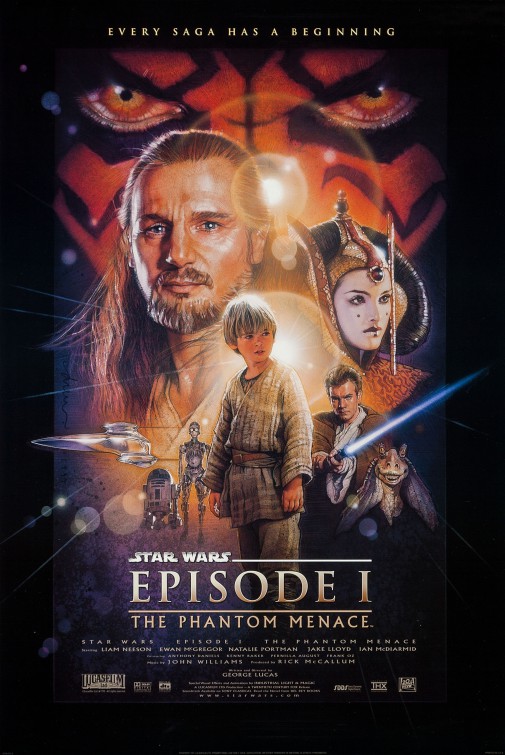 Star Wars, Episode I: The Phantom Menace (Ewan McGregor, Liam Neeson, Natalie Portman, and Samuel L. Jackson)
When the Trade Federation sets up a blockade around the small planet of Naboo, two Jedi set out to negotiate the cessation of hostilities. But the Trade Federation is not acting alone: the Sith, long thought extinct, have re-emerged in an attempt to reclaim power. When negotiations fail the two jedi (Qui-gon Jin and Obi-won Kenobi) set out to save the Queen, and in the process discover a small boy on the familiar planet Tattooine…a boy who may very well be the Chosen One to bring balance to the Force. (Does that sum it up well?)
Pros: Beautiful graphics, a decent enough story, and freaking amazing lightsaber battles. Probably the best of the prequels, to be honest.
Cons: Some questionable acting from the younger cast and too much reliance on CGI. It’s not a perfect movie, but it’s enjoyable. I agree with everyone else that Darth Maul should not have died in this particular movie.
Rating: 3.5/5
Value: $10.00 (Star Wars is totally worth seeing on the big screen.)
And there you have it!
The Mothman Prophecies (Richard Gere)A Washington D.C. journalist mysteriously ends up in a small town where people have reported seeing a bizarre mothman creature…the same creature his wife drew before dying of a brain tumor…
Pros: I’ve always loved this movie. It’s not a horror movie; it’s just damn creepy. The acting is decent, the story is good enough, and overall I just find this one enjoyable. I think it’s the creepy-factor that gets me; every time I see it I am overcome by creepiness.
Cons: It’s not a perfect movie. You never find out what the heck the mothman really is, and a lot of strange stuff happens, but only a few people seem to take notice of what lies underneath. Still, it’s a good one, I think.
Rating: 3.5/5
Value: $7.50
The 13th Warrior (Antonio Banderas)Antonio Banderas plays an emissary on a mission to open communication with the barbarian peoples of the north. But strange things are happening in the far north and an unexpected roll of fate calls thirteen warriors (one of them the emissary) into action to battle an ancient foe. Based on Eaters of the Dead by Michael Crichton.
Pros: Probably my favorite Banderas film next to Assassins. A lot of fantastic action, a decent enough story, and a lot of clever dialogue.
Cons: The ending is incomplete and I am not entirely sure how accurate the film in regards to its Viking-like northmen.
Rating: 4/5
Value: $8.50
Pirates of the Caribbean: The Curse of the Black Pearl (Johnny Depp, Orlando Bloom, Kiera Knightly, and Geoffrey Rush)Honestly, I have no idea how to describe this movie in a short an succinct way. The best I can do is use the blurb on my DVD case: The roguish, yet charming, Captain Jack Sparrow’s idyllic pirate life capsizes after his nemesis, the wily Captain Barbossa, steals his ship, the Black Pearl, and later attacks the town of Port Royal, kidnapping the governor’s beautiful daughter Elizabeth. In a gallant attempt to rescue her and recapture the Black Pearl, Elizabeth’s childhood friend, Will Turner, joins forces with Jack. What will doesn’t know is that a cursed treasure has doomed Barbossa and his crew to live forever as the undead.
Pros: Everything about this film is brilliant. Wonderful effects, wonderful characters (I mean, come on, we all know Captain Jack Sparrow by now, right?), and a downright awesome story. This is a classic. Period. End of story. If you haven’t seen it, or disliked it, then I disown you forever!
Cons: If you hate pirates or fantasy, then don’t see this movie. That’s the only con…
Rating: 4.75/5
Value: $11.00 (or whatever IMAX charges now)
Indiana Jones and the Raiders of the Lost Ark (Harrison Ford)Archaeologist Indiana Jones sets out to find the legendary Ark of the Covenant when a duo of government operatives question him about a series of strange Nazi messages that indicate that Hitler has been searching for all kinds of ancient relics. Filled with Nazis, a Frenchman, Marian (Indy’s female accomplice), and the forces of good and evil, this Lucas/Spielberg classic is not one to be missed or forgotten.
Pros: I’m actually surprised how well this one has aged. Unlike a lot of films, this one still stands up to the tests of time. The action is wonderful, the dialogue is witty and fun, and Harrison Ford is simply delightful. Toss in a fun story, beautiful scenery and special effects, and you’ve got one hell of an action adventure film!
Cons: The only problem I have with this film is that it suffers from being too stereotypical about its enemies. Then again, they’re Nazis and I think any director or writer would have a hard time turning them into gray characters.
Rating: 4/5
Value: $9.50
Star Wars, Episode I: The Phantom Menace (Ewan McGregor, Liam Neeson, Natalie Portman, and Samuel L. Jackson)When the Trade Federation sets up a blockade around the small planet of Naboo, two Jedi set out to negotiate the cessation of hostilities. But the Trade Federation is not acting alone: the Sith, long thought extinct, have re-emerged in an attempt to reclaim power. When negotiations fail the two jedi (Qui-gon Jin and Obi-won Kenobi) set out to save the Queen, and in the process discover a small boy on the familiar planet Tattooine…a boy who may very well be the Chosen One to bring balance to the Force. (Does that sum it up well?)
Pros: Beautiful graphics, a decent enough story, and freaking amazing lightsaber battles. Probably the best of the prequels, to be honest.
Cons: Some questionable acting from the younger cast and too much reliance on CGI. It’s not a perfect movie, but it’s enjoyable. I agree with everyone else that Darth Maul should not have died in this particular movie.
Rating: 3.5/5
Value: $10.00 (Star Wars is totally worth seeing on the big screen.)
And there you have it!
Saturday, October 17, 2009
Racist/Sexist Editors: Still Bad Even If They’re Not
So, apparently if you’re an editor and you don’t publish enough women or people of color in an anthology or magazine, but it’s because your slush pile contained primarily white males, you’re still a sexist or racist bastard. At least, that’s what oldcharliebrown says. It seems that no matter what, even if you have a legitimate excuse, if you don’t publish enough women or people of color, you’re a sexist or racist bastard. Period. No argument. That’s it. Because if your slush pile didn’t have enough women or people of color in it, then you, the editor, clearly didn’t spend enough time “reaching out.”
Well I’m calling bullshit.
Blaming editors like this is like blaming a police officer in another county for not stopping a drunk driver from driving into a tree. Sound frakked up? That’s because it is. It makes no logical sense. I’m not saying that there aren’t sexist/racist editors out there, but the idea that an editor can only work with what is submitted to him or her is 100% true. The whole idea of “reaching out” is neither here nor there. Whether you “reach out” or not does not suddenly make you a sexist/racist bastard—not by a long shot.
The fact that some people are still actively condemning editors even when they are not at fault suggests a mindset that is quite disturbing to me. It’s almost as if some people want editors to be sexist/racist bastards so we have someone to blame for the disparity in minority representation in SF/F. I don’t honestly think there is anyone to blame for this except culture. There are probably dozens of reasons why there are not a lot of women or people of color in the SF/F community, and that long list does not include dozens of different ways to say “racist” or “sexist.” Sometimes racism/sexism is responsible; sometimes it’s not.
Let’s not forget that historically speaking, science fiction (and publishing in general) has been a masculine enterprise, or that there seems to be far more people of color writing about issues such as colonialism/imperialism than there are about space ships or magic swords. That’s not to say that there aren’t women who write science fiction (there are quite a few, many of them damn good ones) or people of color who write SF/F (there are a few that I can name off the top of my head, though, to be fair, there could be more that none of us know about because names rarely indicate someone’s skin color). What I’m saying is that there very well may be other factors influencing the percentage of women and people of color in slush piles that have nothing to do directly with editors working today (editors in the past, yes, but today, not so much, with exception). But, then, you have to wonder how anyone knows how many people of color are in those slush piles in the first place if names are not good indicators of skin color…editors do not typically ask for one’s skin color (though a name can indicate sex, but that’s not always a sure thing, particularly if you’re dealing with writers from countries with non-English names like India or China). What needs to be done is for all aspects of the community to reach out, not just editors. History is working against women and people of color, and there’s no reason why we cannot circumvent historical tradition. But, history also does not make editors today sexist or racist bastards just because they do not publish enough women or people of color. If we want to talk about racist/sexist bastards, then we need to go back in time and point a finger at the people who dominated the publishing industry in the first place, and then at society, who played the race and gender game for centuries.
The point of all of this is that, yes, it is a viable excuse to say that the reason for gender/race disparities in your work is due to a low percentage of women or people of color in the slush pile. That’s a perfectly acceptable excuse, and whether or not an editor should spend time reaching out is an entirely different argument. I think the problem is that people need someone to blame, and why not an editor? They have their hand on the big button, after all. But there’s more at work here than just an editor. This is a community problem and there are no individuals that can be blamed.
That is all.
Well I’m calling bullshit.
Blaming editors like this is like blaming a police officer in another county for not stopping a drunk driver from driving into a tree. Sound frakked up? That’s because it is. It makes no logical sense. I’m not saying that there aren’t sexist/racist editors out there, but the idea that an editor can only work with what is submitted to him or her is 100% true. The whole idea of “reaching out” is neither here nor there. Whether you “reach out” or not does not suddenly make you a sexist/racist bastard—not by a long shot.
The fact that some people are still actively condemning editors even when they are not at fault suggests a mindset that is quite disturbing to me. It’s almost as if some people want editors to be sexist/racist bastards so we have someone to blame for the disparity in minority representation in SF/F. I don’t honestly think there is anyone to blame for this except culture. There are probably dozens of reasons why there are not a lot of women or people of color in the SF/F community, and that long list does not include dozens of different ways to say “racist” or “sexist.” Sometimes racism/sexism is responsible; sometimes it’s not.
Let’s not forget that historically speaking, science fiction (and publishing in general) has been a masculine enterprise, or that there seems to be far more people of color writing about issues such as colonialism/imperialism than there are about space ships or magic swords. That’s not to say that there aren’t women who write science fiction (there are quite a few, many of them damn good ones) or people of color who write SF/F (there are a few that I can name off the top of my head, though, to be fair, there could be more that none of us know about because names rarely indicate someone’s skin color). What I’m saying is that there very well may be other factors influencing the percentage of women and people of color in slush piles that have nothing to do directly with editors working today (editors in the past, yes, but today, not so much, with exception). But, then, you have to wonder how anyone knows how many people of color are in those slush piles in the first place if names are not good indicators of skin color…editors do not typically ask for one’s skin color (though a name can indicate sex, but that’s not always a sure thing, particularly if you’re dealing with writers from countries with non-English names like India or China). What needs to be done is for all aspects of the community to reach out, not just editors. History is working against women and people of color, and there’s no reason why we cannot circumvent historical tradition. But, history also does not make editors today sexist or racist bastards just because they do not publish enough women or people of color. If we want to talk about racist/sexist bastards, then we need to go back in time and point a finger at the people who dominated the publishing industry in the first place, and then at society, who played the race and gender game for centuries.
The point of all of this is that, yes, it is a viable excuse to say that the reason for gender/race disparities in your work is due to a low percentage of women or people of color in the slush pile. That’s a perfectly acceptable excuse, and whether or not an editor should spend time reaching out is an entirely different argument. I think the problem is that people need someone to blame, and why not an editor? They have their hand on the big button, after all. But there’s more at work here than just an editor. This is a community problem and there are no individuals that can be blamed.
That is all.
Friday, October 16, 2009
Interview w/ Edward Willett
Edward Willett is the author of Terra Insegura (see my review here) and Marseguro (see my review here), among other novels. Special thanks to Mr. Willett for doing this interview. Here goes:
Can you talk a little about Terra Insegura for those that have yet to read it?
 Terra Insegura takes up immediately where Marseguro left off. The people of Marseguro have reason to believe that a genetically modified super-plague has made its way to Earth and have decided, even though the Body Purified, the religious dictatorship on Earth, just tried to "purify" their planet, they have to at least attempt to help by sending a vaccine. Good impulse, but things go awry when it turns out the Body Purified is not entirely destroyed yet, nor are the Selkies of Marseguro, genetically modified to be amphibian, the only new race of humans spawned by Victor Hansen, the genius geneticist who both created them and had a nasty habit of leaving clones of himself around for other people to trip over. Terra Insegura is about the battle to decide the shape of the new society about to arise on the depopulated Earth.
 One of the things I loved about Marseguro, and which continues in Terra Insegura, is your approach to human/Other relationships, with the Other being the Selkies (a genetically augmented human/fish race). What about science fiction makes it “easier” to address humanity’s less appealing qualities (discrimination, segregation, and even violent extermination of “the Other”)? (In your opinion, of course)
One of the strengths of science fiction in general is that it allows you to strip out aspects of present-day life that in the real world are wrapped in too many layers of other stuff to be seen clearly. A story about, say, the progressives of the early 20th century who saw forced sterilization or forbidding marriage to certain types of individuals as a good way to improve society, has to deal with so much historical baggage concerning the real people and events of the time, not to mention the politics of the reader (who may not like to be told that some historical figure they revere--Woodrow Wilson, Margaret Sanger, George Bernard Shaw, etc.--had this unsavory side to them), that it can be hard to examine the central issue of eugenics clearly. Science fiction gives us a way of finding, baring and illuminating these kinds of big-picture problems so that we can look at them in a different light and perhaps gain a better understanding of the issues involved.
Terra Insegura follows Marseguro, a particularly dark dystopian future/space opera, yet it takes your already established darkness to new heights. Is there some really scary part of you that just loves to put your characters through hell? Do you mentally torture little voodoo dolls? Or is all this darkness simply you way of making a darn good science fiction story?
It's funny, because while I was reading a recent thread on the SF Canada listserver about dark and dystopian fiction (prompted, I think, by the latest book by Margaret "I Don't Write Science Fiction Because There Aren't Any Talking Cabbages from Planet X" Atwood), I kept thinking, gee, you people are depressing. I'm glad all my fiction is upbeat!
At which point a little inner voice cleared its throat and said, "Have you actually read your own last couple of books?"
Really, the darkness in these two books was entirely a function of the story situation I set up. As I think I explained in the last interview, Marseguro grew out of a writing class exercise, the whole thing springing from a couple of opening sentences, one of which contained the line "the water in her gills smelled of blood." The darkness was built into that first sentence, and the story that grew out of it just seemed to demand the level of unpleasantness I heaped on my poor characters.
I'm actually a very cheerful guy. Really!
As a sequel, you run the risk of falling short of the preceding novel, of letting your fans down. Terra Insegura never disappoints, and in some ways it is a superior novel to its predecessor. Was Terra Insegura planned from the start, or was it something you put together later on? How did you go about approaching the idea of a sequel and were you at all concerned about “sequelitis?”
Terra Insegura was not planned from the start, and Marseguro was complete before I knew for certain I would be writing a sequel, though obviously I had hopes, since I crafted an ending on which to hang one.
Outlining the sequel was really the same process as outlining the original book. Marseguro started from just a couple of sentences, as I mentioned, and I just began asking myself questions about those sentences as a way of getting to the story they implied. Terra Insegura was the same process, except I was asking myself questions about things I had mentioned in Marseguro, so I had a lot more to work with. There are always loose ends in a novel, alleyways you could have explored but didn't, little bits of throw-away scene decoration or dialogue that you put in really as a kind of stage trick, to imply that there is more to the world than is in the foreground of the story. When I started thinking of a sequel, I looked for those bits and pieces that hinted at something more...and then developed that something more. For instance: in Marseguro, early on, there is a scene at a religious service of the Body where a genetically modified female attacks the priest and is shot down. I described her as being feline. That was a throw-away bit, really, just something to dramatize how moddies were being treated on Earth by the Body Purified. Didn't give that poor dead moddie another thought...until I started plotting Terra Insegura. And then I remembered her and thought, wait. If there's one feline moddie, there must be others...maybe a whole race of them. How did they get there? What have they been up to? Etc....and that led to the Kemonomimi, which became a central feature of Terra Insegura. When I wrote Marseguro, I really had no idea they existed beyond that one throw-away character.
I don't worry about sequilitis. Maybe because I haven't written enough sequels yet. Ask me again five or six books into a series some day...
Do you have plans to write more in this universe?
I proposed a third book, which would see the action move back to Marseguro and also further into space to some of the other colonies mentioned in the first two books, but so far, at least, DAW hasn't taken me up on it. For now, it looks like this will be a two-book series only.
What other projects do you have coming up and can you tell us a little about them?
I'm just finishing the first draft of my first adult fantasy novel, Magebane, which will be my next book for DAW, out next year sometime (no date yet). Because of the switch in genres, it will appear as the first book by Lee Arthur Chane. But Lee Arthur Chane c'est moi! (Lee is my oldest brother's middle name, Arthur is my next-oldest brother's middle name, and Chane is my middle name.) It's a slightly subversive fantasy about a rather repressive magical kingdom where those with magical ability--the Mageborn, and in particular the MageLords--rule rather tyrannically over the non-magic-using Commoners. The kingdom hid itself away four hundred years ago behind an impenetrable barrier after a mysterious hero called the Magebane led the Commoners of the day in a successful revolt. Now there are MageLords who want to destroy the barrier and seize control of the outside world again and Commoners and others who want to overthrow the rule of the MageLords inside the hidden kingdom as their ancestors did centuries ago. Meanwhile, outside, the world has advanced to about the 19th-century level of technology, and one day a young man from that outside world crash-lands in an airship next to the manor of a powerful MageLord...
It's got magic, airships, swords AND dogsleds, assassinations, machinations and assignations, and even a lake of lava. What more could you want?
Switching gears, what do you think about the present state of the book industry, both on the selling end and on the making end? What about eBooks/readers?
Well, I'm not exactly plugged into what the publishers are seeing on their spreadsheets, but it doesn't seem all that great. My dream has always been to make a living just by writing fiction. I'm closer than I ever was, but it still seems pretty distant. Most fiction writers do other things to make ends meet. I suspect most small-press fiction publishers do, too!
I'm a big fan of ebooks, but I'm still wondering if dedicated ebook readers are really going to take off. Frankly, the best ebook reader I've seen is the free Stanza software for the iPhone and iPod Touch. And does anyone really want a dedicated piece of hardware for reading books when you can get a terrific general-purpose piece of hardware like the iPhone or iPod Touch you can read books on just as well?
Terra Insegura and Marseguro, and my previous DAW book, Lost in Translation, are all available as ebooks now, by the way, in various formats including Kindle.
What unusual piece of writing advice would you give to budding writers? (Emphasis on unusual)
How about, contrary to what you hear a lot in writing classes, "Don't write what you know! Write what you WANT to know, and then find out about it--or just make it up."
Now for a random question: If you could be a ninja or a pirate, which would you be and why? Don't worry, this is a safe place...
Definitely a pirate. Better clothes, lots of sea cruises, and a chance to bellow sea chanties at the top of your voice. And that parrot-on-the-shoulder deal is petty sweet, too. If you're shipwrecked, you can always eat it.
Thanks again to Mr. Willett. Now go buy his books!
Can you talk a little about Terra Insegura for those that have yet to read it?
Terra Insegura takes up immediately where Marseguro left off. The people of Marseguro have reason to believe that a genetically modified super-plague has made its way to Earth and have decided, even though the Body Purified, the religious dictatorship on Earth, just tried to "purify" their planet, they have to at least attempt to help by sending a vaccine. Good impulse, but things go awry when it turns out the Body Purified is not entirely destroyed yet, nor are the Selkies of Marseguro, genetically modified to be amphibian, the only new race of humans spawned by Victor Hansen, the genius geneticist who both created them and had a nasty habit of leaving clones of himself around for other people to trip over. Terra Insegura is about the battle to decide the shape of the new society about to arise on the depopulated Earth.One of the things I loved about Marseguro, and which continues in Terra Insegura, is your approach to human/Other relationships, with the Other being the Selkies (a genetically augmented human/fish race). What about science fiction makes it “easier” to address humanity’s less appealing qualities (discrimination, segregation, and even violent extermination of “the Other”)? (In your opinion, of course)One of the strengths of science fiction in general is that it allows you to strip out aspects of present-day life that in the real world are wrapped in too many layers of other stuff to be seen clearly. A story about, say, the progressives of the early 20th century who saw forced sterilization or forbidding marriage to certain types of individuals as a good way to improve society, has to deal with so much historical baggage concerning the real people and events of the time, not to mention the politics of the reader (who may not like to be told that some historical figure they revere--Woodrow Wilson, Margaret Sanger, George Bernard Shaw, etc.--had this unsavory side to them), that it can be hard to examine the central issue of eugenics clearly. Science fiction gives us a way of finding, baring and illuminating these kinds of big-picture problems so that we can look at them in a different light and perhaps gain a better understanding of the issues involved.
Terra Insegura follows Marseguro, a particularly dark dystopian future/space opera, yet it takes your already established darkness to new heights. Is there some really scary part of you that just loves to put your characters through hell? Do you mentally torture little voodoo dolls? Or is all this darkness simply you way of making a darn good science fiction story?
It's funny, because while I was reading a recent thread on the SF Canada listserver about dark and dystopian fiction (prompted, I think, by the latest book by Margaret "I Don't Write Science Fiction Because There Aren't Any Talking Cabbages from Planet X" Atwood), I kept thinking, gee, you people are depressing. I'm glad all my fiction is upbeat!
At which point a little inner voice cleared its throat and said, "Have you actually read your own last couple of books?"
Really, the darkness in these two books was entirely a function of the story situation I set up. As I think I explained in the last interview, Marseguro grew out of a writing class exercise, the whole thing springing from a couple of opening sentences, one of which contained the line "the water in her gills smelled of blood." The darkness was built into that first sentence, and the story that grew out of it just seemed to demand the level of unpleasantness I heaped on my poor characters.
I'm actually a very cheerful guy. Really!
As a sequel, you run the risk of falling short of the preceding novel, of letting your fans down. Terra Insegura never disappoints, and in some ways it is a superior novel to its predecessor. Was Terra Insegura planned from the start, or was it something you put together later on? How did you go about approaching the idea of a sequel and were you at all concerned about “sequelitis?”
Terra Insegura was not planned from the start, and Marseguro was complete before I knew for certain I would be writing a sequel, though obviously I had hopes, since I crafted an ending on which to hang one.
Outlining the sequel was really the same process as outlining the original book. Marseguro started from just a couple of sentences, as I mentioned, and I just began asking myself questions about those sentences as a way of getting to the story they implied. Terra Insegura was the same process, except I was asking myself questions about things I had mentioned in Marseguro, so I had a lot more to work with. There are always loose ends in a novel, alleyways you could have explored but didn't, little bits of throw-away scene decoration or dialogue that you put in really as a kind of stage trick, to imply that there is more to the world than is in the foreground of the story. When I started thinking of a sequel, I looked for those bits and pieces that hinted at something more...and then developed that something more. For instance: in Marseguro, early on, there is a scene at a religious service of the Body where a genetically modified female attacks the priest and is shot down. I described her as being feline. That was a throw-away bit, really, just something to dramatize how moddies were being treated on Earth by the Body Purified. Didn't give that poor dead moddie another thought...until I started plotting Terra Insegura. And then I remembered her and thought, wait. If there's one feline moddie, there must be others...maybe a whole race of them. How did they get there? What have they been up to? Etc....and that led to the Kemonomimi, which became a central feature of Terra Insegura. When I wrote Marseguro, I really had no idea they existed beyond that one throw-away character.
I don't worry about sequilitis. Maybe because I haven't written enough sequels yet. Ask me again five or six books into a series some day...
Do you have plans to write more in this universe?
I proposed a third book, which would see the action move back to Marseguro and also further into space to some of the other colonies mentioned in the first two books, but so far, at least, DAW hasn't taken me up on it. For now, it looks like this will be a two-book series only.
What other projects do you have coming up and can you tell us a little about them?
I'm just finishing the first draft of my first adult fantasy novel, Magebane, which will be my next book for DAW, out next year sometime (no date yet). Because of the switch in genres, it will appear as the first book by Lee Arthur Chane. But Lee Arthur Chane c'est moi! (Lee is my oldest brother's middle name, Arthur is my next-oldest brother's middle name, and Chane is my middle name.) It's a slightly subversive fantasy about a rather repressive magical kingdom where those with magical ability--the Mageborn, and in particular the MageLords--rule rather tyrannically over the non-magic-using Commoners. The kingdom hid itself away four hundred years ago behind an impenetrable barrier after a mysterious hero called the Magebane led the Commoners of the day in a successful revolt. Now there are MageLords who want to destroy the barrier and seize control of the outside world again and Commoners and others who want to overthrow the rule of the MageLords inside the hidden kingdom as their ancestors did centuries ago. Meanwhile, outside, the world has advanced to about the 19th-century level of technology, and one day a young man from that outside world crash-lands in an airship next to the manor of a powerful MageLord...
It's got magic, airships, swords AND dogsleds, assassinations, machinations and assignations, and even a lake of lava. What more could you want?
Switching gears, what do you think about the present state of the book industry, both on the selling end and on the making end? What about eBooks/readers?
Well, I'm not exactly plugged into what the publishers are seeing on their spreadsheets, but it doesn't seem all that great. My dream has always been to make a living just by writing fiction. I'm closer than I ever was, but it still seems pretty distant. Most fiction writers do other things to make ends meet. I suspect most small-press fiction publishers do, too!
I'm a big fan of ebooks, but I'm still wondering if dedicated ebook readers are really going to take off. Frankly, the best ebook reader I've seen is the free Stanza software for the iPhone and iPod Touch. And does anyone really want a dedicated piece of hardware for reading books when you can get a terrific general-purpose piece of hardware like the iPhone or iPod Touch you can read books on just as well?
Terra Insegura and Marseguro, and my previous DAW book, Lost in Translation, are all available as ebooks now, by the way, in various formats including Kindle.
What unusual piece of writing advice would you give to budding writers? (Emphasis on unusual)
How about, contrary to what you hear a lot in writing classes, "Don't write what you know! Write what you WANT to know, and then find out about it--or just make it up."
Now for a random question: If you could be a ninja or a pirate, which would you be and why? Don't worry, this is a safe place...
Definitely a pirate. Better clothes, lots of sea cruises, and a chance to bellow sea chanties at the top of your voice. And that parrot-on-the-shoulder deal is petty sweet, too. If you're shipwrecked, you can always eat it.
Thanks again to Mr. Willett. Now go buy his books!
Thursday, October 15, 2009
Quickie Movie Reviews (2009): Volume Nine
Yet another batch of old movies viewed and reviewed. Some interesting ones this time, but also some really bad ones. Here goes:
 Wings of Desire (Peter Falk)
Daniel, an angel who spends his days easing the mental suffering of human beings, falls in love with a young woman and must sacrifice his wings and immortality in order to be with her.
Pros: An interesting concept (this is a film that predated City of Angels) and the last 20-30 minutes of the film are actually quite good. Plus, there’s the lovely Peter Falk playing himself in a rather unique way (in fact, the little surprise about Falk at the end made me grin).
Cons: It’s really boring. Most of the film is spent establishing the concept, and, quite honestly, they could have spent more time on other things. The concept was obvious in the first ten minutes, but the writer/director wouldn’t let up and just pounded it into my head relentlessly. It was too much.
Rating: 1.5/5
Value: $2.00
Hole
This quasi-science fiction / psychological comedy movie posits a world in which a strange cockroach virus has devastated Taiwan, forcing the government to begin evacuating people against their will. But for a couple of unusual characters (a sleazy young man whose upstairs apartment perpetually leaks into the one below it, a woman who randomly breaks out into song, and a bicycle-riding boy who plays games with people’s doorbells), evacuation is not an option.
Pros: There are moments of sheer brilliance in this, like when the guy upstairs decides to shove his whole leg into the whole in his floor and dangle his foot around in the singing woman’s apartment. I found myself laughing here or there, but I think it’s fair to say that this is not a comedy so much as a weird psychological film.
Cons: There is no plot and the movie plods along at an astonishingly slow pace. The good bits are far and few between. There is some good here, but I’m not sure if the wait is worth it. Granted, at least it’s not as boring as some of the films I’ve watched. The subtle humor seems to work well.
Rating: 1.5/5
Value: $2.25
 Jigoku
A Japanese version of Dante’s Inferno, this follows a young man whose life gets turned upside-down when he and a friend run over a drunk gangster on the way home. The event causes an avalanche of disasters that eventually land him and his entire family in hell…
Pros: For its time, this must have been freaking terrifying. It’s fairly gruesome and doesn’t pull any punches. Hell literally looks like hell. The story itself is convenient, but it gets the job done.
Cons: Can be a bit slow in parts and is clearly outdated. It’s good, but it’s from a different era of film, and if you’re not into that, then you won’t be into this. The acting is somewhat ridiculous, too, but, to be honest, I think the insanity portrayed by the characters worked well.
Rating: 3/5
Value: $5.50
 The Big One (Michael Moore)
In this short companion to one of Moore’s first book tours, our favorite Flintian takes on corporate downsizing and outsourcing.
Pros: It’s Michael Moore. You either love him or you hate him. Here Moore is somewhat more level-headed than in his higher profile documentaries, and his jokes and antics are much appreciated and enjoyable.
Cons: This isn’t really a documentary, though I had expected it to be. It’s good, but Moore really should have taken this further and made it more a traditional documentary.
Rating: 2.5/5
Value: $3.50
 Titus (Anthony Hopkins)
A semi-modern adaptation of one of Shakespeare’s most twisted works about a Roman general who slowly loses his sanity after his children are killed, maimed, or worse by a vindictive Goth queen-turned-Roman-empress.
Pros: The opening for this is amazing. I absolutely loved it. The story is also twisted in a good way, and Anthony Hopkins is amazing here. The other actors are mostly good, with a couple bad eggs here or there.
Cons: Not for the faint of heart, though not nearly as gruesome as some of the horror films being made to day. One of the key problems with this film is that all the dialogue is in typical Shakespeare style, which makes it really difficult to understand what is going on at times. Most of the time it’s pretty obvious, but unless you’re familiar with this particular story, the subtlety is lost to you.
Rating: 3.25/5
Value: $6.50
And that's that! I think I'm going to get Netflix, because the University of Florida library is running out of good stuff...
Wings of Desire (Peter Falk)Daniel, an angel who spends his days easing the mental suffering of human beings, falls in love with a young woman and must sacrifice his wings and immortality in order to be with her.
Pros: An interesting concept (this is a film that predated City of Angels) and the last 20-30 minutes of the film are actually quite good. Plus, there’s the lovely Peter Falk playing himself in a rather unique way (in fact, the little surprise about Falk at the end made me grin).
Cons: It’s really boring. Most of the film is spent establishing the concept, and, quite honestly, they could have spent more time on other things. The concept was obvious in the first ten minutes, but the writer/director wouldn’t let up and just pounded it into my head relentlessly. It was too much.
Rating: 1.5/5
Value: $2.00
Hole
This quasi-science fiction / psychological comedy movie posits a world in which a strange cockroach virus has devastated Taiwan, forcing the government to begin evacuating people against their will. But for a couple of unusual characters (a sleazy young man whose upstairs apartment perpetually leaks into the one below it, a woman who randomly breaks out into song, and a bicycle-riding boy who plays games with people’s doorbells), evacuation is not an option.
Pros: There are moments of sheer brilliance in this, like when the guy upstairs decides to shove his whole leg into the whole in his floor and dangle his foot around in the singing woman’s apartment. I found myself laughing here or there, but I think it’s fair to say that this is not a comedy so much as a weird psychological film.
Cons: There is no plot and the movie plods along at an astonishingly slow pace. The good bits are far and few between. There is some good here, but I’m not sure if the wait is worth it. Granted, at least it’s not as boring as some of the films I’ve watched. The subtle humor seems to work well.
Rating: 1.5/5
Value: $2.25
JigokuA Japanese version of Dante’s Inferno, this follows a young man whose life gets turned upside-down when he and a friend run over a drunk gangster on the way home. The event causes an avalanche of disasters that eventually land him and his entire family in hell…
Pros: For its time, this must have been freaking terrifying. It’s fairly gruesome and doesn’t pull any punches. Hell literally looks like hell. The story itself is convenient, but it gets the job done.
Cons: Can be a bit slow in parts and is clearly outdated. It’s good, but it’s from a different era of film, and if you’re not into that, then you won’t be into this. The acting is somewhat ridiculous, too, but, to be honest, I think the insanity portrayed by the characters worked well.
Rating: 3/5
Value: $5.50
The Big One (Michael Moore)In this short companion to one of Moore’s first book tours, our favorite Flintian takes on corporate downsizing and outsourcing.
Pros: It’s Michael Moore. You either love him or you hate him. Here Moore is somewhat more level-headed than in his higher profile documentaries, and his jokes and antics are much appreciated and enjoyable.
Cons: This isn’t really a documentary, though I had expected it to be. It’s good, but Moore really should have taken this further and made it more a traditional documentary.
Rating: 2.5/5
Value: $3.50
Titus (Anthony Hopkins)A semi-modern adaptation of one of Shakespeare’s most twisted works about a Roman general who slowly loses his sanity after his children are killed, maimed, or worse by a vindictive Goth queen-turned-Roman-empress.
Pros: The opening for this is amazing. I absolutely loved it. The story is also twisted in a good way, and Anthony Hopkins is amazing here. The other actors are mostly good, with a couple bad eggs here or there.
Cons: Not for the faint of heart, though not nearly as gruesome as some of the horror films being made to day. One of the key problems with this film is that all the dialogue is in typical Shakespeare style, which makes it really difficult to understand what is going on at times. Most of the time it’s pretty obvious, but unless you’re familiar with this particular story, the subtlety is lost to you.
Rating: 3.25/5
Value: $6.50
And that's that! I think I'm going to get Netflix, because the University of Florida library is running out of good stuff...
Wednesday, October 14, 2009
Good News: A Presentation Involving Fantasy
I recently submitted a proposal to present a paper entitled “Fabricated Histories and Non-Nationalist Identities” to a conference being held here at the University of Florida next month. Just a few days ago I found out that my proposal had been accepted. So, on November 13th, 2009, I will be presenting my paper in front of a bunch of people, probably fellow graduate students and faculty. This, I’m sure, will be a terrifying experience when I am questioned by people far more learned than myself.
But, none of this seems relevant to any of you without context. This particular paper happens to spent quite a good deal of time analyzing The House of the Stag by Kage Baker, and fantastic fantasy novel from last year that I reviewed here; I also interviewed the author some time back. The paper also deals with an interesting book called In an Antique Land by Amitav Ghosh, which is not fantasy, but certainly worthy of your consideration. In any case, what I am most curious about in this paper are the relationships the characters in both novels have to history, particular that of fake or fabricated histories, and how their identities are formulated through their use of such things. It may sound dull, but the Baker text is particularly good at making this rather fascinating to a less academic crowd, since her use of a fabricated history is embodied by what you might call the “Dark Lord narrative.” I won’t go any further than that, since I have a presentation to work on, but I thought you all might find this fascinating indeed!
But, none of this seems relevant to any of you without context. This particular paper happens to spent quite a good deal of time analyzing The House of the Stag by Kage Baker, and fantastic fantasy novel from last year that I reviewed here; I also interviewed the author some time back. The paper also deals with an interesting book called In an Antique Land by Amitav Ghosh, which is not fantasy, but certainly worthy of your consideration. In any case, what I am most curious about in this paper are the relationships the characters in both novels have to history, particular that of fake or fabricated histories, and how their identities are formulated through their use of such things. It may sound dull, but the Baker text is particularly good at making this rather fascinating to a less academic crowd, since her use of a fabricated history is embodied by what you might call the “Dark Lord narrative.” I won’t go any further than that, since I have a presentation to work on, but I thought you all might find this fascinating indeed!
How to Know You’re a Crazy Liberal: Move to Florida
I’m a graduate student at the University of Florida, as some of you well know (studying science fiction and fantasy and postcolonialism and anything that fits into the cracks). The experience, thus far, has taught me a few things about what it’s like to be a graduate student and a teacher, and about myself. That last part is what this post is about.
I’ve always considered myself to be fairly moderate in my political beliefs. Yes, I am for universal healthcare (though I would be willing to settle for significant regulation if someone would bother to come up with something that makes sense) and I am also for gay rights (particularly marriage, which I could go into here, but won’t). But I don’t go so far as to think that we should tax the living hell out of the rich (although I think we should punish the rich accordingly whenever they screw up and not give them passes just because they have money). I could go on and on about my beliefs, but I think ultimately it will either paint the picture that I’m fairly liberal or at least somewhat moderate.
But all that changed when I moved to Gainesville. I was moderate in Santa Cruz, but here I am a crazy liberal. I don’t know what to make of that, except that I know I have to be very aware of my personal beliefs when it comes to teaching my classes. Contrary to popular opinion, not all liberals are out to brainwash your children and turn them into tree-hugging hippies. In fact, I don’t want to brainwash any kids (not really, anyway, though I may joke otherwise). I do, however, want to expose them to different beliefs and ideas, because if they’re going to be useful, productive members of society, they have to be capable of actually thinking about things, even if it goes against what they believe in. Living in a vacuum does these kids no good whatsoever (and if the conservative or liberal fascists who think otherwise, that’s their problem, not mine; I can’t be bothered to deal with people who think it acceptable behavior to intentionally provide their children with an exceedingly limited and biased viewpoint of the world, and then get upset when they grow up and actually want to know what the world is really like).
This is all part of the south, though, right? After all, the University of Florida was the first time I saw public praying on a university campus, and also the first time I have been accosted by born again Christians looking to save my immortal soul at school. Even my students have completely opposite views from me and I suspect that they think me remarkably crazy leftist as a result. Maybe, but I don’t know if I’m that deep in the south in the middle of a university. Such places tend to be a little more liberal than the rest of the world. So maybe I should be afraid of what actual red-ville looks like.
I suppose what this all amounts to is this: it’s a strange experience to find out you’re actually more insane than you thought you were.
I’ve always considered myself to be fairly moderate in my political beliefs. Yes, I am for universal healthcare (though I would be willing to settle for significant regulation if someone would bother to come up with something that makes sense) and I am also for gay rights (particularly marriage, which I could go into here, but won’t). But I don’t go so far as to think that we should tax the living hell out of the rich (although I think we should punish the rich accordingly whenever they screw up and not give them passes just because they have money). I could go on and on about my beliefs, but I think ultimately it will either paint the picture that I’m fairly liberal or at least somewhat moderate.
But all that changed when I moved to Gainesville. I was moderate in Santa Cruz, but here I am a crazy liberal. I don’t know what to make of that, except that I know I have to be very aware of my personal beliefs when it comes to teaching my classes. Contrary to popular opinion, not all liberals are out to brainwash your children and turn them into tree-hugging hippies. In fact, I don’t want to brainwash any kids (not really, anyway, though I may joke otherwise). I do, however, want to expose them to different beliefs and ideas, because if they’re going to be useful, productive members of society, they have to be capable of actually thinking about things, even if it goes against what they believe in. Living in a vacuum does these kids no good whatsoever (and if the conservative or liberal fascists who think otherwise, that’s their problem, not mine; I can’t be bothered to deal with people who think it acceptable behavior to intentionally provide their children with an exceedingly limited and biased viewpoint of the world, and then get upset when they grow up and actually want to know what the world is really like).
This is all part of the south, though, right? After all, the University of Florida was the first time I saw public praying on a university campus, and also the first time I have been accosted by born again Christians looking to save my immortal soul at school. Even my students have completely opposite views from me and I suspect that they think me remarkably crazy leftist as a result. Maybe, but I don’t know if I’m that deep in the south in the middle of a university. Such places tend to be a little more liberal than the rest of the world. So maybe I should be afraid of what actual red-ville looks like.
I suppose what this all amounts to is this: it’s a strange experience to find out you’re actually more insane than you thought you were.
Tuesday, October 13, 2009
Writer Problem: Genre “Bias” as Weakness?
Stay with me here.
The other day I was thinking about my writing and wondering if one of my problems is that I always write the same genre (or genres, since I occasionally do fantasy, but mostly do science fiction, as far as short stories are concerned). I don’t know how many of you who read this blog are writers, but I’m curious how many of you attempt to write outside of your “comfort zone.” For me, my comfort zone is science fiction and fantasy, because those are the genres I tend to read and enjoy the most and the ones that fill my head more often than anything else. But can thinking only of those things hurt your writing? I don’t know. I’ve started to think that for someone like me, it can, because must of what I write seems to suffer from a lack of character and an excess of plot (something that has been identified by some people to be a male thing).
The thing is, while I do read pretty much only science fiction and fantasy, I do occasionally venture outside of that and have, on occasion, enjoyed books so far outside my far outside of my chosen genres that the only thing that remains the same seems to be the language being used (that, of course, is because I can’t read any other languages, although I do have a knack for reading Spanish). For example, I really enjoyed The Dragons of Eden by Carl Sagan, a science book about the evolution of human intelligence. That might not be a great example, though, since science fiction and science often go hand in hand, even though the former tends to get the science very wrong. So, how about a “literary fiction” example: Fog of the Season’s End by … While you could consider this book a pulp-style novel, it is actually a character piece about people dealing with some of the darkest aspects of South Africa’s apartheid. It is one of my favorite books that I was forced to read while at UC Santa Cruz (in a class on South African literature, actually). Maybe I should write a novel like that (not about apartheid, per se, but something that looks at the world I live in, or something). I often feel like I am not educated enough to do that, though, as if I am not in-tune with the world in the way some of the best literary writers seem to be. My fingers aren’t on the world’s pulse.
I don’t know where I’m going with all of this, except that I seriously wonder if my obsession with genre fiction might be hurting me. I even tried to break out of it on Saturday in an attempt to do something new, only to find myself resorting to the same science fiction things that dominate some of my most recent work (well, a little different, but I immediately found myself needing to go into the future in order to pull off what I wanted to do). Maybe I have a psychological condition that perpetually puts me in the future, or I just don’t care about the present enough to write about it, or I simply want to write stories that don’t work in the world we currently live in (give it twenty years and who knows).
What do you all think about this?
The other day I was thinking about my writing and wondering if one of my problems is that I always write the same genre (or genres, since I occasionally do fantasy, but mostly do science fiction, as far as short stories are concerned). I don’t know how many of you who read this blog are writers, but I’m curious how many of you attempt to write outside of your “comfort zone.” For me, my comfort zone is science fiction and fantasy, because those are the genres I tend to read and enjoy the most and the ones that fill my head more often than anything else. But can thinking only of those things hurt your writing? I don’t know. I’ve started to think that for someone like me, it can, because must of what I write seems to suffer from a lack of character and an excess of plot (something that has been identified by some people to be a male thing).
The thing is, while I do read pretty much only science fiction and fantasy, I do occasionally venture outside of that and have, on occasion, enjoyed books so far outside my far outside of my chosen genres that the only thing that remains the same seems to be the language being used (that, of course, is because I can’t read any other languages, although I do have a knack for reading Spanish). For example, I really enjoyed The Dragons of Eden by Carl Sagan, a science book about the evolution of human intelligence. That might not be a great example, though, since science fiction and science often go hand in hand, even though the former tends to get the science very wrong. So, how about a “literary fiction” example: Fog of the Season’s End by … While you could consider this book a pulp-style novel, it is actually a character piece about people dealing with some of the darkest aspects of South Africa’s apartheid. It is one of my favorite books that I was forced to read while at UC Santa Cruz (in a class on South African literature, actually). Maybe I should write a novel like that (not about apartheid, per se, but something that looks at the world I live in, or something). I often feel like I am not educated enough to do that, though, as if I am not in-tune with the world in the way some of the best literary writers seem to be. My fingers aren’t on the world’s pulse.
I don’t know where I’m going with all of this, except that I seriously wonder if my obsession with genre fiction might be hurting me. I even tried to break out of it on Saturday in an attempt to do something new, only to find myself resorting to the same science fiction things that dominate some of my most recent work (well, a little different, but I immediately found myself needing to go into the future in order to pull off what I wanted to do). Maybe I have a psychological condition that perpetually puts me in the future, or I just don’t care about the present enough to write about it, or I simply want to write stories that don’t work in the world we currently live in (give it twenty years and who knows).
What do you all think about this?
Monday, October 12, 2009
Plots Are Not Copyrightable
(I am not directing this topic to any specific event, though I know some of you who read my blog will remember me making this statement in relation to a particular incident; here, I am not making the argument in that relation, but in a more general sense.)
As much as writers might want to keep their plots and storylines safe from thieves, the reality is that short of never putting your work in print and keeping it locked in a volt and buried in your backyard forever, you cannot protect your plots anymore than someone can protect their children from experiencing bad things. No matter what you do, you’ll probably find that someone has “stolen” your plot already.
Why? Well, because plots are not copyrightable. J. K. Rowling can no more protect the plot of Harry Potter than you can protect the plot of your yet unpublished novel. Rowling, however, can protect what amounts to her intellectual property, and there are instances where she has gone after people for what seem like clear acts of plagiarism (I don’t know enough about them to have judgment, except in the case of that encyclopedia thing that Rowling killed with the power of a lawyer). But Rowling has not won cases against plagiarism by arguing for plot; yes, she has made those arguments, but what has worked for you are a collection of factors (characters looking and acting remarkably like her own characters collected with plot, setting, etc.). If she were to argue that someone had stolen her plot, well, then you’d be opening up a can of worms in the writing community, with everyone suing everyone for supposed thefts.
Personally, I think this assumption that one can protect his or her plot stems from an inability to acknowledge that originality is mostly dead. Outside of the “seven plots,” there are far too may near-exact plot replicas flooding the mainstream markets; there are enough Dan Brown rip-offs as there are Tolkien rip-offs (okay, so maybe that’s a bit much, but you get my point) all because of the fact that plots cannot be protected. Maybe they should, but then where would we get our literature from? It doesn’t take a genius to look at a few of the most popular fantasy novels and see where they overlap. Many arguments have been made that Eragon and Eldest by Christopher Paolini are directly taken from Star Wars, which, of course, stole directly from mythology with the help of a fellow who knew quite a bit about the stuff in the first place (Joseph Campbell). But George Lucas isn’t suing Paolini presumably because he’s smart enough to know a bad lawsuit when he sees one (and that might be one of the few things he gets credit for in the smart department, since his directing style, while not absolutely wretched, truly pulls away from the greatness that Star Wars once was—it’s still good, just not as good as it used to be). Plots, to be fair, are simply not original elements by a long shot. They certain can deviate and change little bits here and there, but, ultimately, plots are a constant mimic of themselves, like self-replicating mental machines drilling themselves into parts of our psyches where we have to really dig to be able to yank them out and see what they’re up to.
The best kinds of stories are those that can take an overused plot and turn it into a powerhouse fantasy epic (or insert your favorite genre here). Nobody suggests that Tolkien or J. K. Rowling (except Orson Scott Card, who is obviously a very special brand of crazy) be brought up on charges of plagiarism, despite the fact that, if we assume plagiarism to include plot, these two are probably some of the most prominent plot plagiarizers of all time, from the very inclusion of prophecies and chosen ones to evil magic rings and fantastic unintentional allegories about real events. So, either we hold our favorites up to the guillotine just as we hold up the ones we dislike, or we let it all go and acknowledge that we don’t own plots, we just use them. The characters make the world go round, not the writer-as-god-directed storylines that pull them to and fro for no other purpose other than to get to the end (they’re more complicated than that, but that’s for another place and another time).
And now I want your opinion. Leave a comment!
As much as writers might want to keep their plots and storylines safe from thieves, the reality is that short of never putting your work in print and keeping it locked in a volt and buried in your backyard forever, you cannot protect your plots anymore than someone can protect their children from experiencing bad things. No matter what you do, you’ll probably find that someone has “stolen” your plot already.
Why? Well, because plots are not copyrightable. J. K. Rowling can no more protect the plot of Harry Potter than you can protect the plot of your yet unpublished novel. Rowling, however, can protect what amounts to her intellectual property, and there are instances where she has gone after people for what seem like clear acts of plagiarism (I don’t know enough about them to have judgment, except in the case of that encyclopedia thing that Rowling killed with the power of a lawyer). But Rowling has not won cases against plagiarism by arguing for plot; yes, she has made those arguments, but what has worked for you are a collection of factors (characters looking and acting remarkably like her own characters collected with plot, setting, etc.). If she were to argue that someone had stolen her plot, well, then you’d be opening up a can of worms in the writing community, with everyone suing everyone for supposed thefts.
Personally, I think this assumption that one can protect his or her plot stems from an inability to acknowledge that originality is mostly dead. Outside of the “seven plots,” there are far too may near-exact plot replicas flooding the mainstream markets; there are enough Dan Brown rip-offs as there are Tolkien rip-offs (okay, so maybe that’s a bit much, but you get my point) all because of the fact that plots cannot be protected. Maybe they should, but then where would we get our literature from? It doesn’t take a genius to look at a few of the most popular fantasy novels and see where they overlap. Many arguments have been made that Eragon and Eldest by Christopher Paolini are directly taken from Star Wars, which, of course, stole directly from mythology with the help of a fellow who knew quite a bit about the stuff in the first place (Joseph Campbell). But George Lucas isn’t suing Paolini presumably because he’s smart enough to know a bad lawsuit when he sees one (and that might be one of the few things he gets credit for in the smart department, since his directing style, while not absolutely wretched, truly pulls away from the greatness that Star Wars once was—it’s still good, just not as good as it used to be). Plots, to be fair, are simply not original elements by a long shot. They certain can deviate and change little bits here and there, but, ultimately, plots are a constant mimic of themselves, like self-replicating mental machines drilling themselves into parts of our psyches where we have to really dig to be able to yank them out and see what they’re up to.
The best kinds of stories are those that can take an overused plot and turn it into a powerhouse fantasy epic (or insert your favorite genre here). Nobody suggests that Tolkien or J. K. Rowling (except Orson Scott Card, who is obviously a very special brand of crazy) be brought up on charges of plagiarism, despite the fact that, if we assume plagiarism to include plot, these two are probably some of the most prominent plot plagiarizers of all time, from the very inclusion of prophecies and chosen ones to evil magic rings and fantastic unintentional allegories about real events. So, either we hold our favorites up to the guillotine just as we hold up the ones we dislike, or we let it all go and acknowledge that we don’t own plots, we just use them. The characters make the world go round, not the writer-as-god-directed storylines that pull them to and fro for no other purpose other than to get to the end (they’re more complicated than that, but that’s for another place and another time).
And now I want your opinion. Leave a comment!
Sunday, October 11, 2009
Writing Prompt #6: Random Death
Well, now that we're in the month of October, it's high time for yet another writing prompt! This month's prompt is to write a short story or novel chapter involving the following:
An unknown person is found stabbed to death.Seem simple enough, right? So have at it! You've got the rest of the month. Let me know if you're taking part in the comments!
Saturday, October 10, 2009
Not Fit For Office: Sarah Palin
No, this is not a regular feature here. This is one of those random off-topic posts. I don’t expect many of you to agree with me here, though if you take a moment to read my arguments and understand why I would never support Sarah Palin in any position, maybe you would agree too. I am not a democrat or republican, but am registered independent. I voted for Barack Obama because he was, to me, the better candidate (he seemed to be the only one who actually had any idea what non-rich Americans were going through). I expect some of you reading this are conservatives, and that is fine. Just hear me out.
In a short discussion with a friend at the University of Florida the other day, I brought up that I did not like Sarah Palin. Initially my reasons were that I considered her to be remarkably stupid (and she did a fine job making that case for me in the debates, and elsewhere), but my friend disagreed. She said that Sarah Palin was going through a lot and that she was simply folding under pressure. Why? Because Palin had, apparently, sent her son off to Iraq just prior to heading out to do all those interviews that made her look pretty much unprepared for the position she had been nominated to run for. My rebuttal to this ended the conversation because of a fundamental disagreement between us, but it is this rebuttal that I want to display here.
 I do not care whether or not Sarah Palin sent her son off to Iraq prior to running as vice president. Why? Because if she cannot handle that kind of pressure, how the hell does she expect me or America to believe she can handle the pressure of the oval office? What if she had been President? Would we simply give her an out because she was having a hard time in her personal life? No. And why? Because the people who run this country do not have the luxury of allowing their personal lives to affect the way they function as politicians. We have that luxury (we being non-politicians, all the various collars of workers, etc.), and as such, we expect those who make sure the gears keep turning to have the moral, physical, and psychological fortitude to do their jobs (with exception, perhaps, to unexpected serious illness, like a heart attack). If Sarah Palin were President and sent her son off to Iraq, it would not be acceptable for her to act un-according to her position; we would expect her to do the same job she should have been doing before, keeping us safe, enacting policy, etc. A lapse in that, particularly in a time of war or during a crisis, is simply unacceptable. From individuals outside of that position, perhaps it is acceptable. I do no begrudge average mothers being terrified about their sons; I do not find anything wrong with grieving or displaying any sort of emotion. I do, however, have an issue with someone in a sensitive position performing excessively poorly and other people telling me that I have to give them a break. No. If you have your finger on the big red button, I will not give you a break for pushing it in a fit of emotion, nor in any other instance in which other people might be harmed by an inability to do one’s job as President, Senator, or whatever other political position there might be. We expect more of our politicians, or we should.
So, Sarah Palin’s send off of her son, assuming that’s true, is not an excuse for poor quality of action. It’s not. If that is her reason, I don’t care. She had a job to do, and she failed to do it adequately. She lost as a result and was labeled by her actions. And this is not even talking about her pre-mature resignation from the position of Alaska’s Governor, an entirely new issue that demonstrates, to me, why she is not fit for office. Why anyone would look at her and think she deserves a slot in the oval office is beyond me. She quit Alaska. She wasn’t impeached, the position wasn’t terminated without her knowledge (and that would be silly, since Alaska needs a governor), or any other reason. She quit. Just imagine to yourself, if you will, what it would be like if she quit as President. What then? Exactly.
And that is all I have to say about that. Again, this will not be regular here. This blog is about science fiction, fantasy, writing, and things related to that; it is not about politics unless it is directly relevant to the previously mentioned categories. But every so often I have to speak my mind.
Feel free to leave angry messages in the comments. Or argue with me, if you like.
In a short discussion with a friend at the University of Florida the other day, I brought up that I did not like Sarah Palin. Initially my reasons were that I considered her to be remarkably stupid (and she did a fine job making that case for me in the debates, and elsewhere), but my friend disagreed. She said that Sarah Palin was going through a lot and that she was simply folding under pressure. Why? Because Palin had, apparently, sent her son off to Iraq just prior to heading out to do all those interviews that made her look pretty much unprepared for the position she had been nominated to run for. My rebuttal to this ended the conversation because of a fundamental disagreement between us, but it is this rebuttal that I want to display here.
I do not care whether or not Sarah Palin sent her son off to Iraq prior to running as vice president. Why? Because if she cannot handle that kind of pressure, how the hell does she expect me or America to believe she can handle the pressure of the oval office? What if she had been President? Would we simply give her an out because she was having a hard time in her personal life? No. And why? Because the people who run this country do not have the luxury of allowing their personal lives to affect the way they function as politicians. We have that luxury (we being non-politicians, all the various collars of workers, etc.), and as such, we expect those who make sure the gears keep turning to have the moral, physical, and psychological fortitude to do their jobs (with exception, perhaps, to unexpected serious illness, like a heart attack). If Sarah Palin were President and sent her son off to Iraq, it would not be acceptable for her to act un-according to her position; we would expect her to do the same job she should have been doing before, keeping us safe, enacting policy, etc. A lapse in that, particularly in a time of war or during a crisis, is simply unacceptable. From individuals outside of that position, perhaps it is acceptable. I do no begrudge average mothers being terrified about their sons; I do not find anything wrong with grieving or displaying any sort of emotion. I do, however, have an issue with someone in a sensitive position performing excessively poorly and other people telling me that I have to give them a break. No. If you have your finger on the big red button, I will not give you a break for pushing it in a fit of emotion, nor in any other instance in which other people might be harmed by an inability to do one’s job as President, Senator, or whatever other political position there might be. We expect more of our politicians, or we should.So, Sarah Palin’s send off of her son, assuming that’s true, is not an excuse for poor quality of action. It’s not. If that is her reason, I don’t care. She had a job to do, and she failed to do it adequately. She lost as a result and was labeled by her actions. And this is not even talking about her pre-mature resignation from the position of Alaska’s Governor, an entirely new issue that demonstrates, to me, why she is not fit for office. Why anyone would look at her and think she deserves a slot in the oval office is beyond me. She quit Alaska. She wasn’t impeached, the position wasn’t terminated without her knowledge (and that would be silly, since Alaska needs a governor), or any other reason. She quit. Just imagine to yourself, if you will, what it would be like if she quit as President. What then? Exactly.
And that is all I have to say about that. Again, this will not be regular here. This blog is about science fiction, fantasy, writing, and things related to that; it is not about politics unless it is directly relevant to the previously mentioned categories. But every so often I have to speak my mind.
Feel free to leave angry messages in the comments. Or argue with me, if you like.
Friday, October 09, 2009
Quickie Movie Reviews (2009): Volume Eight
Another batch. There's a little bit more science fiction and fantasy this time. Have at it:
 Ghost in the Shell 2: Innocence (Mamoru Oshii)
Following the acclaimed Ghost in the Shell, this installment follows Bato through a maze of virtual worlds and crazed robots as he tries to discover the reason for a string of brutal murders committed by semi-sentient play-bots (dolls). Beneath all this is the mysterious disappearance of the Major and her connection to Bato.
Pros: Absolutely stunning visually. This film has taken Japanese animation to new heights, in my opinion, and any films that cannot match its beauty are missing something vital. The story in this, while hard to follow, is brilliant. There are a lot of fantastic ideas being portrayed here as far as cyberpunk is concerned. This is a must see.
Cons: As mentioned, the story can be hard to follow and this one suffers from being quite obviously a serious film. There is little comedic relief here (though some). If you can’t devote your full attention to this one, then don’t bother. Rating: 4/5
Value: $9.50
 The Call of Cthulu
This attempt at recreating one of Lovecraft’s most celebrated horror stories as a silent movie follows a small cast of related characters as they try to unravel the mysteries of the monstrous Cthulu.
Pros: A novel attempt, that’s for sure. The producers of this film went all out to recreate the silent movie film, albeit on updated film technologies. It has a certain kind of Lovecraftian charm to it that would otherwise be lost to those unfamiliar with his work.
Cons: As much as the directors tried to justify why they wanted to go with the silent movie approach (some nonsense about how the only good way to do Cthulu is to do a silent movie, and more nonsense about how silent movies don’t have dialogue, which they do), the entire project falls apart. This might have been terrifying in 1920, but we are in the freaking millennium, and as such, there’s no logical reason why one cannot update Lovecraft so that it might actually scare the crap out of viewers today. The silent movie approach doesn’t work anymore, and so anything that might be taken from Lovecraft ends up lost in the attempt to keep with his time period. It’s cut, but it just doesn’t work.
Rating: 1/5
Value: $1.00
 The God Who Wasn’t There (Brian Flemming, Documentary)
Flemming’s controversial short documentary takes a stab at Biblical accuracy and the problem of fundamentalist religion.
Pros: A lot of brilliant observations are made here. Flemming is decent at making his point without dabbling in loads of slightly inaccurate facts and the like. It raises a lot of good questions and grounds itself firmly in the authority of some notable historians.
Cons: Some of the points need stronger backing. I think this is too short to be as effective as it should be, and the ending falls far from the mark it needed to hit. There were a lot of great things in the middle, but Flemming needed to take this further. One of the things that bothered me about this documentary is that Flemming does not have the flair of non-theist critics like Dawkins or Hutchins. He needs to work on that.
Rating: 3/5
Value: $4.75
 The Mists of Avalon (Anjelica Houston)
Based on Marian Zimmer Bradley’s novel, this take on Arthurian legend takes a look at the events through the eyes of the women. From the birth of Arthur to the rise of his son, Mordred.
Pros: The visuals are nice and the music is okay. The story takes forever to get to the meat and potatoes, but once it does, at least it is somewhat interesting. Too bad for all the other bits, though. It could be worse.
Cons: Characterization is absolutely wretched in this movie. Characters act in ways that make no sense (parents just letting their children be whisked off forever, willy nilly, with barely any protest, and other things like that). This movie was supposed to highlight the women, which it does, but ultimately it made me hate the women more than I did the men. Why? Because all but a handful of the women are scheming, conniving, backstabbing witches. Only one or two of the characters are remotely likable. Also, the cast for this is a mixed bag (I think Julianna Margulies is a terrible choice; she’s annoying when she cries). Anjelica Huston is awesome, but she is not given a great role here. The men are inconsequential precisely because they are shoved off to the side. I could go on, but I’ll cut it off here. This one just sucks. Oh, yeah, I forgot to mention that apparently people didn’t age during King Arthur’s days…
Rating: 1/5
Value: $2.00
 The Man Who Wasn’t There (Billy Bob Thornton)
Set in post-WW2 America, this tale of a barber disillusioned with his relatively meaningless life and his cheating wife collects together murder, blackmail, and noir to create an interesting psychological piece.
Pros: The visuals are quite appealing and all of the actors fit right into place. The story itself is rather interesting, but, to be honest, the plot is mostly irrelevant. The key purpose of this tale is to examine the psychological arch of the main character.
Cons: Some parts move rather slow and the feeling of the piece is, I think, problematic for most viewing audiences. There is not a lot of action here and most it is told in an internal monologue style. This makes for a piece that is incredibly introverted. It’s good, but imperfect in that regard.
Rating: 3.25/5
Value: $6.25
And there you have it. Comments appreciated!
Ghost in the Shell 2: Innocence (Mamoru Oshii)Following the acclaimed Ghost in the Shell, this installment follows Bato through a maze of virtual worlds and crazed robots as he tries to discover the reason for a string of brutal murders committed by semi-sentient play-bots (dolls). Beneath all this is the mysterious disappearance of the Major and her connection to Bato.
Pros: Absolutely stunning visually. This film has taken Japanese animation to new heights, in my opinion, and any films that cannot match its beauty are missing something vital. The story in this, while hard to follow, is brilliant. There are a lot of fantastic ideas being portrayed here as far as cyberpunk is concerned. This is a must see.
Cons: As mentioned, the story can be hard to follow and this one suffers from being quite obviously a serious film. There is little comedic relief here (though some). If you can’t devote your full attention to this one, then don’t bother. Rating: 4/5
Value: $9.50
The Call of CthuluThis attempt at recreating one of Lovecraft’s most celebrated horror stories as a silent movie follows a small cast of related characters as they try to unravel the mysteries of the monstrous Cthulu.
Pros: A novel attempt, that’s for sure. The producers of this film went all out to recreate the silent movie film, albeit on updated film technologies. It has a certain kind of Lovecraftian charm to it that would otherwise be lost to those unfamiliar with his work.
Cons: As much as the directors tried to justify why they wanted to go with the silent movie approach (some nonsense about how the only good way to do Cthulu is to do a silent movie, and more nonsense about how silent movies don’t have dialogue, which they do), the entire project falls apart. This might have been terrifying in 1920, but we are in the freaking millennium, and as such, there’s no logical reason why one cannot update Lovecraft so that it might actually scare the crap out of viewers today. The silent movie approach doesn’t work anymore, and so anything that might be taken from Lovecraft ends up lost in the attempt to keep with his time period. It’s cut, but it just doesn’t work.
Rating: 1/5
Value: $1.00
The God Who Wasn’t There (Brian Flemming, Documentary)Flemming’s controversial short documentary takes a stab at Biblical accuracy and the problem of fundamentalist religion.
Pros: A lot of brilliant observations are made here. Flemming is decent at making his point without dabbling in loads of slightly inaccurate facts and the like. It raises a lot of good questions and grounds itself firmly in the authority of some notable historians.
Cons: Some of the points need stronger backing. I think this is too short to be as effective as it should be, and the ending falls far from the mark it needed to hit. There were a lot of great things in the middle, but Flemming needed to take this further. One of the things that bothered me about this documentary is that Flemming does not have the flair of non-theist critics like Dawkins or Hutchins. He needs to work on that.
Rating: 3/5
Value: $4.75
The Mists of Avalon (Anjelica Houston)Based on Marian Zimmer Bradley’s novel, this take on Arthurian legend takes a look at the events through the eyes of the women. From the birth of Arthur to the rise of his son, Mordred.
Pros: The visuals are nice and the music is okay. The story takes forever to get to the meat and potatoes, but once it does, at least it is somewhat interesting. Too bad for all the other bits, though. It could be worse.
Cons: Characterization is absolutely wretched in this movie. Characters act in ways that make no sense (parents just letting their children be whisked off forever, willy nilly, with barely any protest, and other things like that). This movie was supposed to highlight the women, which it does, but ultimately it made me hate the women more than I did the men. Why? Because all but a handful of the women are scheming, conniving, backstabbing witches. Only one or two of the characters are remotely likable. Also, the cast for this is a mixed bag (I think Julianna Margulies is a terrible choice; she’s annoying when she cries). Anjelica Huston is awesome, but she is not given a great role here. The men are inconsequential precisely because they are shoved off to the side. I could go on, but I’ll cut it off here. This one just sucks. Oh, yeah, I forgot to mention that apparently people didn’t age during King Arthur’s days…
Rating: 1/5
Value: $2.00
The Man Who Wasn’t There (Billy Bob Thornton)Set in post-WW2 America, this tale of a barber disillusioned with his relatively meaningless life and his cheating wife collects together murder, blackmail, and noir to create an interesting psychological piece.
Pros: The visuals are quite appealing and all of the actors fit right into place. The story itself is rather interesting, but, to be honest, the plot is mostly irrelevant. The key purpose of this tale is to examine the psychological arch of the main character.
Cons: Some parts move rather slow and the feeling of the piece is, I think, problematic for most viewing audiences. There is not a lot of action here and most it is told in an internal monologue style. This makes for a piece that is incredibly introverted. It’s good, but imperfect in that regard.
Rating: 3.25/5
Value: $6.25
And there you have it. Comments appreciated!
Subscribe to:
Posts (Atom)