"While an interesting subject and some decent characterization, the point of this story fails to meet our expectations. What are you speculating on by writing this story? Work at making this a stronger focus in the story rather than the interplay between a funder and a researcher."Not bad, but not necessarily good, and they said to keep them in mind for future submissions. I intend to, actually. Not sure what I will send, though. In any case, this piece is off somewhere else!

Thursday, April 30, 2009
Rejection: Nobody Gives a Crap About Compsagnathus
This is certainly my month! This rejection was actually not a bad one, though. They had this to say:


Wednesday, April 29, 2009
The Haul of Books: Volume Eight
Alright, time for some more books that have entered my collection. These are the last of the ones given to me by a friend. After this I'll get to go through school books and stuff I've bought for various reasons! Sounds like fun, eh?
Okay, here goes:
 The above books are: Eternity Row and Bio Rescue by S. L. Viehl, Doppleganger by Marie Brennan, In Death Ground by David Weber and Steven White, The Varayan Memoir: Son of the Hero by Rick Shelley, Belgarath the Sorcerer by David and Leigh Eddings, and The Godmother and The Godmother's Web by Elizabeth Ann Scarborough.
 And these are: A Ring of Endless Light by Madeleine L'Engle, Rhapsody by Elizabeth Hayden, Master and Fool by J. V. Jones, The Demon King by Chris Bunch, Phule Me Twice by Robert Asprin and Peter J. Heck, A Time of Darkness by Sherryl Jordan, Stardoc by S. L. Viehl, and Polgara the Sorceress by David and Leigh Eddings.
And there you go. Any new book buys/grabs for all of you?
Okay, here goes:
 The above books are: Eternity Row and Bio Rescue by S. L. Viehl, Doppleganger by Marie Brennan, In Death Ground by David Weber and Steven White, The Varayan Memoir: Son of the Hero by Rick Shelley, Belgarath the Sorcerer by David and Leigh Eddings, and The Godmother and The Godmother's Web by Elizabeth Ann Scarborough.
 And these are: A Ring of Endless Light by Madeleine L'Engle, Rhapsody by Elizabeth Hayden, Master and Fool by J. V. Jones, The Demon King by Chris Bunch, Phule Me Twice by Robert Asprin and Peter J. Heck, A Time of Darkness by Sherryl Jordan, Stardoc by S. L. Viehl, and Polgara the Sorceress by David and Leigh Eddings.
And there you go. Any new book buys/grabs for all of you?
Tuesday, April 28, 2009
Story Wordle: "Interstellar Realty"
Another Story Wordle. I'm mostly playing catchup right now...

Feel free to link to any Story Wordles you might be doing in the comments section!
Feel free to link to any Story Wordles you might be doing in the comments section!
Monday, April 27, 2009
Why I'm Not Going to Talk About RaceFail09 (even though I'm talking about it now)
I know this is a big deal in the blogosphere (or at least it was) and I suspect there are some folks wondering why I haven't chimed in. I have some valid reasons and some not-so-valid ones.
First, I came into the discussion late. It's impossible to keep up with RaceFail. Even though the arguments seem to have died down or shifted to more obscure locales, there is too much to read to get a good idea what has already happened. For a while I had no idea what RaceFail even was because nobody that I saw had put together a logical time line that put into perspective what exactly had occurred.
Second, I'm not interested in being flamed and bashed to death by people who are either understandably passionate about this subject, or illogically consumed by any subject of race. That's partly why I avoid discussing race on this blog, except where it is relevant to something I am interested in (such as the "Other," a subject of academic interest for me). That might seem to be contradictory, but so be it. I suppose what I mean is that I'll discuss the "Other," but I will generally avoid involving myself in those discussions which purposefully try to exclude other people simply because they're not part of a certain group. That's what RaceFail seems to have done, and I think most sides of the argument are at fault.
Third, I think the entire discussion that sprang up in which some people said that other people couldn't write the "Other" properly and yadda yadda is a stupid one. I don't care which side you are on. Why? Because there is no proper way to write the "Other." Period. You can argue against this all you want, but nobody technically writes the "Other" properly, because there is no single unique "Other" experience. Even people who are part of groups identified as the "Other" can only write from their perspective, but not from the perspective of all "Others." A black woman's experience will be different from a black man's1; a Chinese family's experience will be different from a Native American family's. That's just reality. This is like saying that I know what it's like being white because I happen to be white. I know the white experience from my perspective and only that perspective. I am relatively unique in this group of "white people" because I am not part of every different subgroup of white. I do not know what it's like to be Jewish, or a fundamentalist Christian, or even a white man from Iowa. Whatever universal "white" experiences I may have are not really "white" experiences anyway, because much of what I experience is simply part of being human.
So, to reiterate: nobody writes the proper "Other," because no such thing exists. There may be writers who do particularly poorly by inserting stereotypes and claiming to be socially conscious writers, but mostly nobody gets it right.
Having said all this, I think it's clear that I am saying something about RaceFail, which wasn't really my intention. I don't see myself becoming part of the discussion beyond this, though, primarily because I don't think RaceFail has done much good. It got people talking, but from the little I know, it also got people saying things that probably shouldn't have been said. Some folks have been alienated (so much so that they don't feel comfortable in the SF/F genre anymore), and I think that is the most important thing to remember.
And that's pretty much all I've got to say.
-------------------------------------------
1. This difference is something not generally taught in school, but history paints a very disturbing picture of gender and its relationship to race. For example, black women were, for a long time, at the lowest rung of society in America. Since black men were technically subhuman, that made black women practically non-human, and thus relegated to the same status as that of animals. They were slaves on an entirely different level, because they could not legally defend themselves against rape and other horrid acts. For more, I suggest reading Evelyn Higginbotham's essay on race as metalanguage.
First, I came into the discussion late. It's impossible to keep up with RaceFail. Even though the arguments seem to have died down or shifted to more obscure locales, there is too much to read to get a good idea what has already happened. For a while I had no idea what RaceFail even was because nobody that I saw had put together a logical time line that put into perspective what exactly had occurred.
Second, I'm not interested in being flamed and bashed to death by people who are either understandably passionate about this subject, or illogically consumed by any subject of race. That's partly why I avoid discussing race on this blog, except where it is relevant to something I am interested in (such as the "Other," a subject of academic interest for me). That might seem to be contradictory, but so be it. I suppose what I mean is that I'll discuss the "Other," but I will generally avoid involving myself in those discussions which purposefully try to exclude other people simply because they're not part of a certain group. That's what RaceFail seems to have done, and I think most sides of the argument are at fault.
Third, I think the entire discussion that sprang up in which some people said that other people couldn't write the "Other" properly and yadda yadda is a stupid one. I don't care which side you are on. Why? Because there is no proper way to write the "Other." Period. You can argue against this all you want, but nobody technically writes the "Other" properly, because there is no single unique "Other" experience. Even people who are part of groups identified as the "Other" can only write from their perspective, but not from the perspective of all "Others." A black woman's experience will be different from a black man's1; a Chinese family's experience will be different from a Native American family's. That's just reality. This is like saying that I know what it's like being white because I happen to be white. I know the white experience from my perspective and only that perspective. I am relatively unique in this group of "white people" because I am not part of every different subgroup of white. I do not know what it's like to be Jewish, or a fundamentalist Christian, or even a white man from Iowa. Whatever universal "white" experiences I may have are not really "white" experiences anyway, because much of what I experience is simply part of being human.
So, to reiterate: nobody writes the proper "Other," because no such thing exists. There may be writers who do particularly poorly by inserting stereotypes and claiming to be socially conscious writers, but mostly nobody gets it right.
Having said all this, I think it's clear that I am saying something about RaceFail, which wasn't really my intention. I don't see myself becoming part of the discussion beyond this, though, primarily because I don't think RaceFail has done much good. It got people talking, but from the little I know, it also got people saying things that probably shouldn't have been said. Some folks have been alienated (so much so that they don't feel comfortable in the SF/F genre anymore), and I think that is the most important thing to remember.
And that's pretty much all I've got to say.
-------------------------------------------
1. This difference is something not generally taught in school, but history paints a very disturbing picture of gender and its relationship to race. For example, black women were, for a long time, at the lowest rung of society in America. Since black men were technically subhuman, that made black women practically non-human, and thus relegated to the same status as that of animals. They were slaves on an entirely different level, because they could not legally defend themselves against rape and other horrid acts. For more, I suggest reading Evelyn Higginbotham's essay on race as metalanguage.
Rejection: Interstellar Realty
This one came pretty darn quick. I guess it's off somewhere else then. Not much to say other than that...
Anywho!
Anywho!
Sunday, April 26, 2009
E-Book Prices: Calling B.S. on the Publishing Industry
HarperStudio (of HarperCollins) recently had a post about why they price eBooks as high as they do. There has been a big stink in the e-publishing world lately about the price of eBooks, so hearing a publisher try to explain why things are the way they are is interesting and useful...except when it's a load of B.S.
Let's put things in perspective. HarperStudio is arguing that the same production costs should apply to eBooks because they say so. Not because it makes sense or because it sounds right, but because they say so. Most, if not all, of the books being put into eBook form by major publishers are already being printed in dead-tree form as well (or already have been printed that way some time ago).
This intentionally ignores all the money they are saving/making by selling eBooks: no (or lesser) distribution costs, no loss for unsold books, access to a new market, etc. The list really can go on. Essentially, the publisher is saving a lot of money by printing eBooks, and yet those who buy them are still being shafted. Why? I don't know. Maybe because publishers want to make a quick buck off of a new technology? Or maybe because there's something else they're not telling us.
It should be noted that eBook enthusiasts aren't asking that eBooks be priced for pennies on the dollar; far from it. In fact, all eBook readers are asking is for a price tag that makes some sort of sense, and paying dead-tree prices for a book that essentially has none of the following is stupid:
And before anyone comments that I just don't understand how it all works: I understand that there are editors and what not, each with a specific job and each that has to get paid for a service. But I don't find that as a valid excuse for overcharging for eBooks. That seems like a cop out to me, as if to say, "Well, we paid for the dead-tree version, let's punish the electronic folks."
What does everyone else think about this? Am I just flat out wrong? Why? Is there more to this that publishers aren't telling us? Are eBook prices going to go down, or do you think they'll remain high until the market dies? Leave a comment with your thoughts!
Let's put things in perspective. HarperStudio is arguing that the same production costs should apply to eBooks because they say so. Not because it makes sense or because it sounds right, but because they say so. Most, if not all, of the books being put into eBook form by major publishers are already being printed in dead-tree form as well (or already have been printed that way some time ago).
This intentionally ignores all the money they are saving/making by selling eBooks: no (or lesser) distribution costs, no loss for unsold books, access to a new market, etc. The list really can go on. Essentially, the publisher is saving a lot of money by printing eBooks, and yet those who buy them are still being shafted. Why? I don't know. Maybe because publishers want to make a quick buck off of a new technology? Or maybe because there's something else they're not telling us.
It should be noted that eBook enthusiasts aren't asking that eBooks be priced for pennies on the dollar; far from it. In fact, all eBook readers are asking is for a price tag that makes some sort of sense, and paying dead-tree prices for a book that essentially has none of the following is stupid:
- No tangibility
- No sell back potential (i.e. you can't sell it used)
- DRMed (usually)
- *insert other viable reason here*
And before anyone comments that I just don't understand how it all works: I understand that there are editors and what not, each with a specific job and each that has to get paid for a service. But I don't find that as a valid excuse for overcharging for eBooks. That seems like a cop out to me, as if to say, "Well, we paid for the dead-tree version, let's punish the electronic folks."
What does everyone else think about this? Am I just flat out wrong? Why? Is there more to this that publishers aren't telling us? Are eBook prices going to go down, or do you think they'll remain high until the market dies? Leave a comment with your thoughts!
Saturday, April 25, 2009
The Haul of Books: Volume Seven
I think this time around it would be nice to show you all books that weren't given to me by someone who didn't write them or publish them (or weren't giving them away as part of a promotion). So this edition will be all review books and contest snags!
Here goes:
 These four I won in some recent contests. They are: Blood Colony by Tananarive Due, The Kingmaker by Helen Hollick, Where There's Smoke by Terra Little, and The Terror by Dan Simmons.
 I'm amazed I actually won this set of Kitty Norville books! All six of them, if you can believe it. Not much else to say other than that!...
 Last of these are a whole bunch of fantasy books I'm glad to add to my collection: Ranger's Apprentice: The Siege of Macindaw by John Flanagan, The Book of Names by D. Barkley Briggs, The Red Wolf Conspiracy by Robert V. S. Redick, The Warded Man by Peter V. Brett, Warbreaker by Brandon Sanderson, and Enchanters by David Bryan Russell...
Well, any of these you find particularly interesting? Let me know in the comments! And of course check them out at your local bookstore or Amazon or wherever!
Here goes:
 These four I won in some recent contests. They are: Blood Colony by Tananarive Due, The Kingmaker by Helen Hollick, Where There's Smoke by Terra Little, and The Terror by Dan Simmons.
 I'm amazed I actually won this set of Kitty Norville books! All six of them, if you can believe it. Not much else to say other than that!...
 Last of these are a whole bunch of fantasy books I'm glad to add to my collection: Ranger's Apprentice: The Siege of Macindaw by John Flanagan, The Book of Names by D. Barkley Briggs, The Red Wolf Conspiracy by Robert V. S. Redick, The Warded Man by Peter V. Brett, Warbreaker by Brandon Sanderson, and Enchanters by David Bryan Russell...
Well, any of these you find particularly interesting? Let me know in the comments! And of course check them out at your local bookstore or Amazon or wherever!
MEME: 25 Influential Writers
I found this interesting meme and thought I would give it a shot. The object is to list twenty-five writers who have influenced you in some way. Everyone who wants to do this is tagged (and feel free to leave me a link in the comments, as I'd like to see your choices).
Here goes (in no particular order):
1. Philip K. Dick
He may be the one writer who has had the most influence on me. His novels, short stories, and non-fiction have influenced not only my writing, but also my academic interests. PKD is, to put it simply, the man. I owe him a lot as far as my future career is concerned. If it wasn't for him and Tananarive Due I don't think I would be interested in the human in science fiction.
2. Tobias S. Buckell
Mr. Buckell has brought back that adventurous side in my writing interests, which is a good thing. Nothing wrong with a bit of adventure and badassery.
3. Salman Rushdie
I'm not actually a fan of Rushdie's writing, or him as a person (I think he's a tad too pretentious for my tastes). Still, his writing has had a tremendous influence on my style and he has opened a few doors academically, particularly into issues of history within literature (historical continuity, the consumption of history, and the fragmentation of history). So, while I may not read any more of his work unless I have to, I can at least say he has had discernible influence on me as a writer and as a student and future scholar.
4-5. George Orwell and Yevgeny Zamyatin
I would say that Orwell single-handedly got me into science fiction. He was sort of the beginning for me. I love dystopian fiction as a result. Much like George Orwell, Zamyatin has strengthened by interest in dystopian fiction. He was an early influence to Orwell, so it's understandable that I like him as well.
6. Richard A. Knaak
One of the first adult fantasy writers I ever read. He was one of the folks that first got me into writing, particularly fantasy, and, well, not much more can be said about that. I still like his books to this day and still remember how his works started getting me interested in reading for fun.
7. William Horwood
One of the reasons I still love reading is because of Horwood. His Duncton Wood books were fascinating and stunning fantasy stories unlike any other. You should read his book too; his work is probably as original as you can get in the fantasy genre, considering that none of his characters are human.
8. Poul Anderson
One of the few folks who made me a lover of science fiction. "Call Me Joe" is probably the first science fiction story that I fell in love with. I've since resolved myself to collect all his books, because I want an entire Poul Anderson library!
9. J. R. R. Tolkien
I don't think this one needs any explanation, to be honest.
10. Robert J. Sawyer
While not an influence because of his fiction writing, Sawyer has, through his discussions of science fiction and his relative popularity, offered a lot of hope in the field of science fiction. I've been inspired by a lot of what he has said about the genre and hope he will continue to be as popular as he is today.
11-14. Maurice G. Dantec, Richard Calder, Thomas Pynchon, and Brian Francis Slattery
These folks are all relatively recent influences on me. Calder has primarily had influence on my writing style and content. I've become a bit more daring in both, taking up more "controversial" subject matter in some of my stories and altering my prose to be more, well, "literary" (in a good way, I hope).
Dantec has had a similar influence.
As for Pynchon, well I'm not an enormous Pynchon fan, but I have to admit that his writing style, along with several others mentioned here, has made me rethink how I write. The same can be said for Mr. Slattery, who wrote a fantastic novel called Spaceman Blues.
15-17. Isaac Asimov, William Gibson, and Orson Scott Card
As one of those big idea science fiction writers, Asimov has helped secure my interests in science fiction. Foundation was an incredible book.
Gibson is, well, the unintentional creator of cyberpunk, which should be enough for anyone who has read more of my recent science fiction.
Card has been instrumental in fostering my desire to be a professional writer. Not only have I enjoyed many of his books, but his book on writing was, for a long time, my Bible. I'm not sure if I would still be writing today if not for OSC.
18-20. Elizabeth Bear, Nalo Hopkinson, and Tananarive Due
All three of these authors have had an impact on my academic interests through their portrayals of the Other in their work. I've even written a few papers of one of Due's short stories and I hope to do the same for Bear and Hopkinson in the future.
21-25. Karen Miller, James Clemens, Diane Duane, and Obert Skye
These are some of the best fantasy writers I've read. Miller and Clemens have both inspired me as a writer and lover of fantasy, reminding me what good epic fantasy can be (The Innocent/Awakened Mage and Shadowfall are still some of my favorites today). Duane and Skye have kept me fascinated with YA fantasy and have inspired me to write my own series (well, two of them actually, one called The World in the Satin Bag and the other called The Mysterious House of Mr. Whim and the House of (Un)Desirables).
25. Dipesh Chakrabarty, Darko Suvin, Samuel R. Delany, Istvan Csicsery-Ronay, Jr., and Evelyn Brooks Higginbotham (and a lot of others)
I'm putting these all in one primarily because they all have written on similar subjects (or at least subjects I am interested in) and have influenced me academically. Without these writers I don't think I would have developed much in my academic career and I certainly wouldn't be where I am today in my studies.
Well, that's all of them. Who are some of the most influential writers in your life and why?
Here goes (in no particular order):
1. Philip K. Dick
He may be the one writer who has had the most influence on me. His novels, short stories, and non-fiction have influenced not only my writing, but also my academic interests. PKD is, to put it simply, the man. I owe him a lot as far as my future career is concerned. If it wasn't for him and Tananarive Due I don't think I would be interested in the human in science fiction.
2. Tobias S. Buckell
Mr. Buckell has brought back that adventurous side in my writing interests, which is a good thing. Nothing wrong with a bit of adventure and badassery.
3. Salman Rushdie
I'm not actually a fan of Rushdie's writing, or him as a person (I think he's a tad too pretentious for my tastes). Still, his writing has had a tremendous influence on my style and he has opened a few doors academically, particularly into issues of history within literature (historical continuity, the consumption of history, and the fragmentation of history). So, while I may not read any more of his work unless I have to, I can at least say he has had discernible influence on me as a writer and as a student and future scholar.
4-5. George Orwell and Yevgeny Zamyatin
I would say that Orwell single-handedly got me into science fiction. He was sort of the beginning for me. I love dystopian fiction as a result. Much like George Orwell, Zamyatin has strengthened by interest in dystopian fiction. He was an early influence to Orwell, so it's understandable that I like him as well.
6. Richard A. Knaak
One of the first adult fantasy writers I ever read. He was one of the folks that first got me into writing, particularly fantasy, and, well, not much more can be said about that. I still like his books to this day and still remember how his works started getting me interested in reading for fun.
7. William Horwood
One of the reasons I still love reading is because of Horwood. His Duncton Wood books were fascinating and stunning fantasy stories unlike any other. You should read his book too; his work is probably as original as you can get in the fantasy genre, considering that none of his characters are human.
8. Poul Anderson
One of the few folks who made me a lover of science fiction. "Call Me Joe" is probably the first science fiction story that I fell in love with. I've since resolved myself to collect all his books, because I want an entire Poul Anderson library!
9. J. R. R. Tolkien
I don't think this one needs any explanation, to be honest.
10. Robert J. Sawyer
While not an influence because of his fiction writing, Sawyer has, through his discussions of science fiction and his relative popularity, offered a lot of hope in the field of science fiction. I've been inspired by a lot of what he has said about the genre and hope he will continue to be as popular as he is today.
11-14. Maurice G. Dantec, Richard Calder, Thomas Pynchon, and Brian Francis Slattery
These folks are all relatively recent influences on me. Calder has primarily had influence on my writing style and content. I've become a bit more daring in both, taking up more "controversial" subject matter in some of my stories and altering my prose to be more, well, "literary" (in a good way, I hope).
Dantec has had a similar influence.
As for Pynchon, well I'm not an enormous Pynchon fan, but I have to admit that his writing style, along with several others mentioned here, has made me rethink how I write. The same can be said for Mr. Slattery, who wrote a fantastic novel called Spaceman Blues.
15-17. Isaac Asimov, William Gibson, and Orson Scott Card
As one of those big idea science fiction writers, Asimov has helped secure my interests in science fiction. Foundation was an incredible book.
Gibson is, well, the unintentional creator of cyberpunk, which should be enough for anyone who has read more of my recent science fiction.
Card has been instrumental in fostering my desire to be a professional writer. Not only have I enjoyed many of his books, but his book on writing was, for a long time, my Bible. I'm not sure if I would still be writing today if not for OSC.
18-20. Elizabeth Bear, Nalo Hopkinson, and Tananarive Due
All three of these authors have had an impact on my academic interests through their portrayals of the Other in their work. I've even written a few papers of one of Due's short stories and I hope to do the same for Bear and Hopkinson in the future.
21-25. Karen Miller, James Clemens, Diane Duane, and Obert Skye
These are some of the best fantasy writers I've read. Miller and Clemens have both inspired me as a writer and lover of fantasy, reminding me what good epic fantasy can be (The Innocent/Awakened Mage and Shadowfall are still some of my favorites today). Duane and Skye have kept me fascinated with YA fantasy and have inspired me to write my own series (well, two of them actually, one called The World in the Satin Bag and the other called The Mysterious House of Mr. Whim and the House of (Un)Desirables).
25. Dipesh Chakrabarty, Darko Suvin, Samuel R. Delany, Istvan Csicsery-Ronay, Jr., and Evelyn Brooks Higginbotham (and a lot of others)
I'm putting these all in one primarily because they all have written on similar subjects (or at least subjects I am interested in) and have influenced me academically. Without these writers I don't think I would have developed much in my academic career and I certainly wouldn't be where I am today in my studies.
Well, that's all of them. Who are some of the most influential writers in your life and why?
Rejection: Interstellar Realty
Yup, another rejection. I suspect they will be pouring in now, since most of the pieces I have have been out for quite a bit. In any case, the more rejections the merrier, right? Right? I'm at 40 recorded ones here on WISB, and I've got at least five more under my belt that haven't been mentioned. So, yeah!
It's off somewhere else now!
Friday, April 24, 2009
Story Wordle: "In Anguish They Reflect"
I have yet another Story Wordle! Check it out:

What about all of you out there? Any Story Wordles for you?
What about all of you out there? Any Story Wordles for you?
SF/F Links: Another Pre-May Batch
I just keep finding nifty stuff to let you all know about. Hope you find some of these interesting:
- I give you Zombie Kids. I love this image.
- For those of you writing superhero fiction/comics, you might want to check out this detailed questionnaire. Might be a good place to start with developing a superhero or supervillian who is three dimensional.
- Remember that post not too long ago about current events and reader preferences? Well, I was right about a few things, like how escapist fiction gets a rise in not-so-good times.
- Natania Barron has an interesting article on the other in fantasy literature. It's short, but interesting nonetheless.
- Futurismic highlights some of the insanely Orwellian things happening in the U.K. right now. You'll be surprised the things they're doing. You think we have it bad? They're closer to Fascism than we've ever been. I may be ranting about this in the near future.
- Here's an interesting cyberpunk reading list. Might be worth checking out if you're into that genre or are curious about it. (Thanks to SF Signal)

- Today's Adventure has a copy of Bloody Jack by L. A. Meyer to give away.
Reader Question: Why won't you read George R. R. Martin?
I suspect that this question was meant partially in jest, but I see fit to answer it. For the record, I know that this question is directed at GRRM's fantasy series, and not his other writings, which I have had the privilege to read. So I will direct my answer to the intent of the question.
There are a lot of reasons why I have yet to read George R. R. Martin's fantasy series. Some of them, or perhaps all them, the questioner will probably not like (or already knows about):
My biggest problem with reading books recommended to me is that too often it feels like I'm being bludgeoned to death with the entire prospect. This isn't always so, but a lot of folks with a professed love for a particular writer or series have a tendency to really drive home their desire to get you to read the same work that they've fallen head over heels for. This is not directed necessarily at the questioner, but more at the GRRM fanbase in general.
I have been told by multiple GRRM fans that I have to read A Game of Thrones. It's repeated over and over to me by these folks, even when I've asked some of them to stop and let it rest (some of them have been kind enough to stop). This creates a lot of problems for me as a reader. I want my reading experience to be enjoyable, and right now I cannot escape the reality that reading A Game of Thrones will be fraught with conflicting messages: the side of me that wants to remain unbiased, and the part of me that believes that A Game of Thrones is the best fantasy novel ever written, even though I haven't read it. I need to clear my head of all this in order to properly read a game of thrones without bias.
The same thing has happened to a lot of other books. I can't help it, but the more pressure placed on me to read something, the less likely I'm going to read it. Think of it like going to a movie that has received an overwhelming amount of hype and realizing it doesn't live up. I don't want that to happen to A Game of Thrones. I want that book to be great when I read it, not because others say so, but because I can actually see it.
What about you? Any of you out there have similar issues? Have any of you folded to pressure and had a bad experience (or a good one)?
Anywho. If you have a question you'd like me to answer, feel free to send it to arconna[at]yahoo[dot]com, or leave it as a comment, or send it as a twitter message with @shaunduke at the front of the message. Thanks!
There are a lot of reasons why I have yet to read George R. R. Martin's fantasy series. Some of them, or perhaps all them, the questioner will probably not like (or already knows about):
- I have too many books on my review list.
- I have too many books in my reading list for college courses.
- I don't like being pressured into reading books because it ruins the reading experience for me.
- The work is over-hyped by the people who like it, which also ruins the reading experience for me.
My biggest problem with reading books recommended to me is that too often it feels like I'm being bludgeoned to death with the entire prospect. This isn't always so, but a lot of folks with a professed love for a particular writer or series have a tendency to really drive home their desire to get you to read the same work that they've fallen head over heels for. This is not directed necessarily at the questioner, but more at the GRRM fanbase in general.
I have been told by multiple GRRM fans that I have to read A Game of Thrones. It's repeated over and over to me by these folks, even when I've asked some of them to stop and let it rest (some of them have been kind enough to stop). This creates a lot of problems for me as a reader. I want my reading experience to be enjoyable, and right now I cannot escape the reality that reading A Game of Thrones will be fraught with conflicting messages: the side of me that wants to remain unbiased, and the part of me that believes that A Game of Thrones is the best fantasy novel ever written, even though I haven't read it. I need to clear my head of all this in order to properly read a game of thrones without bias.
The same thing has happened to a lot of other books. I can't help it, but the more pressure placed on me to read something, the less likely I'm going to read it. Think of it like going to a movie that has received an overwhelming amount of hype and realizing it doesn't live up. I don't want that to happen to A Game of Thrones. I want that book to be great when I read it, not because others say so, but because I can actually see it.
What about you? Any of you out there have similar issues? Have any of you folded to pressure and had a bad experience (or a good one)?
Anywho. If you have a question you'd like me to answer, feel free to send it to arconna[at]yahoo[dot]com, or leave it as a comment, or send it as a twitter message with @shaunduke at the front of the message. Thanks!
Rejection: Artemis
Well, there goes another one for this piece. I'm going to laugh if I get rejected from every single paying market for this piece. I really will. I'll record it for you all if it happens. Not because I'm being stupid or moping over it, but because it's legitimately funny to me.
Anywho, it's off to some other place!
Anywho, it's off to some other place!
Thursday, April 23, 2009
Young Adult Fiction Can't Win
Is it just me or does it seem like YA fiction is incapable of winning in the lit world? On the one hand there are literature enthusiasts and academics who decry that YA is an unimportant, insignificant, and juvenile form of literature, while on the other there are parents, teachers, religious fanatics, and irresponsible anti-realistic-lit Nazis who throw fits every two seconds if a YA novel so much as talks about a subject that teens are already talking about anyway.
There doesn't seem to be much in the way of a support group for YA fiction. I mean, the readers are there, obviously, and they are voracious readers with an unquenchable thirst for YA, but these folks also seem to not have much of a say when it comes to defending YA from the critics. Sure, they can cry and throw a fit all they want, but when it comes down to it, they aren't really doing much in the way of defending YA from what I see as unfair criticism.
Much like science fiction, YA is a serious genre. I don't understand how we can laugh it off as frivolity one moment, and then have a rectal fit in another when a work decides to talk about sex or drugs. Perhaps this is all a way for us to ignore what YA fiction is really offering. YA is, after all, mean for teenagers, and teenagers really do go through a lot of sh*t. They experience sexual awakening, growth, rejection, confusion, drugs, etc. It all sort of hits them at once. Let's face it, teenagers know a lot more about sex and drugs today than most of us did when we were that age. Even I can admit that and I'm not so far removed from the new generation of teenagers as others (being only 25 and all). It seems silly to get upset over the content of a book that probably wouldn't even surprise a teenager anyway.
Obviously there's a lot of YA that is nothing short of fluff--literature that has little to offer in the way of serious discussion about growing up, about life and reality. We can't keep teenagers in bubble anymore, no matter how hard we try. I've always considered high school to be a transitional period into the real world for most kids. There they begin to face some of the harsh realities that make up the world as it really is.
But critics and academics are largely avoiding this discussion, it seems. They all want to pass off YA as fluff, even the stuff that happens to be more than fluff--more, shall we say, literary (whatever that means these days).
So, perhaps we need a support group for YA, a community of folks willing to give YA the attention it deserves--not necessarily in the sense of trying to sell books or make people see that it is good stuff, but in the sense that we try to point out its importance to teenage readers and literature as a whole. Or is there one already out there? Where's our YAL(ns)A (Young Adult Literature not-so-Anonymous)?
What do you all think about YA? Do you dislike it? Why? Do you hold the same views as those that pass off YA as fluff? Do you love YA? Leave a comment and tell me what you think about all this.
There doesn't seem to be much in the way of a support group for YA fiction. I mean, the readers are there, obviously, and they are voracious readers with an unquenchable thirst for YA, but these folks also seem to not have much of a say when it comes to defending YA from the critics. Sure, they can cry and throw a fit all they want, but when it comes down to it, they aren't really doing much in the way of defending YA from what I see as unfair criticism.
Much like science fiction, YA is a serious genre. I don't understand how we can laugh it off as frivolity one moment, and then have a rectal fit in another when a work decides to talk about sex or drugs. Perhaps this is all a way for us to ignore what YA fiction is really offering. YA is, after all, mean for teenagers, and teenagers really do go through a lot of sh*t. They experience sexual awakening, growth, rejection, confusion, drugs, etc. It all sort of hits them at once. Let's face it, teenagers know a lot more about sex and drugs today than most of us did when we were that age. Even I can admit that and I'm not so far removed from the new generation of teenagers as others (being only 25 and all). It seems silly to get upset over the content of a book that probably wouldn't even surprise a teenager anyway.
Obviously there's a lot of YA that is nothing short of fluff--literature that has little to offer in the way of serious discussion about growing up, about life and reality. We can't keep teenagers in bubble anymore, no matter how hard we try. I've always considered high school to be a transitional period into the real world for most kids. There they begin to face some of the harsh realities that make up the world as it really is.
But critics and academics are largely avoiding this discussion, it seems. They all want to pass off YA as fluff, even the stuff that happens to be more than fluff--more, shall we say, literary (whatever that means these days).
So, perhaps we need a support group for YA, a community of folks willing to give YA the attention it deserves--not necessarily in the sense of trying to sell books or make people see that it is good stuff, but in the sense that we try to point out its importance to teenage readers and literature as a whole. Or is there one already out there? Where's our YAL(ns)A (Young Adult Literature not-so-Anonymous)?
What do you all think about YA? Do you dislike it? Why? Do you hold the same views as those that pass off YA as fluff? Do you love YA? Leave a comment and tell me what you think about all this.
RIP: Ken Rand
Today is truly a sad day. Author Ken Rand has died. Patrick Swenson of Fairwood Press (who has recently published two of Mr. Rand's short story collections) has a few things to say about the author (link found via SF Signal).
This one hit a little closer to home for me than most of the other deaths we have seen in the last year. This is because I have come to greatly admire Mr. Rand's writing based on what I have been reading in the two short story collections mentioned. He was certainly a talented writer and he will be greatly missed.
May he rest in peace and may his stories be remembered forever.
This one hit a little closer to home for me than most of the other deaths we have seen in the last year. This is because I have come to greatly admire Mr. Rand's writing based on what I have been reading in the two short story collections mentioned. He was certainly a talented writer and he will be greatly missed.
May he rest in peace and may his stories be remembered forever.
Wednesday, April 22, 2009
Who Gets to Decide What's Good Literature?
(Originally found this question here).
This question seems fitting considering my post yesterday about 1984 and genre fiction. One of the problems I think many of us have with literature is that there's no consensus on what is good and what isn't--not one, at least, that can be quickly and adequately discovered. Literary critics may say one thing, academics will say another, best seller's lists will say something else, and finally readers themselves will say something either in tune with one of those previous groups, or something entirely different--and it's usually a toss up.
All of these, with, perhaps, some exception to best seller's lists, have, I think, a discernible influence, in the long term, on definitions of "good literature." It wasn't too long ago that we all would have thought it impossible to have college courses dedicated to science fiction or fantasy, let alone high school or college courses that at least included in their curriculum at least one novel in those genres. Now we are seeing them in more regularity, even if programs focused on these genres are scarce at best. This is, to me, an example of how these three groups (literary critics, academics, and readers) have unintentionally worked towards redefining "good literature."
I don't think that there is any one group that gets to make this decision. I also don't think that there is really a way for the three to intentionally work together. Literature has to progress on its own, without people from diametrically opposed positions meeting in the middle and attempting to work it out on their own. Readers must state their opinion, and so too must literary critics and academics. In time, we'll see those statements shift and adjust to accommodate new literature into their circles.
This is how science fiction and fantasy have found their way into literature curriculum and into the hands of serious literary critics who, in previous generations, would have scoffed at the idea of treating genre fiction with any seriousness in the first place. As an example: one of the courses I am currently taking has The Road by Cormac McCarthy on the syllabus. Clearly this is an example of how the public can have influence on everything else, and how the times are changing. But the public didn't decide that McCarthy's novel was good; they formulated an opinion while another group started to pay attention, and without either intended it to happen, The Road achieved its "good literature" status--with sufficient help from Oprah, of course.
Literature simply evolves and works that were once considered of low quality suddenly gain attention. This has happened numerous times in history, and I don't think many of the most staunch and stubborn of "literary" readers realizes this. Some of the works we consider to be classics were, at one time, the equivalent of what genre fiction is to the literary community: trash. This is particularly so of some of the romantic poets in France and other areas of the world, yet we now devote academic study to such work and treat it with the utmost seriousness. We don't really think twice about the rise of such work from the catacombs of "trashiness." This is the same path science fiction and fantasy is taking, and will continue to take as they work their way into every circle.
I think I've rambled quite enough. What do you all think? Do you agree that no one group decided what good literature is and that it is an unintentional process involving the groups I mentioned above? Or do you have another opinion? Whatever thoughts you have, feel free to leave a comment!
Anywho!
This question seems fitting considering my post yesterday about 1984 and genre fiction. One of the problems I think many of us have with literature is that there's no consensus on what is good and what isn't--not one, at least, that can be quickly and adequately discovered. Literary critics may say one thing, academics will say another, best seller's lists will say something else, and finally readers themselves will say something either in tune with one of those previous groups, or something entirely different--and it's usually a toss up.
All of these, with, perhaps, some exception to best seller's lists, have, I think, a discernible influence, in the long term, on definitions of "good literature." It wasn't too long ago that we all would have thought it impossible to have college courses dedicated to science fiction or fantasy, let alone high school or college courses that at least included in their curriculum at least one novel in those genres. Now we are seeing them in more regularity, even if programs focused on these genres are scarce at best. This is, to me, an example of how these three groups (literary critics, academics, and readers) have unintentionally worked towards redefining "good literature."
I don't think that there is any one group that gets to make this decision. I also don't think that there is really a way for the three to intentionally work together. Literature has to progress on its own, without people from diametrically opposed positions meeting in the middle and attempting to work it out on their own. Readers must state their opinion, and so too must literary critics and academics. In time, we'll see those statements shift and adjust to accommodate new literature into their circles.
This is how science fiction and fantasy have found their way into literature curriculum and into the hands of serious literary critics who, in previous generations, would have scoffed at the idea of treating genre fiction with any seriousness in the first place. As an example: one of the courses I am currently taking has The Road by Cormac McCarthy on the syllabus. Clearly this is an example of how the public can have influence on everything else, and how the times are changing. But the public didn't decide that McCarthy's novel was good; they formulated an opinion while another group started to pay attention, and without either intended it to happen, The Road achieved its "good literature" status--with sufficient help from Oprah, of course.
Literature simply evolves and works that were once considered of low quality suddenly gain attention. This has happened numerous times in history, and I don't think many of the most staunch and stubborn of "literary" readers realizes this. Some of the works we consider to be classics were, at one time, the equivalent of what genre fiction is to the literary community: trash. This is particularly so of some of the romantic poets in France and other areas of the world, yet we now devote academic study to such work and treat it with the utmost seriousness. We don't really think twice about the rise of such work from the catacombs of "trashiness." This is the same path science fiction and fantasy is taking, and will continue to take as they work their way into every circle.
I think I've rambled quite enough. What do you all think? Do you agree that no one group decided what good literature is and that it is an unintentional process involving the groups I mentioned above? Or do you have another opinion? Whatever thoughts you have, feel free to leave a comment!
Anywho!
Tuesday, April 21, 2009
1984 and the Label "Science Fiction"
Google alerts brought to my attention this short, interesting, and annoyingly snobbish post about why 1984 shouldn't be stuck in the science fiction category and, being the science fiction nut that I am, I couldn't leave it well enough alone. The author certainly despises science fiction as a genre and I can't help thinking that his problem isn't with science fiction itself, but with what Harlan Ellison considers to be the difference between "science fiction" and "scifi," which are, for better or for worst, pretty distinguishable variations of the same thing. Still, I feel it necessary to tear into this argument, because it's just so wrong.
Let's start with this:
Furthermore, why exactly is it degrading to be placed in a sub-genre of science fiction? All science fiction is not devoid of meaning or message; some science fiction is even highly "literary," whatever that means. In fact, most science fiction has some sort of meaning or message. Some of the best science fiction novels ask us to question our humanity, or consider the "what if" of a certain scenario. It's a genre that speculates on what could be. True, there are entire sections of science fiction devoted entirely to adventures in space, with no discernible message beyond a simplistic "the hero wins" one. But what about the work of Octavia Butler, Samuel R. Delany, Philip K. Dick, etc.? Their work does not fit into the author's lesser form of science fiction. They fit into a different category of SF that is still SF, no matter what you do or say.
But this continues with the author claiming that:
So, in all fairness, I don't think the ordinary person finds anything offensive or senseless in science fiction literature, because they don't read much anyway.
The piece concludes with the following:
I'm also not sure where this assumption came from that science fiction cannot be well written. Why not? Every genre has its weak spots, even literary fiction. Science fiction happens to be a popular form of literature, and therefore much of it is written in that more popular vein. But that doesn't mean that all of it is, and it's not always necessary for a piece to be written like it was meant to be analyzed for word use. Sometimes a piece can be about the ideas, about the characters and what is going on. Science fiction can be on the literary side, it's just not nearly as common as the more popular side. Either side can have value though, and neither should be discounted or removed from the genre for the sake of personal dislike of one or the other.
This whole post seems like an attempt to make science fiction something it isn't. If we remove all the examples to the contrary, then it becomes so. How many novels would this person suck out of the genre in order to make his vision of science fiction a reality? Is Fahrenheit 451 not science fiction because it happens to be really good? Seems absurd.
The point is, 1984 is a science fiction novel. You don't have to like it, you just have to accept it. It's set, at the time of its publication, in a theoretical future dystopia. As much as you might consider quality to be a judgment on the genre of a particular work, quality has absolutely nothing to do with it. A really good book can also be a romance, or a western, or whatever. That's just the way it is. Get over it.
What do you all think?
Let's start with this:
It most certainly does not deserve to be degraded to the point of being a sub-genre of science fiction. Science fiction is just that, fictional. It carries no meaning, no message and usually, no words with more than five lettersAll fiction is fictional, even literary fiction. There's no such thing as fiction that is non-fictional. It's not a possibility. Once something becomes true--to a certain degree--it ceases to be fiction. Historical fiction only gets away with it because it has to make up things during an even that actually happened, thus providing fictional dialogue and sometimes nonexistent characters to real scenery.
Furthermore, why exactly is it degrading to be placed in a sub-genre of science fiction? All science fiction is not devoid of meaning or message; some science fiction is even highly "literary," whatever that means. In fact, most science fiction has some sort of meaning or message. Some of the best science fiction novels ask us to question our humanity, or consider the "what if" of a certain scenario. It's a genre that speculates on what could be. True, there are entire sections of science fiction devoted entirely to adventures in space, with no discernible message beyond a simplistic "the hero wins" one. But what about the work of Octavia Butler, Samuel R. Delany, Philip K. Dick, etc.? Their work does not fit into the author's lesser form of science fiction. They fit into a different category of SF that is still SF, no matter what you do or say.
But this continues with the author claiming that:
Science fiction has never produced a single thing that the ordinary person would not consider offensive, senseless drivel. And yet there are those who waste their time reading this nonsensical garbageWhat exactly is an "ordinary person?" Ordinary implies discernible as part of the average, so, is the author ordinary? Am I? I don't think either of us are particularly ordinary. In fact, if we want to be realistic, the ordinary person doesn't even read (much). They're the vast majority who rarely, if ever, reads a book or newspaper, or anything according to polls. They may still read, but they aren't the ones who will have an opinion on literature that will matter in this context; the ordinary person watches more television than they do read a newspaper article or magazine.
So, in all fairness, I don't think the ordinary person finds anything offensive or senseless in science fiction literature, because they don't read much anyway.
The piece concludes with the following:
Nineteen Eighty Four achieved something few science fiction novels ever have, publication. Besides this, Nineteen Eighty Four was well written, meaningful and above a third grade level, all of which distinguishes it from science fiction. Call Nineteen Eighty Four what you will, dystopic, a cautionary tale, anything but a sub-genre of science fiction.What exactly does the first sentence mean? A lot of science fiction novels have been published. That statement is absurd, because it applies to any genre. Pick a novel, any novel, and you can say that it achieved the same goal while most others in that genre did not. It's not something that applies to only one genre. It's universal. The same can be said of literary fiction.
I'm also not sure where this assumption came from that science fiction cannot be well written. Why not? Every genre has its weak spots, even literary fiction. Science fiction happens to be a popular form of literature, and therefore much of it is written in that more popular vein. But that doesn't mean that all of it is, and it's not always necessary for a piece to be written like it was meant to be analyzed for word use. Sometimes a piece can be about the ideas, about the characters and what is going on. Science fiction can be on the literary side, it's just not nearly as common as the more popular side. Either side can have value though, and neither should be discounted or removed from the genre for the sake of personal dislike of one or the other.
This whole post seems like an attempt to make science fiction something it isn't. If we remove all the examples to the contrary, then it becomes so. How many novels would this person suck out of the genre in order to make his vision of science fiction a reality? Is Fahrenheit 451 not science fiction because it happens to be really good? Seems absurd.
The point is, 1984 is a science fiction novel. You don't have to like it, you just have to accept it. It's set, at the time of its publication, in a theoretical future dystopia. As much as you might consider quality to be a judgment on the genre of a particular work, quality has absolutely nothing to do with it. A really good book can also be a romance, or a western, or whatever. That's just the way it is. Get over it.
What do you all think?
Monday, April 20, 2009
SF/F Links: Pre-May Batch
Here are a few more links. Enjoy:
Thanks!
- Nothing Sacred writes an interesting post about Lord of the Rings as a science fiction tale. I don't agree that it actually is science fiction, but the points he makes about why LOTR is important from an science fictional view certainly have merit.
- The Torch Online has a really cool list of the ten coolest moments in fantasy. What do you think are some of the coolest moments in fantasy?
- Top Cultured has pictures of some really unique bookshelves. I have no idea how useful a bookshelf shaped like a map of the U.S. will be, but it's still cool.
- At risk of being hounded by Twilight fans, I must link to this list of reasons why Twilight sucks (it's funny, give me a break).
- How about a literary rap of Macbeth? See, now this is entertaining: merging pop culture with plays written by dead white guys.
- Lastly, I give you steampunk Alice in Wonderland and Harry Potter vs. the Punisher. Need I say more?

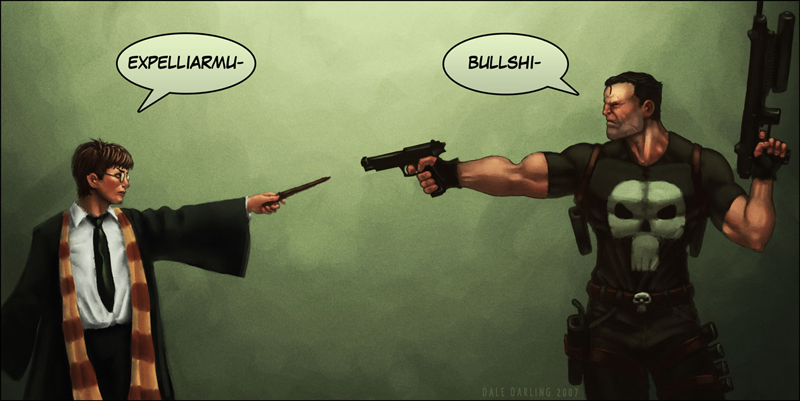
Oh, and a giveaway:
- Blood of the Muse has a copy of the Perfect Dark comic to give away.
Reader Question: How do I get ARCs/galleys easily?
This one was sent to me by LibraryDad via twitter. I think this is one of those questions that eventually gets asked by someone somewhere. Those of us who review books, whether professionally or as amateurs, love getting advanced reader copies (ARCs or galleys). I'm not entirely sure why. I like them because it's nice to know I have one of the first printed copies if a particular book turns out to be a favorite (such as Sly Mongoose, which you should all go buy, because Mr. Buckell recently had twins and could use the extra royalties). But how do you get them?
I'll be honest that I don't think there's an easy answer or even a preferable answer here. I can only say the truth of the matter. There is no way to get ARCs easily, especially not through publishers. Publishers are not going to send free books to anyone. It costs them money not only to print out the book, but also to ship it to you, all on some hope that your review will bring them enough sales to cover it. There has to be some sort of discernible influence bloggers have on sales, otherwise I don't think publishers would keep sending us books.
Here are some key factors that can help you get books from publishers, particularly ARCs:
Assuming you have a following, you review on some sort of timely schedule, and haven't pissed off all the publishers, the next order of the day is actually contacting publishers. My recommendation is either follow their procedures for review requests, if they have any, or read books from that publisher, review them, and let the author know. Either way can work, but neither is a guarantee. All I know is that I have done it both ways and been relatively successful.
It should be noted here that your intention should never be to simply get free books (particularly ARCs/galleys). ARCs are sent out specifically to be reviewed. Publishers are usually aware that reviewers can't review everything, but that doesn't mean you should never review the books. This isn't about showing off that you got a bunch of free books; it's about providing a service for publishers while doing something you like. If you just want to read books and have some collectibles, then you need to find ARCs in some of these ways:
ARCs are sort of like crack for reviewers, I suppose. Most of us love them, even desire them. And there's nothing like getting books in the mail. One of my favorite things is when there's a bubble envelope sitting in the mailbox waiting for me to open it. It doesn't matter if I've had a bad day, that can really cheer me up.
Hopefully that answers the question. This is sort of a short "how to" for reviewing in general, but so be it.
Anyone else out there have advice on this matter? Is there a magical easy way to get ARCs? I don't think signing up for contests is necessarily an easy way, because it's random, but maybe that's the easiest method to get your hands on these things.
Anywho. If you have a question you'd like me to answer, feel free to send it to arconna[at]yahoo[dot]com, or leave it as a comment, or send it as a twitter message with @shaunduke at the front of the message. Thanks!
I'll be honest that I don't think there's an easy answer or even a preferable answer here. I can only say the truth of the matter. There is no way to get ARCs easily, especially not through publishers. Publishers are not going to send free books to anyone. It costs them money not only to print out the book, but also to ship it to you, all on some hope that your review will bring them enough sales to cover it. There has to be some sort of discernible influence bloggers have on sales, otherwise I don't think publishers would keep sending us books.
Here are some key factors that can help you get books from publishers, particularly ARCs:
- A platform for reviews.
This can be in the form of a blog, a website, etc. It needs to be something that can be navigated and has a way to view the reviews. Don't bury them in the abyss. - A niche.
This isn't necessary, but it helps if you have a specific kind of book you read. That helps them target to you and to your readers. This is more about not being a "I read every single thing in the universe" type person. I mean, if you read everything, great, but I've yet to see a successful blog/website that wasn't clearly divided into sections that focused on everything. - A back catalogue of reviews.
Basically, you need to have actually done some reviews. You're not going to get much from publishers if you haven't actually done something productive in the reviewing community. - An online following of some significance.
They are not going to send you books if you get 25 unique hits a month. Not unless you win some from them. You need to have some sort of steady, significant traffic. This doesn't need to be thousands of people, but it does need to be something they can figure into potential sales. The blog that I post my reviews on (run by the awesome SQT) gets a fair amount of traffic (more than I get here, actually). It also has a vibrant community. These things make it a website publishers will turn to for reviews (well, they won't come to you, but you know what I mean), because, presumably, SQT's blog brings them sales and exposure in a quantity that matters.
Oh, and this takes a lot of time and effort. And even with that, there's no guarantee you'll ever succeed in creating a following. I've been at this for three years and while I love my readers, there aren't a whole lot of them. Those that have stuck with me for a while certainly deserve kudos, though. You guys are awesome.
Assuming you have a following, you review on some sort of timely schedule, and haven't pissed off all the publishers, the next order of the day is actually contacting publishers. My recommendation is either follow their procedures for review requests, if they have any, or read books from that publisher, review them, and let the author know. Either way can work, but neither is a guarantee. All I know is that I have done it both ways and been relatively successful.
It should be noted here that your intention should never be to simply get free books (particularly ARCs/galleys). ARCs are sent out specifically to be reviewed. Publishers are usually aware that reviewers can't review everything, but that doesn't mean you should never review the books. This isn't about showing off that you got a bunch of free books; it's about providing a service for publishers while doing something you like. If you just want to read books and have some collectibles, then you need to find ARCs in some of these ways:
- Garage sales, used bookstores (which technically shouldn't be selling them), ebay, and other places like that.
- Friends
- Giveaways (blogs, publishers, authors, etc.).
ARCs are sort of like crack for reviewers, I suppose. Most of us love them, even desire them. And there's nothing like getting books in the mail. One of my favorite things is when there's a bubble envelope sitting in the mailbox waiting for me to open it. It doesn't matter if I've had a bad day, that can really cheer me up.
Hopefully that answers the question. This is sort of a short "how to" for reviewing in general, but so be it.
Anyone else out there have advice on this matter? Is there a magical easy way to get ARCs? I don't think signing up for contests is necessarily an easy way, because it's random, but maybe that's the easiest method to get your hands on these things.
Anywho. If you have a question you'd like me to answer, feel free to send it to arconna[at]yahoo[dot]com, or leave it as a comment, or send it as a twitter message with @shaunduke at the front of the message. Thanks!
Sunday, April 19, 2009
Reader Question: Why Science Fiction?
This is an interesting question submitted by Perry on Facebook. The reason it's interesting is because I'm not sure what it's asking. It could be asking several different things at once, such as:
Why do you like science fiction?
One of the great things about science fiction is that it never ceases to amaze me. While the genre has largely lost it's "wow" factor in the world, it is still a genre full of new and fresh ideas. The reason I like science fiction as much as I do is because I find the genre fascinating, whether it be far-future space opera or near-future hard SF. As a genre of ideas, it is one that constantly challenges me to rethink the world I live in, and the world I will one day live in, to rethink who I am and what it means to be human. Since my academic interests are invested in the notion of "the human," this is a perfect genre for bringing up difficult issues to deal with, particularly about humanity and the other (whatever that other might be).
I also happen to like spaceships and space battles. I like explosions and aliens and all the nifty cliches of the genre. It's sort of hard not to for me. I'm also a big fan of science, even if I am not, and never will be, a scientist. Science fiction either approaches science from a realistic perspective or from a perspective that takes liberty with reality. But in true science fiction, science is always there in some capacity. As an avid fan of science, science fiction lets me see an author's vision of the future based on where we are now; it's also fascinating to see how science fiction and reality blend together.
So, to put it simply: I like science fiction because it is the one genre that offers me everything I want in one package.
Why do I write/blog about science fiction?
I blog about a lot of things, but science fiction is certainly the big one. Fantasy and writing are pretty much tied for second place, I suppose. Blogging is, in part, an extension of what I want to do professionally. It's an avenue through which I can express my opinions on the genre and converse with other fans, etc. I can't exactly go down the street and find a big science fiction fan club to hang out in--I'm not even sure we have one in Santa Cruz. Blogging is basically the best way I have of communicating with folks interested in the same subjects as myself. And since I am going to be spending most of my academic career studying science fiction and its related genres, I find a blog is a healthy way of excavating ideas, thoughts, opinions, etc.--even if they're not particularly good ideas, thoughts, or opinions.
I write science fiction for an entirely different reason, though. I cannot for the life of me write anything but speculative fiction (science fiction, fantasy, etc.). If I start writing a story about the real world, I tune out. Getting excited about such things is impossible for me. The real world is too bland for my tastes, which probably says a lot about my tastes when there is so much going on in this world these days. But that's the truth. When I write normal fiction, I'm pretty much bored after sentence two; when I write science fiction or fantasy, it's a whole other story. I get excited about writing stories where I get to express my ideas of the future, or fiddle with concepts of humanity, etc. There's something purely enjoyable about writing in this genre. Maybe it's just me and I have some sort of ultra-fantasy gene. Whatever the internal or genetic reason, I write science fiction because I enjoy it. Period.
Why science fiction and not something else?
Well, I do like fantasy and related genres, but I am generally uninterested in fiction that is not fantastic in some way. The reason is that I find real life boring. I don't mean my real life, but real life as it pertains to fiction. There's nothing entertaining about people going through regular everyday things. I don't particularly care about anything to do with the real world, as far as fiction is concerned (non-fiction is an entirely different story). The thing is, I live in real life; I don't want to read about it.
For this reason, I am interested in science fiction and related genres both personally and professionally. I am fascinated by the fantastic, by spaceships and dragons and anything that lies in the cracks. If there isn't some sort of speculative premise in a story, I'm unlikely to read it with much enthusiasm. My tastes do change, though, and there are exceptions to this (Thomas Pynchon and a few African authors are good exceptions), but for the most part I stick to my guns on speculative fiction.
And that's that. Thanks for the question, Perry. Now I'll throw it out to all of you. Why science fiction? Or, if science fiction isn't your thing, why whatever you read (fantasy, horror, etc.)?
If you'd like to send me a question, you can email it to me at arconna[at]yahoo[dot]com, leave it as a comment here or anywhere, or send it as a twitter message with @shaunduke at the front of the message. Thanks.
- Why do you like science fiction?
- Why do you write/blog about science fiction?
- Why science fiction and not something else?
Why do you like science fiction?
One of the great things about science fiction is that it never ceases to amaze me. While the genre has largely lost it's "wow" factor in the world, it is still a genre full of new and fresh ideas. The reason I like science fiction as much as I do is because I find the genre fascinating, whether it be far-future space opera or near-future hard SF. As a genre of ideas, it is one that constantly challenges me to rethink the world I live in, and the world I will one day live in, to rethink who I am and what it means to be human. Since my academic interests are invested in the notion of "the human," this is a perfect genre for bringing up difficult issues to deal with, particularly about humanity and the other (whatever that other might be).
I also happen to like spaceships and space battles. I like explosions and aliens and all the nifty cliches of the genre. It's sort of hard not to for me. I'm also a big fan of science, even if I am not, and never will be, a scientist. Science fiction either approaches science from a realistic perspective or from a perspective that takes liberty with reality. But in true science fiction, science is always there in some capacity. As an avid fan of science, science fiction lets me see an author's vision of the future based on where we are now; it's also fascinating to see how science fiction and reality blend together.
So, to put it simply: I like science fiction because it is the one genre that offers me everything I want in one package.
Why do I write/blog about science fiction?
I blog about a lot of things, but science fiction is certainly the big one. Fantasy and writing are pretty much tied for second place, I suppose. Blogging is, in part, an extension of what I want to do professionally. It's an avenue through which I can express my opinions on the genre and converse with other fans, etc. I can't exactly go down the street and find a big science fiction fan club to hang out in--I'm not even sure we have one in Santa Cruz. Blogging is basically the best way I have of communicating with folks interested in the same subjects as myself. And since I am going to be spending most of my academic career studying science fiction and its related genres, I find a blog is a healthy way of excavating ideas, thoughts, opinions, etc.--even if they're not particularly good ideas, thoughts, or opinions.
I write science fiction for an entirely different reason, though. I cannot for the life of me write anything but speculative fiction (science fiction, fantasy, etc.). If I start writing a story about the real world, I tune out. Getting excited about such things is impossible for me. The real world is too bland for my tastes, which probably says a lot about my tastes when there is so much going on in this world these days. But that's the truth. When I write normal fiction, I'm pretty much bored after sentence two; when I write science fiction or fantasy, it's a whole other story. I get excited about writing stories where I get to express my ideas of the future, or fiddle with concepts of humanity, etc. There's something purely enjoyable about writing in this genre. Maybe it's just me and I have some sort of ultra-fantasy gene. Whatever the internal or genetic reason, I write science fiction because I enjoy it. Period.
Why science fiction and not something else?
Well, I do like fantasy and related genres, but I am generally uninterested in fiction that is not fantastic in some way. The reason is that I find real life boring. I don't mean my real life, but real life as it pertains to fiction. There's nothing entertaining about people going through regular everyday things. I don't particularly care about anything to do with the real world, as far as fiction is concerned (non-fiction is an entirely different story). The thing is, I live in real life; I don't want to read about it.
For this reason, I am interested in science fiction and related genres both personally and professionally. I am fascinated by the fantastic, by spaceships and dragons and anything that lies in the cracks. If there isn't some sort of speculative premise in a story, I'm unlikely to read it with much enthusiasm. My tastes do change, though, and there are exceptions to this (Thomas Pynchon and a few African authors are good exceptions), but for the most part I stick to my guns on speculative fiction.
And that's that. Thanks for the question, Perry. Now I'll throw it out to all of you. Why science fiction? Or, if science fiction isn't your thing, why whatever you read (fantasy, horror, etc.)?
If you'd like to send me a question, you can email it to me at arconna[at]yahoo[dot]com, leave it as a comment here or anywhere, or send it as a twitter message with @shaunduke at the front of the message. Thanks.
RIP: J. G. Ballard
According to the BBC, Mr. Ballard passed away from an illness (not sure which) at the age of 78. He was the author of classics such as Crash and Empire of the Sun.
He will be missed.
He will be missed.
SF/F Links: Some More April Goodies
I have a few more links for you all, including some book reviews. Here goes:
- Self-Published Reviews has a discussion of self-publishing that isn't exactly rosy.
- WebEcoist has a list of 12 dystopian science fiction films you should all check out. There are a few in there I've never heard of, but now want to see.
- David Steffen asks: What is "literary?" He makes some great points worth considering.
- ShareWorlds (a world-building workshop for teenagers) is back for 2009.
- Mary Robinette Kowal has a top ten list of evil queens. It's a bit old, but still cool.
- The Plenty Principle asks if science fiction is finished as a genre (from a reader's perspective).
- OnlineColleges.net has an interesting list of fifteen of the strangest college courses in America. Some of these courses really are completely pointless, but a handful I'd take in a heartbeat, because they sound fascinating!
And some book giveaways:
- J. Kaye's Book Blog has a copy of Once Bitten by Kalayna Price to giveaway. She also has a copy of The Chosen One by Carol Lynch Williams to toss out there.
- Reviewer X has a copy of Silver Phoenix by Cindy Pon to giveaway.
And there you go. Enjoy!
Saturday, April 18, 2009
Starting Anew in the Writing Stew
Okay, so the title is a bad attempt at rhyming, but so be it. It's been some time since I last had an update about my writing (with exception to my posts about my rejections). With that in mind, I thought it was high time to give you all an update on what is going on with my writing.
First things first, I made a resolution of sorts at the beginning of the year that I was going to write 200,000 words this year. I came close last year and thought it would be a good challenge. Thus far I have reached 42,727. I'm a bit behind. By April 1st I should have been at 50,000 words. Considering that I am currently in the middle of school, though, I can safely say I'm not doing so bad. I can make up for lost writing time somewhat this quarter and certainly over summer.
The second thing was also on my resolutions list. I said I wanted to have twenty-five works of fiction in the submission queue. I currently have eleven, with at least three more in the editing stage that should be ready to go in the next month or so. That means I'm close, which is good.
The third thing is in relation to my writing style. I'm going to write more about this at another time, because I think it's important. The short version is that over the last six months or so I have been changing my style. This has come largely as a result of the the reading for this academic year at UC Santa Cruz. A lot of writers I had never read before have been influencing me in ways I never expected. And I think it's a good thing.
Lastly, I'd like to briefly mention all the nifty writing projects I've started up. I've got several new short stories in the works (some particularly strange ones, actually), and I've started fiddling with a novel I've been meaning to write for a while called Liminal Spaces. The novel is largely an experiment, which means I'll only be picking at it here and there. It's a science fiction romantic tragedy, meaning it'll have a love story that will end poorly for the main characters.
I think that's it. Any questions?
First things first, I made a resolution of sorts at the beginning of the year that I was going to write 200,000 words this year. I came close last year and thought it would be a good challenge. Thus far I have reached 42,727. I'm a bit behind. By April 1st I should have been at 50,000 words. Considering that I am currently in the middle of school, though, I can safely say I'm not doing so bad. I can make up for lost writing time somewhat this quarter and certainly over summer.
The second thing was also on my resolutions list. I said I wanted to have twenty-five works of fiction in the submission queue. I currently have eleven, with at least three more in the editing stage that should be ready to go in the next month or so. That means I'm close, which is good.
The third thing is in relation to my writing style. I'm going to write more about this at another time, because I think it's important. The short version is that over the last six months or so I have been changing my style. This has come largely as a result of the the reading for this academic year at UC Santa Cruz. A lot of writers I had never read before have been influencing me in ways I never expected. And I think it's a good thing.
Lastly, I'd like to briefly mention all the nifty writing projects I've started up. I've got several new short stories in the works (some particularly strange ones, actually), and I've started fiddling with a novel I've been meaning to write for a while called Liminal Spaces. The novel is largely an experiment, which means I'll only be picking at it here and there. It's a science fiction romantic tragedy, meaning it'll have a love story that will end poorly for the main characters.
I think that's it. Any questions?
Book Review Up: Brave Men Run by Matthew Selznick
Oh yeah, another review. I'm doing good this week. Well, kinda. Technically I've had this read for a while, but so be it.
Check out the review here.
Anywho!
Friday, April 17, 2009
Book Review Up: Shambling Towards Hiroshima by James Morrow
Another review is up! This is an interesting one too, sort of a strange pulp fiction meets monster movie kind of thing.
Check it out here.
Thursday, April 16, 2009
Video Found: Muppets vs. Zombies
(Stolen from SF Signal).
This is possibly one of the most brilliant and hilarious videos I have seen. Muppets and zombies in the same video? Nothing short of awesome.
Enjoy:
This is possibly one of the most brilliant and hilarious videos I have seen. Muppets and zombies in the same video? Nothing short of awesome.
Enjoy:
Uberman Superhero
Some of you I've been applying to scholarships for graduate school. This post is actually for one of my scholarships: TheUberman.com "I AM a superhero" Scholarship. I thought I'd go with something a bit, well, humorous for this. In any case, enjoy:
I am Gauisus, the United Nation's designated superhero. The problem with being like me is that you're always the butt of someone's joke. You see, my name means "happy" in Latin, because I can fabricate happiness out of thin air. And I don't mean the hearty chuckle variety of happiness, or even the hippy, high-as-a-kite kind. I mean the kind of happiness you find in a laughing child: that pure, innocent, and unimaginable sensation forgotten by adulthood, concentrated into a thick, happy syrup and injected straight into the veins. It's like an adrenaline shot of happiness, but without the side effects.
I've stopped wars by turning grumpy politicians into crying bundles of hugs and apologies; selfish oil barons, isolationists, and xenophobes have turned into environmentally and socially conscious progressives. Everyone I target has an experience, a moment of clarity in which they begin to realize that things really do need to change.
But this is all standard superhero fare. The more interesting stuff occurs at the UN. I'm not welcome there anymore, because the politicians are unable to get riled up, to toss insults or argue relentlessly about things they think are important--distributing happiness like crack to politicians can have that effect. Most of the meetings end in people hugging and some superpower vowing to solve a humanitarian problem--poverty, disease, theft by monkeys, you name it.
My ability doesn't always work, but that's life. Injecting happiness into people is at least changing the dynamics of the world, creating new generations of people willing to pay attention, rather than stick their heads in the sand. All the hugs and laughter are making people see the world through someone else's shoes and bring to reality why it doesn't matter that we're all different: because we're all human beings.
I am Gauisus, the United Nation's designated superhero. The problem with being like me is that you're always the butt of someone's joke. You see, my name means "happy" in Latin, because I can fabricate happiness out of thin air. And I don't mean the hearty chuckle variety of happiness, or even the hippy, high-as-a-kite kind. I mean the kind of happiness you find in a laughing child: that pure, innocent, and unimaginable sensation forgotten by adulthood, concentrated into a thick, happy syrup and injected straight into the veins. It's like an adrenaline shot of happiness, but without the side effects.
I've stopped wars by turning grumpy politicians into crying bundles of hugs and apologies; selfish oil barons, isolationists, and xenophobes have turned into environmentally and socially conscious progressives. Everyone I target has an experience, a moment of clarity in which they begin to realize that things really do need to change.
But this is all standard superhero fare. The more interesting stuff occurs at the UN. I'm not welcome there anymore, because the politicians are unable to get riled up, to toss insults or argue relentlessly about things they think are important--distributing happiness like crack to politicians can have that effect. Most of the meetings end in people hugging and some superpower vowing to solve a humanitarian problem--poverty, disease, theft by monkeys, you name it.
My ability doesn't always work, but that's life. Injecting happiness into people is at least changing the dynamics of the world, creating new generations of people willing to pay attention, rather than stick their heads in the sand. All the hugs and laughter are making people see the world through someone else's shoes and bring to reality why it doesn't matter that we're all different: because we're all human beings.
Wednesday, April 15, 2009
The iTunes Meme
(Discovered here)
This has been making the rounds, so I thought I would jump in. I don't have iTunes, so I will be using my Creative Zen Vision:M, since I think the former is an evil piece of hardware placed on this planet to destroy mankind.
Here are the rules:
1. Put your iTunes, Windows Media Player, etc. on shuffle.
2. For each question, press the next button to get your answer.
3. YOU MUST WRITE THAT SONG NAME DOWN NO MATTER HOW SILLY IT SOUNDS.
4. Feel free to steal this for your blog (just link to whomever you stole it from).
5. Have Fun!
IF SOMEONE SAYS 'ARE YOU OKAY' YOU SAY?
"The Wardrobe" from The Chronicles of Narnia (apparently gay jokes are in order).
HOW WOULD YOU DESCRIBE YOURSELF
"If Baseballs Had AIDS" by David Cross (not kidding).
WHAT DO YOU LIKE IN A GUY/GIRL?
"Voyager" by Immediate Music (I'm sure that's some sort of metaphor...).
HOW DO YOU FEEL TODAY?
"Exhale" by System F (apparently I feel like breathing, which is good).
WHAT IS YOUR LIFE'S PURPOSE?
"The Breakdown" by trance[]control (not exactly glorified, now is it?).
WHAT'S YOUR MOTTO?
"I Don't Know" by Lostprophets (well that fits).
WHAT DO YOUR FRIENDS THINK OF YOU?
"The Beat Goes On" by trance[]control (that seems fitting).
WHAT DO YOUR PARENTS THINK OF YOU?
"All of My Life" by Aluna (which also seems fitting, since my mother can't get rid of me.)
WHAT DO YOU THINK ABOUT VERY OFTEN?
"Loose Lips Sink Ships" by A Change of Pace (sounds wrong to me).
WHAT DO YOU THINK OF YOUR BEST FRIEND?
"Boulevard of Broken Dreams" by Green Day (oh man, what a wonderful way to put it).
WHAT IS YOUR LIFE STORY?
"Prom Night With Melinda" by David Cross (I don't know what that means).
WHAT DO YOU WANT TO BE WHEN YOU GROW UP?
"Hands Up" by Lagoona (yeah...).
WHAT WILL THEY PLAY AT YOUR FUNERAL?
"Sunrise at Palamos" by M.I.K.E. (not a bad tune for that).
WHAT IS YOUR HOBBY/INTEREST?
"Darkpop" by The Higher (if you can tell me what a Darkpop is, please do).
WHAT IS YOUR BIGGEST FEAR?
"The Quest" by Immediate Music (well that's crap; I totally want to go on quests).
WHAT IS YOUR BIGGEST SECRET?
"Social Suicide" by Carl B (ain't that the truth).
WHAT DO YOU WANT RIGHT NOW?
"Waking Up Inside My Own Paralysis" by Funeral For a Friend (apparently that's what I'm doing instead of this).
WHAT DO YOU THINK OF YOUR FRIENDS?
"Hymn" by Immediate Music (so, I think that they are a religious tune).
WHAT WILL YOU POST THIS AS?
"Atrophy" by The Red Jumpsuit Apparatus (wonderful).
Well, there you go. This is sort of hard when you have over 2,000 songs on one little mp3 player, but so be it. Maybe I'll redo this in the future and only use rock music.
Anywho!
This has been making the rounds, so I thought I would jump in. I don't have iTunes, so I will be using my Creative Zen Vision:M, since I think the former is an evil piece of hardware placed on this planet to destroy mankind.
Here are the rules:
1. Put your iTunes, Windows Media Player, etc. on shuffle.
2. For each question, press the next button to get your answer.
3. YOU MUST WRITE THAT SONG NAME DOWN NO MATTER HOW SILLY IT SOUNDS.
4. Feel free to steal this for your blog (just link to whomever you stole it from).
5. Have Fun!
IF SOMEONE SAYS 'ARE YOU OKAY' YOU SAY?
"The Wardrobe" from The Chronicles of Narnia (apparently gay jokes are in order).
HOW WOULD YOU DESCRIBE YOURSELF
"If Baseballs Had AIDS" by David Cross (not kidding).
WHAT DO YOU LIKE IN A GUY/GIRL?
"Voyager" by Immediate Music (I'm sure that's some sort of metaphor...).
HOW DO YOU FEEL TODAY?
"Exhale" by System F (apparently I feel like breathing, which is good).
WHAT IS YOUR LIFE'S PURPOSE?
"The Breakdown" by trance[]control (not exactly glorified, now is it?).
WHAT'S YOUR MOTTO?
"I Don't Know" by Lostprophets (well that fits).
WHAT DO YOUR FRIENDS THINK OF YOU?
"The Beat Goes On" by trance[]control (that seems fitting).
WHAT DO YOUR PARENTS THINK OF YOU?
"All of My Life" by Aluna (which also seems fitting, since my mother can't get rid of me.)
WHAT DO YOU THINK ABOUT VERY OFTEN?
"Loose Lips Sink Ships" by A Change of Pace (sounds wrong to me).
WHAT DO YOU THINK OF YOUR BEST FRIEND?
"Boulevard of Broken Dreams" by Green Day (oh man, what a wonderful way to put it).
WHAT IS YOUR LIFE STORY?
"Prom Night With Melinda" by David Cross (I don't know what that means).
WHAT DO YOU WANT TO BE WHEN YOU GROW UP?
"Hands Up" by Lagoona (yeah...).
WHAT WILL THEY PLAY AT YOUR FUNERAL?
"Sunrise at Palamos" by M.I.K.E. (not a bad tune for that).
WHAT IS YOUR HOBBY/INTEREST?
"Darkpop" by The Higher (if you can tell me what a Darkpop is, please do).
WHAT IS YOUR BIGGEST FEAR?
"The Quest" by Immediate Music (well that's crap; I totally want to go on quests).
WHAT IS YOUR BIGGEST SECRET?
"Social Suicide" by Carl B (ain't that the truth).
WHAT DO YOU WANT RIGHT NOW?
"Waking Up Inside My Own Paralysis" by Funeral For a Friend (apparently that's what I'm doing instead of this).
WHAT DO YOU THINK OF YOUR FRIENDS?
"Hymn" by Immediate Music (so, I think that they are a religious tune).
WHAT WILL YOU POST THIS AS?
"Atrophy" by The Red Jumpsuit Apparatus (wonderful).
Well, there you go. This is sort of hard when you have over 2,000 songs on one little mp3 player, but so be it. Maybe I'll redo this in the future and only use rock music.
Anywho!
Tuesday, April 14, 2009
AmazonFail: Another Company Being Stupid
It's apparently been going on for a few weeks, but it's only just exploded in epic proportions in the blogosphere in the last day or so (as far as I know). What is it? I'll give you the short version:
I was shocked when I first heard about it this morning. I don't know if this whole ordeal was done with any malicious intent; it probably wasn't. Maybe it was a glitch after all, but you'd think a company as big and influential as Amazon would have tested this thing before implementing it, or at least took the notices sent to them by angry customers seriously when this all began.
I'm going to keep this post short primarily because it seems like Amazon is going to fix the problem. If things don't improve, I think we can all begin to speculate on why Amazon is pandering to the whims of the religious right. Right now, it doesn't seem like there is much more to say other than pointing to the rants and angry posts of others. Am I upset by this? Yes, actually. Amazon better get its act together soon or they could end up with a hell storm on their doorstep. We'll see what happens in the next week.
Anyone out there have any thoughts? Feel free to leave a comment!
Amazon essentially changed he way they list books on their best seller's list, search feature, and the site in general, by removing sales information (specifically ranks) from books deemed to be "adult." They apparently wanted to make it so "adult" books could not end up on the best seller's list (and other reasons, I'm sure). Only, Amazon has seemingly gone off the deep end by removing sales ranks from a heck of a lot of books that are not only not adult at all (at least not compared to the stuff they've been letting through, such as American Psycho), but happen to have LGBT (lesbian/gay/bisexual/transgender) themes or characters (a good example of how stupid this is can be found here, where a non-fiction book was cut off, while a violent, bloody fiction book was not).So, Twitter and the blogosphere (and all sorts of online news agencies) are throwing a fit over this, and rightly so (one fellow has even written an open letter to Amazon about the whole ordeal). Yes, there are a lot of links in that sentence--to highlight the enormity of this, I assure you. Amazon has apparently blamed this on a glitch in the system, but most are calling B.S. on that, and rightly so.
I was shocked when I first heard about it this morning. I don't know if this whole ordeal was done with any malicious intent; it probably wasn't. Maybe it was a glitch after all, but you'd think a company as big and influential as Amazon would have tested this thing before implementing it, or at least took the notices sent to them by angry customers seriously when this all began.
I'm going to keep this post short primarily because it seems like Amazon is going to fix the problem. If things don't improve, I think we can all begin to speculate on why Amazon is pandering to the whims of the religious right. Right now, it doesn't seem like there is much more to say other than pointing to the rants and angry posts of others. Am I upset by this? Yes, actually. Amazon better get its act together soon or they could end up with a hell storm on their doorstep. We'll see what happens in the next week.
Anyone out there have any thoughts? Feel free to leave a comment!
Monday, April 13, 2009
Red Dwarf: Back to Earth
WARNING: Huge spoiler alerts and ranting ahead.
I was nervously awaiting RD:BTE. I wanted it to be great but expected it to be shocking. Then I saw the adverts and thought it'd be even worse than that. Then I watched the first episode, and thought maybe it was okay. Then I watched the second and refused to watch the third. Luckily, my friend convinced me to give it another shot, and I watched the whole thing back-to-back and it (almost) worked. But then again, it almost completely failed too. Here's why.
1. Audiences were initially shocked at the crew. Where were Kochanski and Holly? Why was Rimmer a hologram again? Kochanski and Holly's absences were explained, and became explicitly clear by the end of the mini-series, so I got over that. Also, it's understandable why Rimmer was a hologram. He was the only crew member stuck on the decaying ship in the original reality at the end of series eight. Everyone else had crossed into the mirror universe. It's feasible to imagine Rimmer died with the crew, although it doesn't explain how he became hardlight (the hardlight drive was developed after Red Dwarf was built and left the solar system) or has memories of the events the previous hologrammatic Arnold Rimmer had (unless, somehow, Holly has updated his memory and personality files based on the logs of Red Dwarf and Starbug from the past few years).
2. Pace. Put simply, in part one there was none. As an episode, it felt entirely like build-up for something else. There were a few good jokes, but they were too sparse, and the CGI sets were too obtrusive. But I hate CGI in general, because I believe it lacks the fullness, body and texture of models and physical structures. Indeed, the whole thing feels like a movie chopped into three parts, because the pacing is slow and the narrative wallows and wanders a bit. It never feels it's going anywhere or is in any rush to do so, until the last 15 mins of episode three.
3. Episode 2. This was scary stuff on first viewing. 'What, the whole of Red Dwarf was a *fucking* dream?' (Well, actually, it was a TV series, and the characters have escaped the TV programme to enter the real world.) This was the same metafictional plot of The League of Gentlemen, and it didn't work for that franchise either. Luckily, episode three redeems the series, but you'd be forgiven for switching off in a rage. I was so appalled I wanted to cry.
4. Coronation Street. When Lister arrives on Coronation Street (which actor Craig Charles currently appears in), I groaned. This was the worst kind of cross-merchandising, self-referential bullshit I could think of, I thought. I cringed and winced and wanted to die. But my friend had spoiled the ending (thankfully), so I could take a deep breath and watch it, knowing it would soon be over.
What saved the entired trio of episodes was the last half of episode three. We discover, thankfully, that this is a reworking of Back to Reality. We should've guessed from the title and the squid, right? But apparently we didn't (not all of us, or at least, not right away). It makes sense, though, since Back to Reality was voted fans' favourite ever episode.
And here's the big spoiler: the squid was a female despair squid (a 'joy' squid), whose own ink is the opposite of the male's. Instead of inspiring despair, it creates joyous hallucinations where all the dreamer's desires come true. So in this world Kochanski is still with us and even when Lister realises he's in a hallucination, he initially decides to die with Kochanski in the dreamworld. It's only when he realises Kochanski is still alive, and Kryten staged her death to hide the fact she dumped him, that he eventually decides he can win the real Kochanski back and leaves the dream world.
Apparently, all four of the heroes have an immunity to the ink from their previous encounter with the squid, which allows them a degree of agency and awareness in the dream, and thus the ability to wake up. Of course, for Rimmer to have this immunity, Holly was either a very clever computer, who altered Rimmer's hardlight 'biology' to account for his experiences, or he's the same Rimmer who left to become Ace in 'Stoke Me a Clipper'.
The Blade Runner references were nice but blatant, although far preferable to the Coronation Street ones and the scenes where Lister and co find their own Red Dward TV show DVDs. The dialogue was less infantile than series eight, though not as sharp as series six (perhaps more like series seven). The special effects were neither here or nor there.
So overall it wasn't too bad. Two thirds of it were annoying at first, but the final revelation is interesting, if not original. Especially when Kryten reveals that the reality of their hallucination has, because of multiverse theory, become real. Effectively there is a new universe where people believe Red Dwarf is a TV show, which is actually not quite real itself (i.e., our world is born of their hallucination and theirs is the 'real' world). This salvages some of the more awkward moments, and the gags soften the blow somewhat along the way.
Obviously, it's a far cry from the excellent comedy of previous series, and continues the tread into comedy drama over sit com territory, but it's not as bad as I initially thought. Furthermore, it does show promise that Doug Naylor has some really great plot twists in his head, albeit ones that rely on hackneyed stories in the first place. I would have preferred something more daring, but whatever.
A mixed bag, but worth a watch when it comes out on DVD (most likely in an unedited film-length version, which would be much better).
I was nervously awaiting RD:BTE. I wanted it to be great but expected it to be shocking. Then I saw the adverts and thought it'd be even worse than that. Then I watched the first episode, and thought maybe it was okay. Then I watched the second and refused to watch the third. Luckily, my friend convinced me to give it another shot, and I watched the whole thing back-to-back and it (almost) worked. But then again, it almost completely failed too. Here's why.
1. Audiences were initially shocked at the crew. Where were Kochanski and Holly? Why was Rimmer a hologram again? Kochanski and Holly's absences were explained, and became explicitly clear by the end of the mini-series, so I got over that. Also, it's understandable why Rimmer was a hologram. He was the only crew member stuck on the decaying ship in the original reality at the end of series eight. Everyone else had crossed into the mirror universe. It's feasible to imagine Rimmer died with the crew, although it doesn't explain how he became hardlight (the hardlight drive was developed after Red Dwarf was built and left the solar system) or has memories of the events the previous hologrammatic Arnold Rimmer had (unless, somehow, Holly has updated his memory and personality files based on the logs of Red Dwarf and Starbug from the past few years).
2. Pace. Put simply, in part one there was none. As an episode, it felt entirely like build-up for something else. There were a few good jokes, but they were too sparse, and the CGI sets were too obtrusive. But I hate CGI in general, because I believe it lacks the fullness, body and texture of models and physical structures. Indeed, the whole thing feels like a movie chopped into three parts, because the pacing is slow and the narrative wallows and wanders a bit. It never feels it's going anywhere or is in any rush to do so, until the last 15 mins of episode three.
3. Episode 2. This was scary stuff on first viewing. 'What, the whole of Red Dwarf was a *fucking* dream?' (Well, actually, it was a TV series, and the characters have escaped the TV programme to enter the real world.) This was the same metafictional plot of The League of Gentlemen, and it didn't work for that franchise either. Luckily, episode three redeems the series, but you'd be forgiven for switching off in a rage. I was so appalled I wanted to cry.
4. Coronation Street. When Lister arrives on Coronation Street (which actor Craig Charles currently appears in), I groaned. This was the worst kind of cross-merchandising, self-referential bullshit I could think of, I thought. I cringed and winced and wanted to die. But my friend had spoiled the ending (thankfully), so I could take a deep breath and watch it, knowing it would soon be over.
What saved the entired trio of episodes was the last half of episode three. We discover, thankfully, that this is a reworking of Back to Reality. We should've guessed from the title and the squid, right? But apparently we didn't (not all of us, or at least, not right away). It makes sense, though, since Back to Reality was voted fans' favourite ever episode.
And here's the big spoiler: the squid was a female despair squid (a 'joy' squid), whose own ink is the opposite of the male's. Instead of inspiring despair, it creates joyous hallucinations where all the dreamer's desires come true. So in this world Kochanski is still with us and even when Lister realises he's in a hallucination, he initially decides to die with Kochanski in the dreamworld. It's only when he realises Kochanski is still alive, and Kryten staged her death to hide the fact she dumped him, that he eventually decides he can win the real Kochanski back and leaves the dream world.
Apparently, all four of the heroes have an immunity to the ink from their previous encounter with the squid, which allows them a degree of agency and awareness in the dream, and thus the ability to wake up. Of course, for Rimmer to have this immunity, Holly was either a very clever computer, who altered Rimmer's hardlight 'biology' to account for his experiences, or he's the same Rimmer who left to become Ace in 'Stoke Me a Clipper'.
The Blade Runner references were nice but blatant, although far preferable to the Coronation Street ones and the scenes where Lister and co find their own Red Dward TV show DVDs. The dialogue was less infantile than series eight, though not as sharp as series six (perhaps more like series seven). The special effects were neither here or nor there.
So overall it wasn't too bad. Two thirds of it were annoying at first, but the final revelation is interesting, if not original. Especially when Kryten reveals that the reality of their hallucination has, because of multiverse theory, become real. Effectively there is a new universe where people believe Red Dwarf is a TV show, which is actually not quite real itself (i.e., our world is born of their hallucination and theirs is the 'real' world). This salvages some of the more awkward moments, and the gags soften the blow somewhat along the way.
Obviously, it's a far cry from the excellent comedy of previous series, and continues the tread into comedy drama over sit com territory, but it's not as bad as I initially thought. Furthermore, it does show promise that Doug Naylor has some really great plot twists in his head, albeit ones that rely on hackneyed stories in the first place. I would have preferred something more daring, but whatever.
A mixed bag, but worth a watch when it comes out on DVD (most likely in an unedited film-length version, which would be much better).
Science Fiction For Non-Readers?
This is one of those questions that has me really stumped. I know there have been posts on the net about this subject, but I can't say whether it has ever been answered. Often times when this question is asked science fiction fans blurt out a load of typical names and novels; rarely are these suggestions actually good ones (primarily because they're good suggestions for folks interested in expanding their horizons in the genre rather than for folks who have never liked the genre in the first place).
In thinking about this, I think it's fair to say that non-readers fall into two categories:
The first group, however, is the hard one. How do we get people who literally believe that science fiction is trash to read it? Do we point them to Isaac Asimov or Arthur C. Clarke? This is the problem. When we start making suggestions for non-readers, we often point to classic SF or even popular SF as if the popularity of the title will actually matter. But most of the titles we automatically suggest are not going to get these folks to read SF. Period. It will only serve to reinforce the idea that SF is trash. This isn't because SF is actually trash; it's because this particular group of readers considers considers SF to be so.
So what do we do? How do we get these folks to even consider SF? Do we point to 1984 and Margaret Atwood? What other books are there other than those in the canon (which isn't that many books anyway)? I don't know. I don't think there is an easy way through to this group; there are only a handful of books that they'd willingly read (and probably already have), and SF is not exactly rich with stylistically aware prose (in the sense that popular-styles are replaced with more complicated ones).
Do any of you have suggestions? How would you get through to this group? Can we get through to this group, or is it hopeless?
In thinking about this, I think it's fair to say that non-readers fall into two categories:
- Literary Readers
Folks who primarily read literary fiction or have particularly sophisticated tastes as far as literature is concerned. This group tends to hold general disdain for literature that focuses on plot rather than characters or style (and specifically all genre fiction and popular literary forms). - Popular Fiction Readers
Think anyone who reads the stuff on the best seller's list, but who have avoided science fiction or fantasy for whatever reason. Sometimes these sorts of readers have little book clubs and what not where they discuss Dan Brown and other such authors.
The first group, however, is the hard one. How do we get people who literally believe that science fiction is trash to read it? Do we point them to Isaac Asimov or Arthur C. Clarke? This is the problem. When we start making suggestions for non-readers, we often point to classic SF or even popular SF as if the popularity of the title will actually matter. But most of the titles we automatically suggest are not going to get these folks to read SF. Period. It will only serve to reinforce the idea that SF is trash. This isn't because SF is actually trash; it's because this particular group of readers considers considers SF to be so.
So what do we do? How do we get these folks to even consider SF? Do we point to 1984 and Margaret Atwood? What other books are there other than those in the canon (which isn't that many books anyway)? I don't know. I don't think there is an easy way through to this group; there are only a handful of books that they'd willingly read (and probably already have), and SF is not exactly rich with stylistically aware prose (in the sense that popular-styles are replaced with more complicated ones).
Do any of you have suggestions? How would you get through to this group? Can we get through to this group, or is it hopeless?
Sunday, April 12, 2009
A Fun Fantasy Quiz
(Found over at Fantasy Book Reviews)
1) Lord of the Rings: Movies or books?
In all honesty, I prefer the movies. I respect the books for what they are, but I hate reading them. The movies managed to take an exceedingly dull story and bring it to life. I'll always take the movies over the books.
2) Dragonlance or Forgotten Realms?
Dragonlance. I never got into the Forgotten Realms stuff.
3) Online bookstores or physical (local) bookstores?
Depends on the situation. If I'm buying books for school, I'll use Amazon. If I'm buying books for myself, I prefer physical stores because I get to actually touch the books and see them in real life. You can learn a lot about a book by actually touching it with your fingers (or smelling it).
4) Hardcover or paperback?
This depends too. I prefer hardback to trade paperback, primarily because the latter has a tendency to end up bent or in shoddy shape. But I prefer mass market paperback to hardback because I can get three mass markets for the price of one hardback. Seems logical, right?
5) Secondary World or Real World?
Hmm. Now this is a hard one. I don't think I can properly answer this. Are science fiction worlds representative of the real world? Or are they secondary? Or neither? If neither, then I'd have to say I prefer secondary worlds, even though I do happen to enjoy a lot of contemporary fantasy that takes place in our own world. If the real world is meant to be science fiction, then I prefer that to the other. It's a bit of a dilemma.
Well, there you go! Feel free to answer the questions in the comments or turn this into a meme and write a blog post!
1) Lord of the Rings: Movies or books?
In all honesty, I prefer the movies. I respect the books for what they are, but I hate reading them. The movies managed to take an exceedingly dull story and bring it to life. I'll always take the movies over the books.
2) Dragonlance or Forgotten Realms?
Dragonlance. I never got into the Forgotten Realms stuff.
3) Online bookstores or physical (local) bookstores?
Depends on the situation. If I'm buying books for school, I'll use Amazon. If I'm buying books for myself, I prefer physical stores because I get to actually touch the books and see them in real life. You can learn a lot about a book by actually touching it with your fingers (or smelling it).
4) Hardcover or paperback?
This depends too. I prefer hardback to trade paperback, primarily because the latter has a tendency to end up bent or in shoddy shape. But I prefer mass market paperback to hardback because I can get three mass markets for the price of one hardback. Seems logical, right?
5) Secondary World or Real World?
Hmm. Now this is a hard one. I don't think I can properly answer this. Are science fiction worlds representative of the real world? Or are they secondary? Or neither? If neither, then I'd have to say I prefer secondary worlds, even though I do happen to enjoy a lot of contemporary fantasy that takes place in our own world. If the real world is meant to be science fiction, then I prefer that to the other. It's a bit of a dilemma.
Well, there you go! Feel free to answer the questions in the comments or turn this into a meme and write a blog post!
Saturday, April 11, 2009
Show Review: Dollhouse (Final Comments)
I've officially tuned out on Dollhouse. I was initially incredibly excited about the show. I thought the concept was brilliant and that it had a lot of potential. Then the first episode came out. It was good, I thought, and at least established the characters, but nothing special. Then episode two failed to add anything new to the series, and shortly after than we were left with episodes three and four, which provided some interesting side plots, but stuck us with the mostly uninteresting Echo. And that's when I tuned out.
Granted, I am terribly picky about my TV shows. The problem with Dollhouse is that it fails to do what great shows like BSG have done: tell a good story. Dollhouse essentially doesn't have a story. True, the subplots were building up to make it seem like there was a lot of interesting things ahead, but instead of focusing on those stories, Dollhouse focused on Echo, who, after one episode, is essentially the most uninteresting and useless character. If she's become more interesting after episode four, wonderful, but I'm not going to waste any more time watching, because Dollhouse had the chance to get me interested and wasted it on four episodes where nothing happens. I simply don't care about Echo. I really don't. Her character is utterly pointless and not enough time is afforded to characters who deserve more.
Someone said (possibly Whedon or a producer) that you should stick with the show until episode seven to give it a good chance, but quite honestly if you can't keep me entertained past episode two, what point is there for me? I'm making an investment of my time (an hour each episode) and blowing seven hours on a show that I don't find all that great to begin with seems relatively pointless to me.
So, I suppose the question is: what do you all think of the show? Are any of you still watching? Do you think it should be canceled?
Granted, I am terribly picky about my TV shows. The problem with Dollhouse is that it fails to do what great shows like BSG have done: tell a good story. Dollhouse essentially doesn't have a story. True, the subplots were building up to make it seem like there was a lot of interesting things ahead, but instead of focusing on those stories, Dollhouse focused on Echo, who, after one episode, is essentially the most uninteresting and useless character. If she's become more interesting after episode four, wonderful, but I'm not going to waste any more time watching, because Dollhouse had the chance to get me interested and wasted it on four episodes where nothing happens. I simply don't care about Echo. I really don't. Her character is utterly pointless and not enough time is afforded to characters who deserve more.
Someone said (possibly Whedon or a producer) that you should stick with the show until episode seven to give it a good chance, but quite honestly if you can't keep me entertained past episode two, what point is there for me? I'm making an investment of my time (an hour each episode) and blowing seven hours on a show that I don't find all that great to begin with seems relatively pointless to me.
So, I suppose the question is: what do you all think of the show? Are any of you still watching? Do you think it should be canceled?
Thursday, April 09, 2009
Meme: The Guardian List of Best SF/F
Peggy over at Biology in Science Fiction brought to my attention this meme of the Guardian's list of 149 best science fiction and fantasy novels. Being the good little bookworm, I decided to join in on the fun:
1. Douglas Adams: The Hitchhiker's Guide to the Galaxy (1979)
2. Brian W Aldiss: Non-Stop (1958)
3. Isaac Asimov: Foundation (1951)
4. Margaret Atwood: The Blind Assassin (2000)
5. Margaret Atwood: The Handmaid's Tale (1985)
6. Paul Auster: In the Country of Last Things (1987)
7. J.G. Ballard: The Drowned World (1962)
8. J.G. Ballard: Crash (1973)
9. J.G. Ballard: Millennium People (2003)
10. Iain Banks: The Wasp Factory (1984)
11. Iain M Banks: Consider Phlebas (1987)
12. Clive Barker: Weaveworld (1987)
13. Nicola Barker: Darkmans (2007)
14. Stephen Baxter: The Time Ships (1995)
15. Greg Bear: Darwin's Radio (1999)
16. William Beckford: Vathek (1786)
17. Alfred Bester: The Stars My Destination (1956)
18. Ray Bradbury: Fahrenheit 451 (1953)
19. Poppy Z Brite: Lost Souls (1992)
20. Charles Brockden Brown: Wieland (1798)
21. Algis Budrys: Rogue Moon (1960)
22. Mikhail Bulgakov: The Master and Margarita (1966)
23. Edward Bulwer-Lytton: The Coming Race (1871)
24. Anthony Burgess: A Clockwork Orange (1960)
25. Anthony Burgess: The End of the World News (1982)
26. Edgar Rice Burroughs: A Princess of Mars (1912)
27. William Burroughs: Naked Lunch (1959)
28. Octavia Butler: Kindred (1979)
29. Samuel Butler: Erewhon (1872)
30. Italo Calvino: The Baron in the Trees (1957)
31. Ramsey Campbell: The Influence (1988)
32. Lewis Carroll: Alice's Adventures in Wonderland (1865)
33. Lewis Carroll: Through the Looking-Glass, and What Alice Found There (1871)
34. Angela Carter: Nights at the Circus (1984)
35. Angela Carter: The Passion of New Eve (1977)
36. Michael Chabon: The Amazing Adventures of Kavalier and Clay (2000)
37. Arthur C Clarke: Childhood's End (1953)
38. GK Chesterton: The Man Who Was Thursday (1908)
39. Susanna Clarke: Jonathan Strange and Mr Norrell (2004)
40. Michael G Coney: Hello Summer, Goodbye (1975)
41. Douglas Coupland: Girlfriend in a Coma (1998)
42. Mark Danielewski: House of Leaves (2000)
43. Marie Darrieussecq: Pig Tales (1996)
44. Samuel R Delany: The Einstein Intersection (1967)
45. Philip K Dick: Do Androids Dream of Electric Sheep? (1968)
46. Philip K Dick: The Man in the High Castle (1962)
47. Thomas M Disch: Camp Concentration (1968)
48. Umberto Eco: Foucault's Pendulum (1988)
49. Michel Faber: Under the Skin (2000)
50. John Fowles: The Magus (1966)
51. Neil Gaiman: American Gods (2001)
52. Alan Garner: Red Shift (1973)
53. William Gibson: Neuromancer (1984)
54. Charlotte Perkins Gilman: Herland (1915)
55. William Golding: Lord of the Flies (1954)
56. Joe Haldeman: The Forever War (1974)
57. M John Harrison: Light (2002)
58. Nathaniel Hawthorne: The House of the Seven Gables (1851)
59. Robert A Heinlein: Stranger in a Strange Land (1961)
60. Frank Herbert: Dune (1965)
61. Hermann Hesse: The Glass Bead Game (1943)
62. Russell Hoban: Riddley Walker (1980)
63. James Hogg: The Private Memoirs and Confessions of a Justified Sinner (1824)
64. Michel Houellebecq: Atomised (1998)
65. Aldous Huxley: Brave New World (1932)
66. Kazuo Ishiguro: The Unconsoled (1995)
67. Shirley Jackson: The Haunting of Hill House (1959)
68. Henry James: The Turn of the Screw (1898)
69. PD James: The Children of Men (1992)
70. Richard Jefferies: After London; Or, Wild England (1885)
71. Gwyneth Jones: Bold as Love (2001)
72. Franz Kafka: The Trial (1925)
73. Daniel Keyes: Flowers for Algernon (1966)
74. Stephen King: The Shining (1977)
75. Marghanita Laski: The Victorian Chaise-longue (1953)
76. CS Lewis: The Chronicles of Narnia (1950-56) (not all of them)
77. Joseph Sheridan Le Fanu: Uncle Silas (1864)
78. Stanislaw Lem: Solaris (1961)
79. Ursula K Le Guin: The Earthsea series (1968-1990)
80. Ursula K Le Guin: The Left Hand of Darkness (1969)
81. Doris Lessing: Memoirs of a Survivor (1974)
82. MG Lewis: The Monk (1796)
83. David Lindsay: A Voyage to Arcturus (1920)
84. Ken MacLeod: The Night Sessions (2008)
85. Hilary Mantel: Beyond Black (2005)
86. Michael Marshall Smith: Only Forward (1994)
87. Richard Matheson: I Am Legend (1954)
88. Charles Maturin: Melmoth the Wanderer (1820)
89. Patrick McCabe: The Butcher Boy (1992)
90. Cormac McCarthy: The Road (2006)
91. Jed Mercurio: Ascent (2007)
92. China Miéville: The Scar (2002)
93. Andrew Miller: Ingenious Pain (1997)
94. Walter M Miller Jr: A Canticle for Leibowitz (1960)
95. David Mitchell: Cloud Atlas (2004)
96. Michael Moorcock: Mother London (1988)
97. William Morris: News From Nowhere (1890)
98. Toni Morrison: Beloved (1987)
99. Haruki Murakami: The Wind-up Bird Chronicle (1995)
100. Vladimir Nabokov: Ada or Ardor (1969)
101. Audrey Niffenegger: The Time Traveler's Wife (2003)
102. Larry Niven: Ringworld (1970)
103. Jeff Noon: Vurt (1993) (part of it)
104. Flann O'Brien: The Third Policeman (1967)
105. Ben Okri: The Famished Road (1991)
106. George Orwell: Nineteen Eighty-four (1949)
107. Chuck Palahniuk: Fight Club (1996)
108. Thomas Love Peacock: Nightmare Abbey (1818)
109. Mervyn Peake: Titus Groan (1946)
110. Frederik Pohl & CM Kornbluth: The Space Merchants (1953)
111. John Cowper Powys: A Glastonbury Romance (1932)
112. Terry Pratchett: The Discworld series (1983- ) (A few of them)
113. Christopher Priest: The Prestige (1995)
114. Philip Pullman: His Dark Materials (1995-2000)
115. François Rabelais: Gargantua and Pantagruel (1532-34)
116. Ann Radcliffe: The Mysteries of Udolpho (1794)
117. Alastair Reynolds: Revelation Space (2000)
118. Kim Stanley Robinson: The Years of Rice and Salt (2002)
119. JK Rowling: Harry Potter and the Philosopher's Stone (1997)
120. Geoff Ryman: Air (2005)
121. Salman Rushdie: The Satanic Verses (1988)
122. Joanna Russ: The Female Man (1975)
123. Antoine de Sainte-Exupéry: The Little Prince (1943)
124. José Saramago: Blindness (1995)
125. Will Self: How the Dead Live (2000)
126. Mary Shelley: Frankenstein (1818)
127. Dan Simmons: Hyperion (1989)
128. Olaf Stapledon: Star Maker (1937)
129. Neal Stephenson: Snow Crash (1992)
130. Robert Louis Stevenson: The Strange Case of Doctor Jekyll and Mr Hyde (1886)
131. Bram Stoker: Dracula (1897)
132. Rupert Thomson: The Insult (1996)
133. JRR Tolkien: The Hobbit (1937)
134. JRR Tolkien: The Lord of the Rings (1954-55)
135. Mark Twain: A Connecticut Yankee at King Arthur's Court (1889)
136. Kurt Vonnegut: Sirens of Titan (1959)
137. Horace Walpole: The Castle of Otranto (1764)
138. Robert Walser: Institute Benjamenta (1909)
139. Sylvia Townsend Warner: Lolly Willowes (1926)
140. Sarah Waters: Affinity (1999)
141. HG Wells: The Time Machine (1895)
142. HG Wells: The War of the Worlds (1898)
143. TH White: The Sword in the Stone (1938)
144. Angus Wilson: The Old Men at the Zoo (1961)
145. Gene Wolfe: The Book of the New Sun (1980-83)
146. Virginia Woolf: Orlando (1928)
147. John Wyndham: Day of the Triffids (1951)
148. John Wyndham: The Midwich Cuckoos (1957)
149. Yevgeny Zamyatin: We (1924)
1. Douglas Adams: The Hitchhiker's Guide to the Galaxy (1979)
2. Brian W Aldiss: Non-Stop (1958)
3. Isaac Asimov: Foundation (1951)
4. Margaret Atwood: The Blind Assassin (2000)
5. Margaret Atwood: The Handmaid's Tale (1985)
6. Paul Auster: In the Country of Last Things (1987)
7. J.G. Ballard: The Drowned World (1962)
8. J.G. Ballard: Crash (1973)
9. J.G. Ballard: Millennium People (2003)
10. Iain Banks: The Wasp Factory (1984)
11. Iain M Banks: Consider Phlebas (1987)
12. Clive Barker: Weaveworld (1987)
13. Nicola Barker: Darkmans (2007)
14. Stephen Baxter: The Time Ships (1995)
15. Greg Bear: Darwin's Radio (1999)
16. William Beckford: Vathek (1786)
17. Alfred Bester: The Stars My Destination (1956)
18. Ray Bradbury: Fahrenheit 451 (1953)
19. Poppy Z Brite: Lost Souls (1992)
20. Charles Brockden Brown: Wieland (1798)
21. Algis Budrys: Rogue Moon (1960)
22. Mikhail Bulgakov: The Master and Margarita (1966)
23. Edward Bulwer-Lytton: The Coming Race (1871)
24. Anthony Burgess: A Clockwork Orange (1960)
25. Anthony Burgess: The End of the World News (1982)
26. Edgar Rice Burroughs: A Princess of Mars (1912)
27. William Burroughs: Naked Lunch (1959)
28. Octavia Butler: Kindred (1979)
29. Samuel Butler: Erewhon (1872)
30. Italo Calvino: The Baron in the Trees (1957)
31. Ramsey Campbell: The Influence (1988)
32. Lewis Carroll: Alice's Adventures in Wonderland (1865)
33. Lewis Carroll: Through the Looking-Glass, and What Alice Found There (1871)
34. Angela Carter: Nights at the Circus (1984)
35. Angela Carter: The Passion of New Eve (1977)
36. Michael Chabon: The Amazing Adventures of Kavalier and Clay (2000)
37. Arthur C Clarke: Childhood's End (1953)
38. GK Chesterton: The Man Who Was Thursday (1908)
39. Susanna Clarke: Jonathan Strange and Mr Norrell (2004)
40. Michael G Coney: Hello Summer, Goodbye (1975)
41. Douglas Coupland: Girlfriend in a Coma (1998)
42. Mark Danielewski: House of Leaves (2000)
43. Marie Darrieussecq: Pig Tales (1996)
44. Samuel R Delany: The Einstein Intersection (1967)
45. Philip K Dick: Do Androids Dream of Electric Sheep? (1968)
46. Philip K Dick: The Man in the High Castle (1962)
47. Thomas M Disch: Camp Concentration (1968)
48. Umberto Eco: Foucault's Pendulum (1988)
49. Michel Faber: Under the Skin (2000)
50. John Fowles: The Magus (1966)
51. Neil Gaiman: American Gods (2001)
52. Alan Garner: Red Shift (1973)
53. William Gibson: Neuromancer (1984)
54. Charlotte Perkins Gilman: Herland (1915)
55. William Golding: Lord of the Flies (1954)
56. Joe Haldeman: The Forever War (1974)
57. M John Harrison: Light (2002)
58. Nathaniel Hawthorne: The House of the Seven Gables (1851)
59. Robert A Heinlein: Stranger in a Strange Land (1961)
60. Frank Herbert: Dune (1965)
61. Hermann Hesse: The Glass Bead Game (1943)
62. Russell Hoban: Riddley Walker (1980)
63. James Hogg: The Private Memoirs and Confessions of a Justified Sinner (1824)
64. Michel Houellebecq: Atomised (1998)
65. Aldous Huxley: Brave New World (1932)
66. Kazuo Ishiguro: The Unconsoled (1995)
67. Shirley Jackson: The Haunting of Hill House (1959)
68. Henry James: The Turn of the Screw (1898)
69. PD James: The Children of Men (1992)
70. Richard Jefferies: After London; Or, Wild England (1885)
71. Gwyneth Jones: Bold as Love (2001)
72. Franz Kafka: The Trial (1925)
73. Daniel Keyes: Flowers for Algernon (1966)
74. Stephen King: The Shining (1977)
75. Marghanita Laski: The Victorian Chaise-longue (1953)
76. CS Lewis: The Chronicles of Narnia (1950-56) (not all of them)
77. Joseph Sheridan Le Fanu: Uncle Silas (1864)
78. Stanislaw Lem: Solaris (1961)
79. Ursula K Le Guin: The Earthsea series (1968-1990)
80. Ursula K Le Guin: The Left Hand of Darkness (1969)
81. Doris Lessing: Memoirs of a Survivor (1974)
82. MG Lewis: The Monk (1796)
83. David Lindsay: A Voyage to Arcturus (1920)
84. Ken MacLeod: The Night Sessions (2008)
85. Hilary Mantel: Beyond Black (2005)
86. Michael Marshall Smith: Only Forward (1994)
87. Richard Matheson: I Am Legend (1954)
88. Charles Maturin: Melmoth the Wanderer (1820)
89. Patrick McCabe: The Butcher Boy (1992)
90. Cormac McCarthy: The Road (2006)
91. Jed Mercurio: Ascent (2007)
92. China Miéville: The Scar (2002)
93. Andrew Miller: Ingenious Pain (1997)
94. Walter M Miller Jr: A Canticle for Leibowitz (1960)
95. David Mitchell: Cloud Atlas (2004)
96. Michael Moorcock: Mother London (1988)
97. William Morris: News From Nowhere (1890)
98. Toni Morrison: Beloved (1987)
99. Haruki Murakami: The Wind-up Bird Chronicle (1995)
100. Vladimir Nabokov: Ada or Ardor (1969)
101. Audrey Niffenegger: The Time Traveler's Wife (2003)
102. Larry Niven: Ringworld (1970)
103. Jeff Noon: Vurt (1993) (part of it)
104. Flann O'Brien: The Third Policeman (1967)
105. Ben Okri: The Famished Road (1991)
106. George Orwell: Nineteen Eighty-four (1949)
107. Chuck Palahniuk: Fight Club (1996)
108. Thomas Love Peacock: Nightmare Abbey (1818)
109. Mervyn Peake: Titus Groan (1946)
110. Frederik Pohl & CM Kornbluth: The Space Merchants (1953)
111. John Cowper Powys: A Glastonbury Romance (1932)
112. Terry Pratchett: The Discworld series (1983- ) (A few of them)
113. Christopher Priest: The Prestige (1995)
114. Philip Pullman: His Dark Materials (1995-2000)
115. François Rabelais: Gargantua and Pantagruel (1532-34)
116. Ann Radcliffe: The Mysteries of Udolpho (1794)
117. Alastair Reynolds: Revelation Space (2000)
118. Kim Stanley Robinson: The Years of Rice and Salt (2002)
119. JK Rowling: Harry Potter and the Philosopher's Stone (1997)
120. Geoff Ryman: Air (2005)
121. Salman Rushdie: The Satanic Verses (1988)
122. Joanna Russ: The Female Man (1975)
123. Antoine de Sainte-Exupéry: The Little Prince (1943)
124. José Saramago: Blindness (1995)
125. Will Self: How the Dead Live (2000)
126. Mary Shelley: Frankenstein (1818)
127. Dan Simmons: Hyperion (1989)
128. Olaf Stapledon: Star Maker (1937)
129. Neal Stephenson: Snow Crash (1992)
130. Robert Louis Stevenson: The Strange Case of Doctor Jekyll and Mr Hyde (1886)
131. Bram Stoker: Dracula (1897)
132. Rupert Thomson: The Insult (1996)
133. JRR Tolkien: The Hobbit (1937)
134. JRR Tolkien: The Lord of the Rings (1954-55)
135. Mark Twain: A Connecticut Yankee at King Arthur's Court (1889)
136. Kurt Vonnegut: Sirens of Titan (1959)
137. Horace Walpole: The Castle of Otranto (1764)
138. Robert Walser: Institute Benjamenta (1909)
139. Sylvia Townsend Warner: Lolly Willowes (1926)
140. Sarah Waters: Affinity (1999)
141. HG Wells: The Time Machine (1895)
142. HG Wells: The War of the Worlds (1898)
143. TH White: The Sword in the Stone (1938)
144. Angus Wilson: The Old Men at the Zoo (1961)
145. Gene Wolfe: The Book of the New Sun (1980-83)
146. Virginia Woolf: Orlando (1928)
147. John Wyndham: Day of the Triffids (1951)
148. John Wyndham: The Midwich Cuckoos (1957)
149. Yevgeny Zamyatin: We (1924)
And another list where I did poorly! Twenty novels from this list (well, twenty three if you count the ones I read in the Chronicles of Narnia). Insane.
How did you do?
SF/F Links: More April Goodies
Here are a few more lovely links for you all!
And that's it!
- LocusMag has an article on why science fiction fails to predict the future. Some interesting points made here.
- Here are some really pretty moleskine drawing things. Definitely worth a look if you like nifty fantasy artwork and moleskines.
- Speculative Fiction, Damaged Genre? I don't know if I completely agree, but it's and interesting point of view.
- This is not exactly the best or most accurate list of subgenres I have ever seen (and not just in science fiction, but in all genres). Actually, I can't say this is a good list at all. It's blaringly obvious the writer doesn't really know what he or she is talking about...
- Jim C. Hines talks about writing rape scenes. Interesting stuff, if you're curious about a writer's perspective on the subject.
Giveaways:
- Shhh I'm Reading has two copies of The Physick Book of Deliverance Dane up for grabs.
- Jenn's Bookshelf has a whole bunch of audiobooks up for grabs.
Wednesday, April 08, 2009
Sometimes Your Writing Just Sucks
And sometimes there's nothing you can do to fix it. Mur Lafferty had a post some time ago about tough love and there was one thing she said that I have to disagree with:
And I'm also thinking of those folks in the writing world that you meet from time to time that truly believe their self-published novel is really amazing, when in actuality it's one of the worst things ever put into print. These are the folks who cannot take constructive advice, who won't change or get better either because they can't or because they won't. These are the folks that don't need encouraging, because they get enough of it from friends and family that don't have the heart to tell them that they are horrible.
But how do writers know if they really do suck? How do we know when it's time to throw in the towel and stop, because writing really isn't our thing? I don't know. I don't think anyone can really know, but I still take issue with this idea that one shouldn't re-evaluate themselves if they meet complete failure at the hands of publishers. I still feel like we should be careful to encourage people to self-publish, because often times the folks who do so don't realize what they are getting themselves into. Sometimes your novel just isn't good enough to get published.
And that's okay. Really. It's okay for your novel to not be good enough. We call those trunk novels (or stories, for that matter). Sometimes your dream project can be let go. I've let projects go. I've had to. I got to a point where I had moved so far from something that it wasn't worth keeping it alive just to feed that part of me that wanted it to succeed. I could find new things that could fill that void. Not everything you write will get published. That's the honest truth. Sometimes your stories or novels can be put in the trunk and left there, maybe forever, or maybe long enough for you to get enough distance to see what was wrong with it in the first place.
The reality is that sometimes your writing does suck. Sometimes your novel, story, etc. sucks beyond measure. In fact, this is true almost every time. If you get rejected from every editor and agent in the business, maybe you should really think twice before self-publishing, or podcasting, or whatever. Maybe your novel actually is horrible. It happens. A lot. And it's okay. Write something else. Try again. When people talk about persistence being the key to success, this is what they mean. Don't throw up your hands and say, "Well, I couldn't get X, Y, and Z to take it, so I'll just have to self-publish!" Write something else, submit, and keep trying if you honestly believe you have the talent. How many writers in history have trunked a novel only to have it published later after selling something else? Quite a few.
If you really do have the talent, you can get published. You just have to keep going. This is why I have such a problem with self-publishing (podcasting included). It's easy. Really easy. All one has to do is waltz on over to Lulu, format a document, and submit. Maybe that ease of access is a bad thing. And it's not helping self-publishing gain any respect in the world when folks who didn't give up when they should pay for a publishing package or go through Lulu.
Sometimes you just suck. And nothing you do can fix that. Never assume that you will get lucky like the handful of self-pubbed people that have made it "big" (and not even that big, to be honest, since I have yet to hear of any self-pubbed author who has shattered records). There's no such thing as luck in the writing world. There is only talent and persistence (and a few other things that I can't remember right now).
What does anyone else think about this?
P.S.: Yes, I am fully aware that technically I have self-published WISB. The only difference is that I never intended to sell WISB. Not really. It was an experiment that I truly enjoyed and want to keep going not because I want it to make me famous or for it to get into print format, but because it brings me joy. It wasn't rejected from publishers, nor would I send it to them. I have other work that I submit and I'm not giving up on that stuff so long as there is somewhere to send it!
My point is that if you write a book, and you can’t get it published, it doesn’t mean the dream is over. It doesn’t mean that you as a writer suck. It means that book wasn’t attractive to agents/editors. It means that perhaps you need to improve as a writer, see your first book as an exercise to make yourself a better writer.Or it means that you actually suck. I have no problem with encouraging people to continue, to push on and never give up on their dreams, but sometimes some people really should give up on their dreams. This isn't just to save all of us out there from having to deal with them; it's also to save them from the humiliation of constant failure and ridicule. While writing this, I'm thinking about all those examples on American Idol where someone with a vision, with an immense dream comes up against Simon (and sometimes Paula and Randy) and has to face the reality that they are not good enough. Sometimes these failed people throw a fit, proclaiming that they are the greatest thing since sliced bread, and other times they break down entirely, feeling the immense pain of not rejection, but absolute and total internal destruction.
And I'm also thinking of those folks in the writing world that you meet from time to time that truly believe their self-published novel is really amazing, when in actuality it's one of the worst things ever put into print. These are the folks who cannot take constructive advice, who won't change or get better either because they can't or because they won't. These are the folks that don't need encouraging, because they get enough of it from friends and family that don't have the heart to tell them that they are horrible.
But how do writers know if they really do suck? How do we know when it's time to throw in the towel and stop, because writing really isn't our thing? I don't know. I don't think anyone can really know, but I still take issue with this idea that one shouldn't re-evaluate themselves if they meet complete failure at the hands of publishers. I still feel like we should be careful to encourage people to self-publish, because often times the folks who do so don't realize what they are getting themselves into. Sometimes your novel just isn't good enough to get published.
And that's okay. Really. It's okay for your novel to not be good enough. We call those trunk novels (or stories, for that matter). Sometimes your dream project can be let go. I've let projects go. I've had to. I got to a point where I had moved so far from something that it wasn't worth keeping it alive just to feed that part of me that wanted it to succeed. I could find new things that could fill that void. Not everything you write will get published. That's the honest truth. Sometimes your stories or novels can be put in the trunk and left there, maybe forever, or maybe long enough for you to get enough distance to see what was wrong with it in the first place.
The reality is that sometimes your writing does suck. Sometimes your novel, story, etc. sucks beyond measure. In fact, this is true almost every time. If you get rejected from every editor and agent in the business, maybe you should really think twice before self-publishing, or podcasting, or whatever. Maybe your novel actually is horrible. It happens. A lot. And it's okay. Write something else. Try again. When people talk about persistence being the key to success, this is what they mean. Don't throw up your hands and say, "Well, I couldn't get X, Y, and Z to take it, so I'll just have to self-publish!" Write something else, submit, and keep trying if you honestly believe you have the talent. How many writers in history have trunked a novel only to have it published later after selling something else? Quite a few.
If you really do have the talent, you can get published. You just have to keep going. This is why I have such a problem with self-publishing (podcasting included). It's easy. Really easy. All one has to do is waltz on over to Lulu, format a document, and submit. Maybe that ease of access is a bad thing. And it's not helping self-publishing gain any respect in the world when folks who didn't give up when they should pay for a publishing package or go through Lulu.
Sometimes you just suck. And nothing you do can fix that. Never assume that you will get lucky like the handful of self-pubbed people that have made it "big" (and not even that big, to be honest, since I have yet to hear of any self-pubbed author who has shattered records). There's no such thing as luck in the writing world. There is only talent and persistence (and a few other things that I can't remember right now).
What does anyone else think about this?
P.S.: Yes, I am fully aware that technically I have self-published WISB. The only difference is that I never intended to sell WISB. Not really. It was an experiment that I truly enjoyed and want to keep going not because I want it to make me famous or for it to get into print format, but because it brings me joy. It wasn't rejected from publishers, nor would I send it to them. I have other work that I submit and I'm not giving up on that stuff so long as there is somewhere to send it!
Subscribe to:
Posts (Atom)