I'm currently writing a relatively far future military SF novel (or revolutionary military SF, since it involves revolution). One thing that I want to indicate about this future and its wide-reaching human empire is its relative inclusiveness. Race is not as much an issue there as it is today, which means that the cast of characters I intend to show will embody a mixed world.
To make that clear in the story, I feel as though I need to identify several characters by their race (or everyone by their race, really). But I don't want to in part because I really don't know how to go about doing so without essentializing or reducing characters to their race (or even identifying them by something that I personally feel has no say on one's character). What exactly is the best method for introducing the race of a character (any race)?
I honestly don't know...and I'd much rather have an idea on how to go about it before shoving my foot in my mouth.
The comments are yours.

Showing posts with label Questions. Show all posts
Showing posts with label Questions. Show all posts
Wednesday, September 11, 2013


Friday, May 10, 2013
Source Help: Books on Race in the Spanish Empire (and Mexico)
The other day, I stuck my foot really far into my mouth. While recording an episode of The Skiffy and Fanty Show, we managed to get into a discussion about race in the various colonial empires (a discussion that is not part of the actual episode -- beyond off topic, really). I managed to say something that, moments later, I realized was phenomenally stupid. Why was it stupid? Because I simply did not have enough information to make any reasonable assertion whatsoever. If it's not already obvious, the topic was race in the Spanish Empire (Mexico in particular -- pre- and post-independence). I caught myself fairly quickly (which is nice, considering the last time I said some stupid stuff on the show), but I still feel pretty damn bad about it.
Julia Rios has already suggested one book related to the subject of race in the Spanish Empire or Mexico (pre-/post-independence), but I was hoping some of you folks might have some good suggestions. Basically, I'm looking for books that explore the relationship between the Spanish and the native populations at any point from the start of colonization to at least its end (if not later). I have a preference for academic books (stuff printed by actual academic presses, rather than one of the big six), but even a really good popular text will give me a lot of gateways into exploring the topic in depth.
Any help here would be greatly appreciated! Education is wonderful, and since the Spanish Empire and Mexico are not my strong points, I'd like to do some educating...
Wednesday, May 08, 2013
Comic and Graphic Novel Suggestions: First Comic Book Shop Trip...in a While!
I'm going to run off to the comic book shop at some point this week. And that means I'm going to buy me some comics...which is where you lot come in. Since I haven't been in the comic/graphic novel world in a while (aside from some manga here or there), I really don't know what's interesting and what's not. I'd like to know what kind of stuff you have enjoyed that you think I might enjoy too.
What I'm looking for:
What I'm looking for:
- SF/F-ish stuff (broadly speaking)
- Things that won't require me to be overly familiar with preceding material (so don't drop me flat in the middle of a story arc if I need to have read the previous two to figure out what the hell is going on)
- Graphic novels OR standard comics (or collections/omnibuses)
- No "universe" restrictions (you can throw me into DC, Marvel, or whatever)
Pretty basic wants, no? Superheroes, space stuff, dragons, whatever. I'll take my list of suggestions and go play around.
So have at it!
Tuesday, May 07, 2013
Comics and Tablets: Your Thoughts?
I've recently become interested in reading comics again. I used to read them as a youngin', but sort of gave up on them for one reason or another (I used to collect all the trading cards from Marvel, too, and probably still have some floating around -- there's a box of comics somewhere in my closet). But rather than jump in to whatever is going on right now, I want to read a lot of the backlist to get a sense of how things have progressed. Understandably, that means doing so digitally (through the Marvel database, etc.), as trying to buy all those older comics would probably bankrupt me.
What I'm wondering is whether any of you have experience reading comics on any tablet. I know there are a lot of different types out there, from the ASUS Transformer to the iPad to the Galaxy, but reviews can only go so far for me. I need a bit more before I make that investment.
If you have read comics on a tablet, or at least have experience with one, let me know your thoughts about that particular device: pros, cons, recommendations, etc. I am partial to tablets that are connected to a vibrant app community, as reading comics will probably requiring the use of apps (PDF and CBR/CBZ readers).
Thanks!
What I'm wondering is whether any of you have experience reading comics on any tablet. I know there are a lot of different types out there, from the ASUS Transformer to the iPad to the Galaxy, but reviews can only go so far for me. I need a bit more before I make that investment.
If you have read comics on a tablet, or at least have experience with one, let me know your thoughts about that particular device: pros, cons, recommendations, etc. I am partial to tablets that are connected to a vibrant app community, as reading comics will probably requiring the use of apps (PDF and CBR/CBZ readers).
Thanks!
Saturday, March 02, 2013
Hugo Award Recommendations Needed! Inquire Within...
I've never voted for the Hugos before, which means this year is a huge "first." Regardless, I've always had a problem filling out some of the categories, sometimes because I'm not familiar with the field (comics, for example). This is where you all come in. Below is the list of all the categories in which my nominations are either entirely absent or not firm. What would you recommend I check out to help me fill the gaps?
Best Novella
Best Novelette
Best Related Work (I've got four ideas, but maybe I missed something you all know about?)
Best Graphic Story
Best Dramatic Presentation (minus Game of Thrones, as I've already seen it)
Best Fan Artist
Best Fanzine (I have ideas, but only one standout thus far)
Best Fancast (ditto)
Have at it!
Best Novella
Best Novelette
Best Related Work (I've got four ideas, but maybe I missed something you all know about?)
Best Graphic Story
Best Dramatic Presentation (minus Game of Thrones, as I've already seen it)
Best Fan Artist
Best Fanzine (I have ideas, but only one standout thus far)
Best Fancast (ditto)
Have at it!
Wednesday, August 01, 2012
Writing Wonders: Are Flashbacks Evil?
I think with all writing concepts, there are no simple answers. Flashbacks are no different. Just as you can ruin a book with poorly constructed multiple POVs, so too can you ruin a book with flashbacks. It all comes down to how and when you do it.
Case in point: I am currently reading Tobias Buckell's The Apocalypse Ocean, the fourth book in his Xenowealth series. One of the POVs in the book is of a woman born from genetically augmented stock by an alien race known as the Nesaru. But the only way we can really understand what her past means to her in the present of the novel (after the events in Ragamuffin, in which a human revolution against alien control had its first and most important victory) is by flashback. Buckell could tell us her history in an infodump, but the result would
Saturday, July 28, 2012
Question: What happens when laser pistols are everywhere?
The question is actually more complicated than the title suggests. It reads as follows:
In a science fiction world where guns can be made of deadly lasers, pew pew pew, that you'd have to move at the speed of light to avoid, would there be a need for guns? I mean, if you got mad at someone and whipped out your laser gun, they could be dead before they heard the gun go off, sonic boom style. So... why guns?I take as the underlying assumption here that such guns use realistic laser technology and not the sort of thing we see in science fiction from practically everything written in the 30s, 40s, and 50s to Star Wars to even the absolutely gorgeous trailer for the film adaptation of David Mitchell's Cloud Atlas. In other words, lasers that likely make less noise than contemporary guns, have
Friday, July 27, 2012
Question: Why does fantasy default to pseudo-medieval?
It's an obsession. The contemporary fantasy genre has been making sweet, soft, dirty love to vaguely medieval Western cultures for almost a century now. You can tell because the two have made so many degenerate babies that the bookshelves are full with them. Some of them are more degenerate than others, taking those medieval Western cultures as mere background rather than as setting. Others are clearly the product of a well-managed, passionate marriage (or other applicable union).
Joking aside, the reason for the clinging behavior of fantasy has more to do with the heritage of colonialism than it does with anything else. The last 400 years of empires, scientific racism, hierarchical anthropology, and so on have created a deep link within our conscious and subconscious minds that privileges the West. At some point in our cultural history, we started calling some "ancient cultures" by a new name: "primitive." Thus, Rome became the pinnacle of the West, despite also being an "ancient culture," and all those non-Western cultures, from Africa to Asia to the Americas, became "primitive." "Primitive" ceased to mean "old, dead culture" and
Joking aside, the reason for the clinging behavior of fantasy has more to do with the heritage of colonialism than it does with anything else. The last 400 years of empires, scientific racism, hierarchical anthropology, and so on have created a deep link within our conscious and subconscious minds that privileges the West. At some point in our cultural history, we started calling some "ancient cultures" by a new name: "primitive." Thus, Rome became the pinnacle of the West, despite also being an "ancient culture," and all those non-Western cultures, from Africa to Asia to the Americas, became "primitive." "Primitive" ceased to mean "old, dead culture" and
Wednesday, June 20, 2012
Gritty Fantasy: Why Do I Love It So?
Today's post is based on a question from Dirk Reul:
First, to definitions, just so we're clear what we mean (or I mean) by "gritty fantasy." George R. R. Martin's A Song of Ice and Fire is gritty fantasy. J. R. R. Tolkien's The Lord of the Rings and successor works are the classic "hero's journey" stories. The difference between the two isn't so much the lack of a quest, but rather a rejection on the part of gritty fantasy of romantic notions
What is it that people find fascinating about gritty fantasy compared to the classic story types like The Hero's Journey?As I noted when the question was asked, I can only talk about this topic from my personal perspective. Sadly, the radiation from Japan's nuclear power plan problems has yet to give me the ability to read the minds of everyone on the planet. I'm as upset about it as you (admit it, you wanted to get super powers too).
First, to definitions, just so we're clear what we mean (or I mean) by "gritty fantasy." George R. R. Martin's A Song of Ice and Fire is gritty fantasy. J. R. R. Tolkien's The Lord of the Rings and successor works are the classic "hero's journey" stories. The difference between the two isn't so much the lack of a quest, but rather a rejection on the part of gritty fantasy of romantic notions
Saturday, August 27, 2011
What Are You Reading? Inquiring Minds Want to Know
In the interest of giving all of you the floor to talk about books, I'd like to know what you all are reading and what you think of it (anything counts, from articles to audiobooks).
I am currently smack dab in the middle of the following:
I am currently smack dab in the middle of the following:
- Down the Mysterly River by Bill Willingham (and Mark Buckingham)
- Loving it!
- The Uncertain Places by Lisa Goldstein
- Interesting, but I need to get deeper before I can make a valid judgment.
- Gateways edited by Elizabeth Anne Hull
- Some really smart stories in here!
- Future Media edited by Rick Wilbur
- Just started!
- When the Great Days Come by Gardner Dozois
- So far: loving it!
- Imperial Eyes: Travel Writing and Transculturation by Louise Pratt
- Just started! But I've read it before, and it's an interesting text.
- Maps of Englishness by Simon Gikandi
- Just started!
- The English in the West Indies by Froude (can't remember the the first name)
- Just started!
- The Portable Harlem Renaissance Reader
- Just started!
- The New Negro: Voices of the Harlem Renaissance
- Just started!
I also finished a few short stories by Mary Robinette Kowal ("Clockwork Chickadee" and For Want of a Nail -- the latter won the Hugo and is quite good). And yes, I realize that is a lot of reading. I'm a grad student. So sue me...
So what are you reading?
Sunday, June 05, 2011
An Anthology Idea: Science Fiction and Fantasy Stories About Homophobia
In the last twenty-four hours, I have been having a very interesting discussion with Fabio Ferndandes, Charles Tan, and others on the subject of homophobia and science fiction. Our talk stems from a post I wrote a few days ago on that very subject and has sparked serious consideration of queer-related anthologies (at the time of this post, many were discussing the possibility of a queer military SF anthology, of which I would love to be a part). I suggested early on that it would be interesting to see an anthology of SF/F stories which deal with homophobia. A number of people thought that was a good idea too, and so I am writing this post as a way to further test the waters (and have something concrete on "paper").
The anthology would obviously serve a social/political purpose: to help spread knowledge about the issue of homophobia, discrimination against LGBT people, and so on within the SF/F community. How could it not have a purpose if it is on that very subject? I think an anthology dealing directly with these issues would have an impact on the SF/F community (and, perhaps, outside of it).
In terms of the actual theme, it has occurred to me that diversity in content is essential. Nobody wants to read a collection in which every story is about a gay man or gay woman being treated like garbage by
Saturday, December 04, 2010
What Genre Books Are You Looking Forward To?
The title pretty much says it all. I want to know which science fiction, fantasy, horror, crime, mystery, etc. books you're looking forward to, whether coming this month, the first quarter of 2011, or at any point in the next year.
Let me know in the comments. Or, if you like, you can respond to the tweet I left on Twitter.
Let me know in the comments. Or, if you like, you can respond to the tweet I left on Twitter.
Monday, August 30, 2010
Question: What do you look for in a review?
(Note: I am still working on another post on the whole New Weird/Scifi Strange thing. I've been busy, and those posts tend to take a lot of time that I currently don't have. Derrida is killing me. The next post will be up this week, though.)
Jeff of Genre Reader has a post up on his blog about reviews and what we look for when we read them. Part of his blog contains a series of questions intended for his listeners, but because I think the questions are worth addressing among readers everywhere, I thought I would post them here along with my answers. Here goes:
Jeff of Genre Reader has a post up on his blog about reviews and what we look for when we read them. Part of his blog contains a series of questions intended for his listeners, but because I think the questions are worth addressing among readers everywhere, I thought I would post them here along with my answers. Here goes:
Thursday, August 26, 2010
Climate Change Science Fiction: Making a List
While I was in England earlier this year, I had the opportunity to meet a fellow who was working on a climate change fiction project. We got to talking one day and he asked me if I knew of any science fiction works that dealt with climate change, either explicitly, or as a background element (post- or pre-change). I named a few and told him I'd do some more research when I got home. Since then, I've emailed him a long list of post-nuclear science fiction and a few things I've read or read about that deal with something akin to what scientists are talking about today.
Now I'm looking for a little help from the science fiction community. I'm looking for science fiction that deals specifically with climate change brought on by global warming. The climate change need not be central to the plot, but it does need to have a presence in some way within the text (as background is fine). The only stipulation is that the climate change be a result of global warming (CO2).
So, have you read any books or short stories that fit into this theme? Let me know in the comments, and please spread the word about this post. The more texts I can throw at this fellow, the better. He's working on a huge project, and having more science fiction in his list will help diversify what he's talking about.
Thanks for your help.
Now I'm looking for a little help from the science fiction community. I'm looking for science fiction that deals specifically with climate change brought on by global warming. The climate change need not be central to the plot, but it does need to have a presence in some way within the text (as background is fine). The only stipulation is that the climate change be a result of global warming (CO2).
So, have you read any books or short stories that fit into this theme? Let me know in the comments, and please spread the word about this post. The more texts I can throw at this fellow, the better. He's working on a huge project, and having more science fiction in his list will help diversify what he's talking about.
Thanks for your help.
Thursday, August 19, 2010
Question for Readers: How did you find your favorite books?
We all know there are too many books for any one person to read each year (except for Larry Nolen, who reads about nine books a second and shoots laser beams from his eyes), but one thing that I don't think we talk about enough is how we discover the books that we read.
So, I'm going to throw some questions out to you, the readers:
- How did you find your favorite books?
- What process do you use to find new books?
- How do you know if a book you've discovered is a book you're going to buy? Is it the cover? The back cover text? The secret code words on the first page used by publishers to send subliminal messages to their assassins?
Tell me! I really want to know.
Saturday, July 24, 2010
Comic Book/Graphic Novel Suggestions: What Are Your Favorites?
I'm notoriously picky when it comes to comics. When I was a kid, I was a huge Marvel junkie. I had all kinds of comic books, the collectible cards, action figures, and a very strict Saturday morning X-men cartoon viewing schedule (by that, I mean that if I missed an episode, someone would feel my wrath; unfortunately, that person usually was my mother). Then, when I hit my late teens, I got into Japanese manga (and am still very much into it, although in phases, rather than as a constant). But, despite all this, I feel very much disconnected from the comic/graphic novel community and I'd like to get into it again, partly for sheer enjoyment of the visual medium and partly because I am considering adding comics/graphic novels to my academic repertoire.
So, here's what I'm looking for (after the fold):
Comic books or graphic novels from anywhere (online, print, Tibet, wherever) that have a high quality of artistic style, that are in some way fantastic in nature (science fiction, fantasy, weird, or slightly horror-oriented) and have complex, unique, or fascinating story lines. They do not have to be in color.
I'm not particularly interested in standard American superhero comic style (i.e. X-men, Spiderman, and so on). That's not because I don't like X-men and so on, but I'm more interested in projects that pay as much attention to the visual medium as to the story line. I want my eyeballs to explode and my brain to melt...at the same time.
So, what would you suggest I look into? What are your favorites?
So, here's what I'm looking for (after the fold):
Comic books or graphic novels from anywhere (online, print, Tibet, wherever) that have a high quality of artistic style, that are in some way fantastic in nature (science fiction, fantasy, weird, or slightly horror-oriented) and have complex, unique, or fascinating story lines. They do not have to be in color.
I'm not particularly interested in standard American superhero comic style (i.e. X-men, Spiderman, and so on). That's not because I don't like X-men and so on, but I'm more interested in projects that pay as much attention to the visual medium as to the story line. I want my eyeballs to explode and my brain to melt...at the same time.
So, what would you suggest I look into? What are your favorites?
Saturday, June 19, 2010
Reader Question: Do you think science fiction is inherently liberal?
A friend sent this question to me the other day, along with a bunch of others. I couldn't answer them all in one post, but this one in particular sparked my curiosity.
One thing that has to be decided is what the word "liberal" means in a political context (since that is the context in which the question was asked). It would be nice to look at American politics, but the more you look into that, the more the lines blur. What is an American liberal or conservative? Is it a raging socialist vs. a mouth-foaming Tea Bagger? Can we reduce the political parties to less government vs. more government?
For the purposes of this post, I am going to take liberal to mean a belief in reform, progress, equality in a broad sense, environmentalism, and moderate to significant government intervention to achieve social cohesion; conservative will, for me, represent a disinterest in change (i.e. maintaining traditional values), individual liberty over sanctioned equality, and valuing profit and capitalism over people and the environment. These are all debatable, but this is the closest I can get to addressing the liberal vs. conservative argument in SF without bringing in irrelevant stuff. For example, while liberals are typically for abortion (if not in every form, then at least on a basic level) and conservatives are typically against it, it isn't an issue that regularly appears within SF (I can't even think of an example right now). Other liberal/conservative issues are the same, and so I'm not including them in the definition.
Now to the answer:
Having read and watched loads of science fiction books and movies, and dabbled in writing the stuff myself, I consider myself well-versed in SF. Yet, when I think about this question it occurs to me that the liberal/conservative issue has never seemed to be, well, an issue. I'll read most anything in SF, and have wandered around enough in the SF landscape to be considered an SF slut.
But looking back at what has been applauded by the SF community, or enjoyed fervently by me, it does seem that the majority of SF stories are to the left of the political scale. James Cameron's Avatar, whether great or terrible, is undoubtedly liberal; its messages range from environmental to racial and so on, with the bad guys clearly marked as the wicked militaristic capitalists, and the good guys the soon-to-be-tree-hugging whiteys (and the giant smurfs, obviously).
 Examples of similar liberal leanings exist throughout SF film: Star Wars, WALL-E, and so on. There are exceptions: Metropolis both critiques industrialization and scientific/social progress (after all, the workers' revolt in the end leads to the workers' city being destroyed, which is not exactly a positive for the anti-industrialization crowd); Aliens isn't altogether clear what it is (on the one hand it's about the evils of the company/corporation, but on the other it's about the gung-ho "shoot before asking" mentality that exemplifies the rather conservative old west more so than the probable more liberal future); District 9 only sort of supports liberal anti-corporate interests in the end, but the rest is only liberal if you don't agree with the point of view being presented (which is exactly what happens in the real world in Africa, in terms of corporations dictating what goes on); and so on.
Literature is no different. Regularly SF novels play the liberal vs. conservative card (defined generally by the present-day political climate). Edward Willett's novels Marsegura and Terra Insegura pit genetically augmented fish people against a rabidly religious post-apocalypse Earth; issues of race, religion, tradition, and so on appear in the novel and, despite some ambiguities towards the end of the second book, present liberal values as the "good" ones and conservative values (albeit of the most extreme kind) as the "bad" ones. There are certainly plenty of other examples, most less obvious than might be found in Willett's work or in the work of the infamous Kim Stanley Robinson.
 Some examples of conservative SF do exist, though: Frankenstein (against unfettered scientific progress; 1984 (an easy choice, since it is a critique of extremist liberalism); some of Heinlein's work (entrepreneurs fighting government restriction, and so on); and many more.
 The interesting thing about SF literature is that its political leanings are somewhat easily isolated by genre. Military SF, for example, tends to be rather conservative compared to other forms of SF, mostly notably because the military often is perceived as conservative (even if that perception is inaccurate). Most of this is hearsay, to be honest, since I am not altogether familiar with military SF as a reader (just as an academic).
But (and this is a big but) none of this proves that SF is inherently liberal. It does demonstrate that much--perhaps most--SF is liberal, sure, but that is an entirely different thing that what is implied in the question: that a liberal view of the world is an essential characteristic of SF. There are only a handful of things that I would be comfortable saying are inherent to SF, but a liberal view is not one of them. The other side of this is somewhat more complicated: even when liberal views are present and emphasized, they are often in league with conservative values. This seems to reflect the wishy-washy way in which Americans deal with politics, because most of us are a collection of liberal and conservative ideals, with one seemingly more pronounced than the other. SF, in my opinion, is less about the flaws of any particular political position or belief than about human flaws, and if you think about the extreme future of any human flaw, you'll end up with something worth critiquing.
I think the much more interesting part of all of this is the relative paucity of conservative SF in film and literature. Are conservatives less able or less inclined to think about their own future? Are writers more often than not of the liberal persuasion? You'd think that the answer to these two questions would be a resounding "no," but here I am...wondering.
So, the question I'm going to throw out to all of you is the same question that was asked of me: is science fiction inherently liberal?
Let me know what you think in the comments.
-------------------------------------
If you'd like to ask me a question about science fiction, fantasy, books, writing, or whatever (anonymously, even), feel free to ask on my Formspring page or via email at arconna[at]yahoo[dot]com (or as a comment).
One thing that has to be decided is what the word "liberal" means in a political context (since that is the context in which the question was asked). It would be nice to look at American politics, but the more you look into that, the more the lines blur. What is an American liberal or conservative? Is it a raging socialist vs. a mouth-foaming Tea Bagger? Can we reduce the political parties to less government vs. more government?
For the purposes of this post, I am going to take liberal to mean a belief in reform, progress, equality in a broad sense, environmentalism, and moderate to significant government intervention to achieve social cohesion; conservative will, for me, represent a disinterest in change (i.e. maintaining traditional values), individual liberty over sanctioned equality, and valuing profit and capitalism over people and the environment. These are all debatable, but this is the closest I can get to addressing the liberal vs. conservative argument in SF without bringing in irrelevant stuff. For example, while liberals are typically for abortion (if not in every form, then at least on a basic level) and conservatives are typically against it, it isn't an issue that regularly appears within SF (I can't even think of an example right now). Other liberal/conservative issues are the same, and so I'm not including them in the definition.
Now to the answer:
Having read and watched loads of science fiction books and movies, and dabbled in writing the stuff myself, I consider myself well-versed in SF. Yet, when I think about this question it occurs to me that the liberal/conservative issue has never seemed to be, well, an issue. I'll read most anything in SF, and have wandered around enough in the SF landscape to be considered an SF slut.
But looking back at what has been applauded by the SF community, or enjoyed fervently by me, it does seem that the majority of SF stories are to the left of the political scale. James Cameron's Avatar, whether great or terrible, is undoubtedly liberal; its messages range from environmental to racial and so on, with the bad guys clearly marked as the wicked militaristic capitalists, and the good guys the soon-to-be-tree-hugging whiteys (and the giant smurfs, obviously).
 Examples of similar liberal leanings exist throughout SF film: Star Wars, WALL-E, and so on. There are exceptions: Metropolis both critiques industrialization and scientific/social progress (after all, the workers' revolt in the end leads to the workers' city being destroyed, which is not exactly a positive for the anti-industrialization crowd); Aliens isn't altogether clear what it is (on the one hand it's about the evils of the company/corporation, but on the other it's about the gung-ho "shoot before asking" mentality that exemplifies the rather conservative old west more so than the probable more liberal future); District 9 only sort of supports liberal anti-corporate interests in the end, but the rest is only liberal if you don't agree with the point of view being presented (which is exactly what happens in the real world in Africa, in terms of corporations dictating what goes on); and so on.
Literature is no different. Regularly SF novels play the liberal vs. conservative card (defined generally by the present-day political climate). Edward Willett's novels Marsegura and Terra Insegura pit genetically augmented fish people against a rabidly religious post-apocalypse Earth; issues of race, religion, tradition, and so on appear in the novel and, despite some ambiguities towards the end of the second book, present liberal values as the "good" ones and conservative values (albeit of the most extreme kind) as the "bad" ones. There are certainly plenty of other examples, most less obvious than might be found in Willett's work or in the work of the infamous Kim Stanley Robinson.
 Some examples of conservative SF do exist, though: Frankenstein (against unfettered scientific progress; 1984 (an easy choice, since it is a critique of extremist liberalism); some of Heinlein's work (entrepreneurs fighting government restriction, and so on); and many more.
 The interesting thing about SF literature is that its political leanings are somewhat easily isolated by genre. Military SF, for example, tends to be rather conservative compared to other forms of SF, mostly notably because the military often is perceived as conservative (even if that perception is inaccurate). Most of this is hearsay, to be honest, since I am not altogether familiar with military SF as a reader (just as an academic).
But (and this is a big but) none of this proves that SF is inherently liberal. It does demonstrate that much--perhaps most--SF is liberal, sure, but that is an entirely different thing that what is implied in the question: that a liberal view of the world is an essential characteristic of SF. There are only a handful of things that I would be comfortable saying are inherent to SF, but a liberal view is not one of them. The other side of this is somewhat more complicated: even when liberal views are present and emphasized, they are often in league with conservative values. This seems to reflect the wishy-washy way in which Americans deal with politics, because most of us are a collection of liberal and conservative ideals, with one seemingly more pronounced than the other. SF, in my opinion, is less about the flaws of any particular political position or belief than about human flaws, and if you think about the extreme future of any human flaw, you'll end up with something worth critiquing.
I think the much more interesting part of all of this is the relative paucity of conservative SF in film and literature. Are conservatives less able or less inclined to think about their own future? Are writers more often than not of the liberal persuasion? You'd think that the answer to these two questions would be a resounding "no," but here I am...wondering.
So, the question I'm going to throw out to all of you is the same question that was asked of me: is science fiction inherently liberal?
Let me know what you think in the comments.
-------------------------------------
If you'd like to ask me a question about science fiction, fantasy, books, writing, or whatever (anonymously, even), feel free to ask on my Formspring page or via email at arconna[at]yahoo[dot]com (or as a comment).
Monday, June 14, 2010
Reader Question: Have you ever been squirrel fishing and, if so, how much did you enjoy it?
Once again someone has asked me a very intriguing question on Formspring, which I intend to answer here.
I must admit that I have not been squirrel fishing before, but I have managed to actively participate in the next best thing. You see, many years ago, I was part of MARTI (that is, Mankind Against the Regional Tamias Invasion). Our purpose was, essentially, to keep at bay the impending enslavement of mankind by chipmunks, something they had been planning for centuries. They were so patient and diligent at making this goal a reality that they had managed to pull most of the rodent population under their command, with the exception of the rats--who were smart enough to realize that humanity had basically made it possible for them to survive the Darvasti Plague of 443 R.C.P. (rodent century prime; roughly 25,000 B.C.E. in human years). But the chipmunks had a lot of power and influence.
 You might be shocked to learn that most human wars were actually fought over chipmunks, and not the various other things that have been cited. Unfortunately, chipmunks have so infected the historical database by buying off historians that it is impossible to tell the difference between fiction and reality anymore. On top of this, the chipmunks were excellent stockpilers, having learned just about every trick from their ancestors--and their cousins, the squirrels (even a few tricks were picked up from the marsupials, who, oddly enough, never joined the chipmunks, but did try to wage their own war against the mice over recent invasions of the Australian mainland). The chipmunks knew how to hide a full-sized tank right under your nose and they had mountains and mountains of weapons. They'd even discovered how to manipulate human brains, which resulted in a few dozen human males under the direct authority of Chhtchkttch Grtchtkhk, the then dictator of the Chipmunk Empire. The plan ended in disaster for them, but that's another story.
 That said, when I was active in MARTI, I had the opportunity to go chipmunk fishing, which is a very strange practice where a nut or a piece of very thick break is jammed over a hook, hiding it within, and then dropped down a hole via a line attached to a reeling machine. When the chipmunk bites down and tries to run off with the bait, the machine is turned on, which jams the hook into the chipmunk's mouth and drags the little beast at about forty-five miles per hour out of the hole. They are typically caught by another person who wears a very large catcher's mitt. This whole process is then repeated. On a good night, we caught forty-seven.
If anyone intends to go chipmunk fishing in the future, feel free to send me an email asking for some tips. Not many people can do it well and it does take a lot of practice.
Now I'm going to throw the question to you. Have you ever been squirrel fishing?
-------------------------------------
If you'd like to ask me a question about science fiction, fantasy, books, writing, or whatever (anonymously, even), feel free to ask on my Formspring page or via email at arconna[at]yahoo[dot]com (or as a comment).
I must admit that I have not been squirrel fishing before, but I have managed to actively participate in the next best thing. You see, many years ago, I was part of MARTI (that is, Mankind Against the Regional Tamias Invasion). Our purpose was, essentially, to keep at bay the impending enslavement of mankind by chipmunks, something they had been planning for centuries. They were so patient and diligent at making this goal a reality that they had managed to pull most of the rodent population under their command, with the exception of the rats--who were smart enough to realize that humanity had basically made it possible for them to survive the Darvasti Plague of 443 R.C.P. (rodent century prime; roughly 25,000 B.C.E. in human years). But the chipmunks had a lot of power and influence.
 You might be shocked to learn that most human wars were actually fought over chipmunks, and not the various other things that have been cited. Unfortunately, chipmunks have so infected the historical database by buying off historians that it is impossible to tell the difference between fiction and reality anymore. On top of this, the chipmunks were excellent stockpilers, having learned just about every trick from their ancestors--and their cousins, the squirrels (even a few tricks were picked up from the marsupials, who, oddly enough, never joined the chipmunks, but did try to wage their own war against the mice over recent invasions of the Australian mainland). The chipmunks knew how to hide a full-sized tank right under your nose and they had mountains and mountains of weapons. They'd even discovered how to manipulate human brains, which resulted in a few dozen human males under the direct authority of Chhtchkttch Grtchtkhk, the then dictator of the Chipmunk Empire. The plan ended in disaster for them, but that's another story.
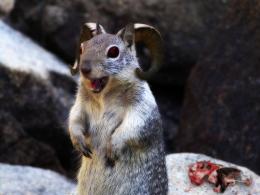 That said, when I was active in MARTI, I had the opportunity to go chipmunk fishing, which is a very strange practice where a nut or a piece of very thick break is jammed over a hook, hiding it within, and then dropped down a hole via a line attached to a reeling machine. When the chipmunk bites down and tries to run off with the bait, the machine is turned on, which jams the hook into the chipmunk's mouth and drags the little beast at about forty-five miles per hour out of the hole. They are typically caught by another person who wears a very large catcher's mitt. This whole process is then repeated. On a good night, we caught forty-seven.
If anyone intends to go chipmunk fishing in the future, feel free to send me an email asking for some tips. Not many people can do it well and it does take a lot of practice.
Now I'm going to throw the question to you. Have you ever been squirrel fishing?
-------------------------------------
If you'd like to ask me a question about science fiction, fantasy, books, writing, or whatever (anonymously, even), feel free to ask on my Formspring page or via email at arconna[at]yahoo[dot]com (or as a comment).
Saturday, June 12, 2010
Reader Question: What is the best way to explain foreign technology in science fiction?
This question was sent to me anonymously via my Formspring profile. After thinking about it for a while, I've come to the realization that it's not exactly an easy one to answer. There are no hard-set rules for how to deal with description and explanation in fiction, particularly in science fiction. People try to say that there are, but any time someone comes up with a writing rule that is rigid and absolute, rather than usually right, but reasonably flexible, you should know you're dealing with a bad piece of advice. "Show, don't tell," for example, is not absolute, yet it is told as if it is. This question is very much related to that, and I'm going to try to answer it based on my experience as a writer and as a reader, since what works and doesn't work is, for me, tied up in both.
Explaining technology, specifically technology that is foreign to the reader, is not an easy task primarily because how you can or should explain will depend very much on the situation. For example, typically one explains something in one of the following three ways:
--Telling It
Literally writing "it does this," but, preferably, in more eloquent prose.
--Showing It
Describing the thing in action. For example, instead of saying how a toaster works, the author would simply show it doing what it was designed to do. A simple example, but the point easily applies to anything else.
--By Comparison
You can apply comparison to "telling" or "showing." By using a comparison you are essentially saying that your new-fangled thing is similar to this old thing, but different because of X, Y, and Z, perhaps implicitly or explicitly.
All three of these types have their place in science fiction (and fiction in general), and any writer can make all of them work. While the universal rule has always been "show, don't tell," trying to show too much can be just as annoying as trying to tell too much. It's a balance issue.
If you have a new technology present in a scene, but have no reason to show that thing in action (perhaps because it isn't integral to the plot), then you should avoid telling or showing it at all. But if you need the main character to know what something does before s/he uses it, then you can't avoid telling the audience what's what. The rule about telling really should be: use it sparingly. If you can show it, then do so. If you can't without bogging down the story, then don't. "Show, don't tell" really only applies in its most rigid sense when you are talking about action. You always want to avoid telling in action. You can bring in emotions and brief snippets of things, but the reason why writers say to avoid telling is because it typically bogs down action, which is not a good thing when you want your reader to be engrossed in what is going on.
The last from the list above is one that gets used from time to time, but never really discussed. Depending on the situation, using a comparison is very much a form of telling, but it can be done in a way that a) doesn't bog down the story, and b) keeps things brief and to the point. For example, instead of describing how a futuristic printing press works, you can simply make a comparison between the presses of today and note, briefly, the differences (similes and metaphors are a must). Simpler versions use old terms with a modifier (laser toaster; you know what it does and how just by the title--a ridiculous example, sure, but it gets the point across). This method isn't used often and really doesn't apply to very complicated processes or systems, particularly if your audience doesn't know those systems, but it can be very effective.
Ultimately, if you don't have to tell how something works, or even describe it, then don't. If there's no reason for it, then that's really the only response you should have. If you do have to describe something, however, then consider how it would be best to do so; the more complicated of a system/process it is, the less likely you can reduce it to an info-dump without pulling your readers out of the story. This applies to all forms of fiction.
In the end, the best way to deal with this is to come to terms with whether you have to describe it. Don't waste space doing something you don't need to do.
What about you? If you've found ways to deal with this, let me know in the comments!
-------------------------------------
If you'd like to ask me a question about science fiction, fantasy, books, writing, or whatever (anonymously, even), feel free to ask on my Formspring page.
Explaining technology, specifically technology that is foreign to the reader, is not an easy task primarily because how you can or should explain will depend very much on the situation. For example, typically one explains something in one of the following three ways:
--Telling It
Literally writing "it does this," but, preferably, in more eloquent prose.
--Showing It
Describing the thing in action. For example, instead of saying how a toaster works, the author would simply show it doing what it was designed to do. A simple example, but the point easily applies to anything else.
--By Comparison
You can apply comparison to "telling" or "showing." By using a comparison you are essentially saying that your new-fangled thing is similar to this old thing, but different because of X, Y, and Z, perhaps implicitly or explicitly.
All three of these types have their place in science fiction (and fiction in general), and any writer can make all of them work. While the universal rule has always been "show, don't tell," trying to show too much can be just as annoying as trying to tell too much. It's a balance issue.
If you have a new technology present in a scene, but have no reason to show that thing in action (perhaps because it isn't integral to the plot), then you should avoid telling or showing it at all. But if you need the main character to know what something does before s/he uses it, then you can't avoid telling the audience what's what. The rule about telling really should be: use it sparingly. If you can show it, then do so. If you can't without bogging down the story, then don't. "Show, don't tell" really only applies in its most rigid sense when you are talking about action. You always want to avoid telling in action. You can bring in emotions and brief snippets of things, but the reason why writers say to avoid telling is because it typically bogs down action, which is not a good thing when you want your reader to be engrossed in what is going on.
The last from the list above is one that gets used from time to time, but never really discussed. Depending on the situation, using a comparison is very much a form of telling, but it can be done in a way that a) doesn't bog down the story, and b) keeps things brief and to the point. For example, instead of describing how a futuristic printing press works, you can simply make a comparison between the presses of today and note, briefly, the differences (similes and metaphors are a must). Simpler versions use old terms with a modifier (laser toaster; you know what it does and how just by the title--a ridiculous example, sure, but it gets the point across). This method isn't used often and really doesn't apply to very complicated processes or systems, particularly if your audience doesn't know those systems, but it can be very effective.
Ultimately, if you don't have to tell how something works, or even describe it, then don't. If there's no reason for it, then that's really the only response you should have. If you do have to describe something, however, then consider how it would be best to do so; the more complicated of a system/process it is, the less likely you can reduce it to an info-dump without pulling your readers out of the story. This applies to all forms of fiction.
In the end, the best way to deal with this is to come to terms with whether you have to describe it. Don't waste space doing something you don't need to do.
What about you? If you've found ways to deal with this, let me know in the comments!
-------------------------------------
If you'd like to ask me a question about science fiction, fantasy, books, writing, or whatever (anonymously, even), feel free to ask on my Formspring page.
Tuesday, April 27, 2010
eBooks and the Future of Books: A Question From WhoHub
Someone on WhoHub recently asked me the following and I thought I would respond here:
First, eReaders are expensive. Almost all of them are over $200; for me, that's a lot to spend on a device that a) doesn't excel at what it does, and b) is not at the pinnacle of its device history. MP3 players, for example, have gone well past their peak, but the result is that pretty much every major MP3-specific device still being sold right now is excellent at what it does and reasonably priced. The eReader market isn't quite there yet. For example, most of the eReaders have significant problems with justified text, which is pretty much the gold standard for text formatting for any book, and part of what makes them pleasing to the eyes. When you have lines with strange caps or ragged edges, it strains the reading process (and this might also explain why professors are always quite irritated when they have to grade papers).
Second, I still love dead-tree media. Books are lovely things. They have strange smells, interesting texture, and a load of other appealing features that other forms don't have. No eReader can match this, but with a low enough price tag, features that work at a more-than-adequate level, and more attention paid to how we read books, I might be influenced to buy an eBook-specific device. Right now, the only purpose I have in purchasing an eReader is to make it easier for publishers to send me review copies of books without incurring unnecessary shipping costs (it costs basically nothing to send me an electronic file); even that, though, is not as easy as it sounds, since publishers and their friends use annoying DRM on everything they create for the electronic market. DRM, by the way, is generally despised by anyone who regularly uses the Internet, and for good reason.
Having said all of this, I think it only fair that I point out some of the things that I do like about eReaders based on personal experience with them. I've already talked about the Nook before, and eReaders in general, but one thing that I think eReaders and devices that have the capability to display eBooks have going for them is functionality. No, they are not, as I have already pointed out, perfect, nor all that wonderful at what they do, but things like the Nook, or, hell, even the iPad (which I loathe simply because it's Apple) have great interfaces and sleek design, something that, unfortunately, the Kindle and the Sony Reader currently don't have. The result is that these two devices have a lot of potential (the iPad more so than anything else, since it can do so much). But most eReaders do have weight going for them, with the exception of the iPad, and reading from them doesn't hurt the eyes, which should alleviate any concerns people may have about them--this despite the clunky design of some of the bigger eReaders out there, like the Kindle.
Really, there are a lot of great things to be said about eReaders, despite the fact that I'm not ready to throw down $200 to get one. They have come a long way, and I absolutely believe that the next ten years will bring us superior, standard-setting devices, better functionality, and a larger market. While I don't think eBooks will destroy the print market, I do think that eReaders have the potential to increase the market of readers ten fold by tapping into a demographic of non-readers or infrequent-readers that have gone relatively unscathed by the print market (with the exception of the YA market, which has exploded and sucked in a lot of young would-be readers; I'd argue, though, that you can't really count young people in the non-reading category until they become adults, but that's another discussion entirely).
The worst-case-scenario for the print market is one in which eReaders dominate the reading market, and print is relegated to special-edition/collector status. Things like signed editions of books really don't work in the eBook market simply because their value in the print market is predicated upon limited printings, which is not possible to reproduce in electronic form (and even if you can, someone will simply hack that form and distribute it online; you can certainly scan books, but an electronic scan can never reach the same value plane as the printed article).
The best-case-scenario is a larger reading public. This is the one that I both think will happen and hope will happen. Instead of taking over, eReaders simply suck in new readers, take a few readers from the printed medium who are more inclined to read on an electronic device anyway, and, overall, triple the size of the publishing industry (which means more books, more writers, and more money for publishers and writers alike). That, in my book, is a darn good thing.
But, these are all predictions that, quite honestly, will probably turn out to be wrong. I was wrong way back in the day when I said that eBooks would never catch on (I don't have a quote because I don't think I said it on this blog); a lot of people were wrong about that one, what with eBooks taking up 3-6% of the market (I could be wrong on that figure) and establishing themselves as here to stay. For all I know, everything I say here will turn out to be a load of crap and something entirely unexpected will happen. Only time will tell.
What do you all think about eBooks? Do you think they'll destroy the print book?
What is your experience with ebook readers? Are they comfortable for your eyes? Will the paper book fade away?One thing that an old-school book lover like me has had to admit is that eReaders have gone from being clunky, annoying devices, to aesthetically pleasing monsters with a lot of potential. Personally, I don't think eReaders are quite there yet. The Apple iPad, while not strictly an eReader, has the potential to essentially destroy the entire eReader market, but the 1.0 is far from being the device it should be. Likewise, eBook-specific devices like Amazon's Kindle, the various Sony readers, and Barnes & Noble's Nook all have a lot of great features, but also a lot of bugs; all of those are heading in the right direction, but none of them have quite reached that point where I, as a potential buyer, see the benefit to me. Why is that?
First, eReaders are expensive. Almost all of them are over $200; for me, that's a lot to spend on a device that a) doesn't excel at what it does, and b) is not at the pinnacle of its device history. MP3 players, for example, have gone well past their peak, but the result is that pretty much every major MP3-specific device still being sold right now is excellent at what it does and reasonably priced. The eReader market isn't quite there yet. For example, most of the eReaders have significant problems with justified text, which is pretty much the gold standard for text formatting for any book, and part of what makes them pleasing to the eyes. When you have lines with strange caps or ragged edges, it strains the reading process (and this might also explain why professors are always quite irritated when they have to grade papers).
Second, I still love dead-tree media. Books are lovely things. They have strange smells, interesting texture, and a load of other appealing features that other forms don't have. No eReader can match this, but with a low enough price tag, features that work at a more-than-adequate level, and more attention paid to how we read books, I might be influenced to buy an eBook-specific device. Right now, the only purpose I have in purchasing an eReader is to make it easier for publishers to send me review copies of books without incurring unnecessary shipping costs (it costs basically nothing to send me an electronic file); even that, though, is not as easy as it sounds, since publishers and their friends use annoying DRM on everything they create for the electronic market. DRM, by the way, is generally despised by anyone who regularly uses the Internet, and for good reason.
Having said all of this, I think it only fair that I point out some of the things that I do like about eReaders based on personal experience with them. I've already talked about the Nook before, and eReaders in general, but one thing that I think eReaders and devices that have the capability to display eBooks have going for them is functionality. No, they are not, as I have already pointed out, perfect, nor all that wonderful at what they do, but things like the Nook, or, hell, even the iPad (which I loathe simply because it's Apple) have great interfaces and sleek design, something that, unfortunately, the Kindle and the Sony Reader currently don't have. The result is that these two devices have a lot of potential (the iPad more so than anything else, since it can do so much). But most eReaders do have weight going for them, with the exception of the iPad, and reading from them doesn't hurt the eyes, which should alleviate any concerns people may have about them--this despite the clunky design of some of the bigger eReaders out there, like the Kindle.
Really, there are a lot of great things to be said about eReaders, despite the fact that I'm not ready to throw down $200 to get one. They have come a long way, and I absolutely believe that the next ten years will bring us superior, standard-setting devices, better functionality, and a larger market. While I don't think eBooks will destroy the print market, I do think that eReaders have the potential to increase the market of readers ten fold by tapping into a demographic of non-readers or infrequent-readers that have gone relatively unscathed by the print market (with the exception of the YA market, which has exploded and sucked in a lot of young would-be readers; I'd argue, though, that you can't really count young people in the non-reading category until they become adults, but that's another discussion entirely).
The worst-case-scenario for the print market is one in which eReaders dominate the reading market, and print is relegated to special-edition/collector status. Things like signed editions of books really don't work in the eBook market simply because their value in the print market is predicated upon limited printings, which is not possible to reproduce in electronic form (and even if you can, someone will simply hack that form and distribute it online; you can certainly scan books, but an electronic scan can never reach the same value plane as the printed article).
The best-case-scenario is a larger reading public. This is the one that I both think will happen and hope will happen. Instead of taking over, eReaders simply suck in new readers, take a few readers from the printed medium who are more inclined to read on an electronic device anyway, and, overall, triple the size of the publishing industry (which means more books, more writers, and more money for publishers and writers alike). That, in my book, is a darn good thing.
But, these are all predictions that, quite honestly, will probably turn out to be wrong. I was wrong way back in the day when I said that eBooks would never catch on (I don't have a quote because I don't think I said it on this blog); a lot of people were wrong about that one, what with eBooks taking up 3-6% of the market (I could be wrong on that figure) and establishing themselves as here to stay. For all I know, everything I say here will turn out to be a load of crap and something entirely unexpected will happen. Only time will tell.
What do you all think about eBooks? Do you think they'll destroy the print book?
Subscribe to:
Posts (Atom)