The World in the Satin Bag has moved to my new website.  If you want to see what I'm up to, head on over there!

Monday, August 31, 2009

Punking Everything in SF/F (Part One): The Present

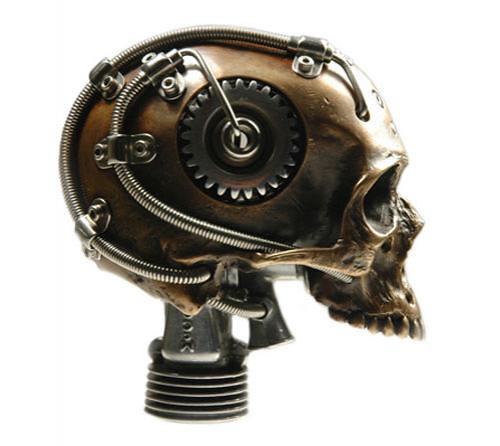
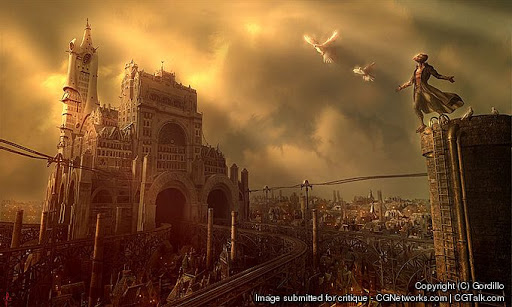
Cyberpunk, steampunk, biopunk, and now greenpunk? When will it end? Fans have been punkifying science fiction and fantasy for decades, and it doesn't seem like it will let up any time soon. With each passing moment, new ideas spring into the collective consciousness of SF/F fans, who, in turn, impart their selective, subgenre-crazed minds on all of us by bringing to task the next stage in science fiction and fantasy's evolutionary ride.

But are we getting ahead of ourselves, and is this constant segmentation of SF/F pointless or, at least, premature? What flaws are inherent in the frequent punking of speculative fiction?

Publishers have yet to grasp onto the punk genres, and neither have bookstores, independent or otherwise. Subgenres have little use outside of the relatively isolated, and sometimes rabid, fanbase. Realistically speaking, it would be impossible to incorporate even a pinch of the subgenres in existence today into bookstores, with logical exceptions to the Internet--after all, Amazon has been kind enough to narrow the science fiction and fantasy sections into nebulous, cross-pollinating subcategories.
So what is our obsession with subgenres (and sub-subgenres)? Are we inherently segmentative, meaning do we have an innate desire to categorize? That might be true, because it is without hindrance that we can see the makings of our own segmentarian nature in the desire to isolate ourselves. But here we might consider the distance of prejudice, which exists only insofar as personal grudges permeate the subgenre sphere. How many of those sub-subgenres are created simply to get rid of an unwanted swath of books? None? Perhaps we can only see prejudice as it exists in the academic, the purist academic who longs for the demise of science fiction and fantasy with an unhindered gaze. You can see the joy in his eyes when he looks down upon those who so willingly accept Margaret Atwood into their ranks. Or maybe he is a she, and the bitterness is just as strong. Who knows?
What we do know is that punk, in its newest, and historically disjointed (disconnected) form is science fiction and fantasy fans' greatest tool. Isolate the good, the bad, and the ugly, put them in the little jar of context-less wonder, and consume them as readily as a meat pie (or a veggie pie, should your personal inclination be to the earth). Punk is dead, perhaps, but alive too, reborn as a suffix with a mysterious past.

And all this, the thoughts presented here, the continued arrival of punkified sub-subgenres, makes me wonder if we need to educate ourselves as to what punk actually is, or was, to properly evaluate whether our suffix-obsessive punking nature is well served in a genre so clearly complicated by its weaving in and out of popular culture and literature itself. Yes, that is where we should go next. To the punk-mobile. Let's take our Peabody-and-Sherman-style journey into the past to unravel the not-so-distant history of a forgotten genre (forgotten, at least, by those not steeped in the rather confusing realms of cultural criticism and literary theory). Expect that post soon.

For now, consider, if you will, the nature of subgenres, the drive to create them, and the question of whether doing is has a purpose other than for our amusement. And if you have thoughts, share them here, because your thoughts are of interest to me. I must consume them, like candy.

Creepiness aside, comments are welcome.

---------------------------------------

Continue to Part Two (Punk), Part Three (Cyberpunk A), Part Four (Cyberpunk B), and Part Five (Cyberpunk C).

Disney Buys Marvel For $4 Billion

Matt Staggs brought this to my attention, but apparently Disney has purchased Marvel Comics for $4 billion USD. That's right, the massive corporation that brought you Peter Pan and Hanna Montana now owns the rights to over 5,000 Marvel characters, or something of that nature.

Might not sound like a big deal to all you reading this, but it's certainly something to be surprised about. I certainly am surprised.

Sunday, August 30, 2009

Animals and Empathy: Social Imperatives and the Future

Disclaimer: No, this will not be a long diatribe about why we shouldn't eat animals and other such animal rights topics. It's a brief look at our attitudes towards animals and where the future will likely take us. It's related to science fiction. Honest.

We live in a curious world where humans clash with the remaining members of the animal kingdom on a regular basis. Disrespect for the animal is two-pronged, for on the one hand we must separate ourselves from them, because they are inferior beings, but on the other, we split the human species by defining those of us who do not fit a particular cultural norm as animal. Society is resistant to anything beyond these two extremes, because we have a culture that, in most parts of the world, relies on animals for everything from social interaction to sustenance. Imagine if we changed our ways and suddenly became like the extremists want us to be? We would have to rely so much on our own kind, and whether that is something possibility within the limits of human consciousness, I cannot say.

What I am getting at here isn't so much the need for a change in how we operate; I will always consume meat, because that is my personal preference. Rather, I am proposing an examination of human attitudes, an alteration of how we view our animal brethren, and even ourselves, and an acceptance of the social/cultural imperative to use animals as tools for our survival. Nothing is suspect about the necessity for emotional maturity. We are a complicated species, no less complex than the chimpanzee or the baboon, excempt insofar as our technology dictates complexity, and within us we have the ability to enjoy empathy. The future will, undoubtedly, involve a paradigm shift in our conscious acknowledgement of the animal; vegetarians, vegans, and others will influence how we perceive the other beings that inhabit this planet, and, I hope, for good reasons. Why should we not at least understand that a cow does not deserve to be treated poorly, even if we're just going to eat it when it gets big and strong?

I suspect our distance is one of necessity, because to love our fellow animals as much as we might love a pet dog would constitute the steady recurrence of the betrayal of a social trust. You would not, I presume, kill Benji the Dog after raising him from puppyhood to the adult dog he would become, unless his existence directly threatened your own--and even then, you would likely feel bad about it if you are part of the cultural norm that seems to revere these sorts of creatures, but loathes others.

Perhaps emotional distance is absolutely necessary, but such distance does not mean we cannot punish people like Michael Vick and even the myriad employees of slaughterhouses everywhere who find it necessary to mistreat the animals they will eventually butcher to feed the nation. These individuals make conscious decisions to cause pain to animals. Animals feel, even if they do not contain within their minds the ability to properly examine those feelings. Is it too much to ask that these animals get at least the most basic of comforts? After all, we grant death row inmates a final meal, and even read them their final rights, or whatever you call those religious prayers offered up as final penance for a lifetime of mediocrity. But, then we are back at square one: our resistance to the animal, to, perhaps, the unknown.

Otherness. That's what we often call this human imperative for separation. Built into the genetic structure of our kind, we are always considering new ways to segment ourselves from those that don't meet our personal, or even societal, norms. The nerd, now seemingly adored, was once a social pariah; so too were women and people of color, constantly ridiculed and made inferior because of the circumstances of their birth. One cannot forget the resistance to animality in human culture, this push to define ourselves by an arbitrary religious or personal idea as non-animal, as separate, always and forever, from our animal brethren. Damn science for telling us otherwise.

The future, however, may breed new life into the social apparatus of humanity. Slaughterhouses will become a thing of the past as artificial methods for cultivating meat become not only possible, but effective at recreating what we love so much in cows, pigs, and other edible creatures. While now we may scoff at the idea, it is only a matter of time before the consumption of the animal ceases to run parallel to the enormous quantities of slaughter and abuse. I would argue, here, that artificial forms of food production are essential to the survival of our species, unless someone can develop a method that suits all nations, all governments, and all peoples which can adequately reduce our population. Artificial means of production are the only way for our species to continue to feed itself and reproduce at our current rate, and even to potentially feed those that haven't the means to do so themselves.

That is the future, the utopian ideal that exists on the horizon. We can embrace it, or we can reject it, but ultimately, there will be a change, and our future selves will have to deal with it as it occurs. We cannot be resistant to change if it means sacrificing our ability to feel, or our ability to be human, or even biological beings equally as important to this planet as the bee or the rat or the elephant. But the assumption, of course, is that we are important, that we are special, in some way. True, we are special for existing, but the universe is a vast and complicated place, constantly making us realize how insignificant this little blue planet really is.

SF/F Link: End of August Catchup!

No need for introductions, except this one. It's time to dive right in:
And there we go! Enjoy!

Saturday, August 29, 2009

Interview w/ Kage Baker

Kage Baker is the author of The House of the Stag and many other books. You can find my review of The House of the Stag here. Special thanks to Ms. Baker for agreeing to do this interview. Here goes:

Thank you for agreeing to this interview. First, can you tell us briefly about yourself? What led you down the path of authorhood and why fantasy and science fiction?

You're welcome. About myself... I'm a middle-aged spinster aunt living in Pismo Beach, California, with my parrot Harry. I was frequently ill as a child and my mother saw to it that I had plenty of books to read, early and often. She also wanted me to become a writer, which for many years I resolutely refused to do-- publicly, anyway. Privately I filled several volumes with stuff, mostly set in a fantasy world I'd invented. What I did publicly was join the Living History Center, who put on the original Renaissance Faire, which was nothing like the plastic models now in circulation. It was an educational extravaganza, painfully authentic and absolutely magical. I taught Elizabethan English as a Second Language for them for close to thirty years, and worked as an actress, stage manager and occasional dramaturge as well. This gave me a lot of what you could call unique life experience, so by the time I finally gave in and began to sell what I wrote, I had a lot of material with which to work. Why fantasy and science fiction? Fantasy because I was inclined that way, and science fiction as an offering to my mother's ghost. She loved science fiction.

Who have been some of your influences, whether in writing or some other hobby or profession? What are some of your favorite books?

Oh, gosh... Shakespeare, especially A Midsummer Night's Dream, and it's affected me in so many ways: wanting to escape to the Wood Near Athens as a child, watching the filmed versions, reading it and savoring the words, watching it being staged Elizabethan-style on a crude wooden stage in an oak forest... All the works of Robert Louis Stevenson, but most especially Treasure Island. C.S. Lewis and Edward Eager and Elizabeth Enright. L. Frank Baum. All their books. Patrick O'Brian's Aubrey-Maturin series takes my breath away. I'll read anything Terry Pratchett writes, and his books for kids are even better than his books for adults. The Asterix the Gaul comics. The Flashman novels. Thorne Smith's supernatural comedies. Peter S. Beagle! Way too many others to mention.

The House of the Stag is the second book set in this particular world. What drew you to return to this world? And what about the fantasy genre made you want to return?

Actually, The House of the Stag is drawn directly from the huge fantasy world about which I'd been writing from the age of nine or so. Gard's story is the oldest part. When I was trying to earn money at my craft as an adult, I adapted a minor incident concerning one of Gard's sons into a short story and sent it out to test the waters, as it were. The story was favorably received, so I went ahead and wrote the first part of the triptych that became The Anvil of the World, my first published fantasy book. Tor was interested in a second fantasy novel, so I went back to my original source material and revised it, and rewrote it (because you may think you know everything when you're fourteen, but by the time you're fifty-three your perspective has changed somewhat). Et voila! The House of the Stag.

One of the powerful features of this book is how it takes an otherwise cliché plot and twists it on its head. Your novel seems keenly aware of the past of its genre (fantasy), including delving into aspects of myth and fairytale. What do you see as the connection between modern (contemporary) fantasy and the stories of our past? Do you see The House of the Stag as a novel that breaks convention (in a good way)?

I hope it breaks convention in a good way, certainly... Here's the other disadvantage of writing from a fourteen-year-old's perspective, especially at a time when Tolkien was God and trilogies set in immense detailed universes were what every aspiring young writer set out to create: you don't realize you're not being terribly original. But by the time you're older and you've read your Joseph Campbell and you've seen all the really cheesy Tolkien knockoffs that make millions at the cost of their muses, and you've read a bit of the sort of things Tolkien's contemporaries were writing, you see the field in a new light. My story involved a foundling coming of age and discovering who he was and what his heritage entailed, which is one o' them there Universal Themes, and it helps that he discovers that his destiny is to be the world's Bad Guy, but even so-- it seemed to me it was wiser to pare it down to its essential myth, and tell it not as an Oxford don would tell it, but as people would tell it. And just incidentally using that incident in which Gard becomes an actor to comment on the larger Epic Fantasy tradition... sort of getting a dig in.

The House of the Stag also deals with issues of identity, slavery, and colonialism, in particularly powerful ways. Can you talk about what drew you to these themes and any other thoughts you might have in how they played a role in your novel?

Well, they were in the original version, begun in my childhood, and I suppose that came from the fact that my father was of Native American descent. We grew up keenly aware that there was another side entirely to the story of how Pioneers Conquered America Because God Gave it to Them. When my dad was in school he frequently had to fight to defend himself. It was never an issue for me because I had white skin, but I hated it when people acted as though Indians were mostly dead and any remaining were drunks living in trailers. I knew the Red Man hadn't vanished at all. There was a certain amount of bitterness about that, about the way the history books sort of pasted over the truth. I'm firmly of the "Custer had it coming" persuasion.

But when you look at the history of the world, it's always been that way, everywhere there were people: you're living quietly in the place in which you've always lived, where your parent's bones are buried and your children have been born, and then along comes someone more powerful who says "Guess what? My technology is more advanced than yours and my god said I could kick you out and take your land, so shove off." Or, worse: "Don't shove off; I'm going to put chains on you and make you mine, gold and silver for me". Wherever cultures collide, it happens, I have always found it hard to get personally furious. But it worked its way into The House of the Stag, certainly.

The House of the Stag has a rather unique narrative structure. I used the term “postmodern” to describe this in my interview, but could you talk about why you chose to have these unique breaks in story that expose the reader to a sort of metanarrative (a narrative that seems to comment on the fairytale/myth aspects of the story)?

Because the story isn't simply about Gard and his advancement through life; it's the story of cultures colliding, the history of a race, the way in which people tell stories that create the masks worn by the heroes and the villains. And how much are people driven by storytelling conventions to become what they appear to the world? Terry Pratchett has proposed that humans are not properly Homo sapiens but rather Pan narrans: not wise men, but storytellers.

The original, 1966-era version was written in ghastly imitation Tolkien flowery pseudo-medieval English, when really it's the story of one man moving from a stone age culture through different technological layers to a fairly sophisticated one. As well as a woman leading her people through pretty much the same transitions. Both these people are born naked into primitive tribes and a generation later their son is fussing about his tailor's bills. I wanted to show that evolution in the storytelling process too. That's why it begins with rock paintings, in this world that is still close to ancestral myth; moves in the next section to account ledgers, which are the earliest writings preserved; then goes to vocal narrative of history; then to drama presented with masks; then to epistolary correspondence; finally to a technologically produced printed book. And the styles of the narrative change somewhat to reflect that. My agent and editor were rather concerned that people wouldn't make it past the aboriginal style of the first section...

Something I think a lot of people will enjoy about The House of the Stag is how realistic and unhindered by magic it is. While magic does exist, it is, to great effect, kept within reasonable boundaries, and only “flashy” when it serves a viable purpose in the narrative. How do you view magic in fantasy, or in general, and how would you describe your attitude towards it?

Magic is a problem, for a fantasy writer, because in order to have a believable story the magic must have limits and structure. Which means you have to invent a whole science, a consistent one, that isn't simply parroting the system devised by D&D players. Pratchett handles this well: Granny Weatherwax can stop a knife with her hand in a crisis and magically escape harm, but afterwards has to inflict the wound the knife should have made, because the magic has a price. Zelazny worked out some very plausible magic systems too. Peter S. Beagle's magic follows the systems of the heart, and is thoroughly believable. My own feeling is that magic should be used sparingly, otherwise it loses its effect.

Do you have future plans for this world or any of the characters currently established?

If I'm spared, yes. It's such a huge canvas with so many characters! I've already written several short stories about the various children of Gard. I'd like to be able to do another novel. Lord Ermenwyr is a fun character and of course in The House of the Stag he doesn't appear until the end, as a puling infant. I'd like the chance to write a bit more about him. And see below...

Could you tell us a bit about your upcoming projects or anything you’ve done that you’d like people to know about?

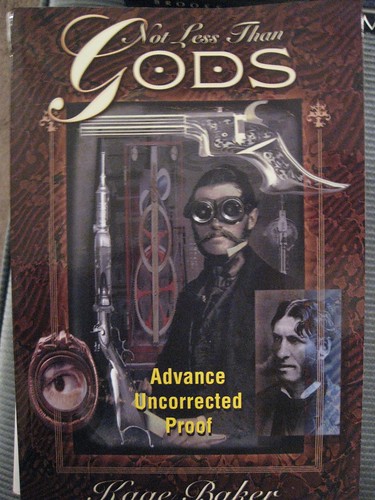
Yes indeed. I have a steampunk novel coming out next year, Not Less Than Gods, and fans of the Company novels may be pleased to know it's about the company's Victorian-era predecessor, The Gentlemen's Speculative Society, and features Edward Alton Bell-Fairfax. Beyond that I've just handed in another novel set in Gard's universe but featuring an entirely different cast of characters. There's a river in it, and a river god, and a girl's journey. It will probably appear as The Bird of the River. And my children's book, The Hotel Under the Sand, has just been published for the ages 8-to-11 market. It's sort of steampunk for kids.

If you could offer budding writers one piece of unusual advice, what would it be?

Kids, I mean this in the kindest possible way: Do Not Quit Your Day Job. Ever. Just because you get a book published doesn't mean you will become instantly rich. At all. Go read what Robert Louis Stevenson wrote on the subject.

And for a random question: If you could choose one sport to teach aliens when they visit, which would it be and why? (You can define sport however you like.)
Morris Dancing! It would bewilder them and introduce them to beer. They'd be so drunk and exhausted all the time they'd be unable to conquer us.

And there you have it!

Thursday, August 27, 2009

Interview w/ Nicole Kimberling

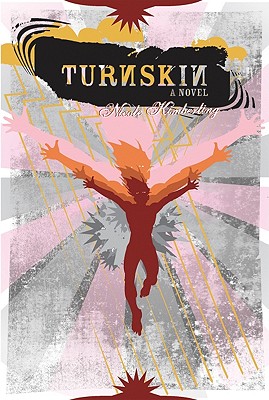
Nicole is the author of Turnskin, an interesting tale that I reviewed not too long ago. Additional thanks goes to her for taking the time out of her day to do this interview.

Thanks for doing this interview. First, can you tell us a bit about yourself? What drew you into authorhood and why fantasy?

I started writing stories to impress this girl I was into. It worked a little too well since once I got the girl I had to continue to produce more and better stories. As for fantasy, I've just always liked it. I was one of those kids who had a lightsaber and a first edition box of Dungeons & Dragons.

What have been some of your influences as a writer? What are some of your favorite books, whether fantasy or otherwise?

When I like a piece of fiction I read it compulsively, the same book over and over again for about six months. So, in order of appearance, here are a few books and novellas I've read like that:

The Borrowers by Mary Norton
Dragonsinger by Anne McCaffrey
Vampirella #4: Blood Wedding by Ron Goulart
Dirk Gently's Hollistic Detective Agency by Douglas Adams
Comfort and Joy by Jim Grimsley
Snowball in Hell by Josh Lanyon

I also love art and comics so I’ll add a few comic titles:

As for Western comics, I was a fan of Red Sonja and Wonder Woman when I was a kid. Then when I was about 29 years old manga started to be translated into English. I really like manga a lot. A few of my favorites:

Black and White (Tekkonkinkreet) by Taiyo Matsumoto
Kusatta Kyoushi no Houteshiki by Kodaka Kazuma
Ichigenme by Fumi Yoshinaga (I can’t wait for Kinou Nani Tabeta? to be translated into English. I’m reading Ooku: the Inner Chambers right now. It’s an AU story that presupposes a gender inversion in medieval Japan that would have put women in charge of society.)
Future Lovers by Saika Kunieda

Turnskin is a curious love story that crosses multiple forbidden boundaries: non-human/human, Romeo/Juliet, etc. What do you think is so captivating for readers when it comes to forbidden love stories?

Beats me. Really I never thought of Turnskin as a forbidden love story so much as a coming of age story. Because the love of Tom & Cloud isn’t really forbidden so much as it’s a bad idea for both of them. I think that’s different than being something like a societal taboo.

Where did you come up with the idea for the shifters? Will we find out anything more about Tom’s genetic past, or is this the last we will hear from him and the other characters?

I came up with the shifters during a conversation with Ginn Hale. It’s actually impossible for a writer to have a conversation with her for more than five minutes without coming up with an idea. She’s like a force for creativity and it rubs off if you stand close to her for very long.

I have no plans to revisit Tom’s world at present. It was invented specifically to tell this story so I don’t really know what else I would write about it.

Is Turnskin set anywhere we might know (as in an alternate version of a place that might be familiar to readers) or is this a completely separate world?

It’s a completely separate world, based directly on nowhere.

Lesbian and gay speculative fiction seem to be taking off in the last few years, and while Turnskin turns the lesbian/gay theme on its head using “alien” figures, it is still, ultimately, a story about people struggling with their identities. Where do you see LGBT speculative fiction going in the relatively near future?

I don’t really know if lesbian spec fic could be described as “taking off” but gay spec fic sales have definitely increased, fueled by the rise of the m/m romance reader.

As for the future of the whole genre, there is really no way to know.

What are some advantages, in your opinion, of being published with a small press?

Personal care and attention from the editor and from the publisher.

What other projects do you have coming up and can you tell us a little about them?

Samhain has just released a short novel of mine called Ghost Star Night. I think I just have to give the blurb, because it’s really hard to sum up.

“Thomas Myrdin has been used and betrayed by his king. But his heartbreak troubles him less than the apocalyptic visions that have begun to haunt him; the world burns in ruins and at the center of the destruction is the king’s newborn daughter. As vengeance and visions waken a power deep within him, not even Thomas knows if he’s becoming the kingdom’s salvation or its destruction.

Lord Adam Wexley harbors a secret longing for Thomas, but his duty is to protect the newborn princess. When a sudden threat arises Adam must procure the services of the Magician, Edwin Drake, even if it means sacrificing his own body and soul.

Drake had seen the worst of kings and courtiers; as a child he witnessed his father’s soul stripped away to leave behind a stumbling slave. Now, Drake protects himself with powerful sorcery and the adamant refusal to affiliate with any of the Four Courts. But the Grand Magician isn’t without weaknesses and Adam may be the one enticement that can draw him to ruin.”

Ghost Star Night is a lot more action-packed than Turnskin. It’s the piece I wrote directly after. I think I wanted to write something with more doing and less feeling.

And, of course, I am part of the Hell Cop anthology series with Astrid Amara and Ginn Hale. Hell Cop is set in the shared world of Parmas City and it’s kind of an urban fantasy. Hell Cop 2 was released by Loose Id in June.

In December I’ll release another, longer book with Samhain called Happy Snak. This is not an LGBT book, per se, unless you think hermaphroditic aliens qualify as an LGBT element (which I do, actually).

What unusual piece of writing advice would you give to budding writers?

Try to have interests other than writing. I mean, you’ve got to have something to write about, right? Get another hobby or a different day job. It will help you survive things like barbecues and cocktail parties as well by giving you something to talk about other than your own novels.

Now for a random question: If you could try any bizarre delicacy (by Western standards), from anywhere in the world, what would you try and why?

You know I’ve tried a lot of bizarre delicacies in my time. Right now what I’d most like to try is the the food at Ferran Adria’s restaurant, El Bulli. I had some molecular gastronomist fare at Wylie Dufresne’s WD-50 in Manhattan and I have never had so much food that made me laugh and also think.

Wednesday, August 26, 2009

Reader Question: Future Definitions

Bowie of Young Writers Online was on a role when he was asking questions. Here goes:
Realistically speaking, would we consider a "holo-vid" a television or would we somehow adapt to calling it a "holo-vid"?
Most likely we would call it a hol0-vid, or whatever term was created to describe that new technology. New advances in technology produce new devices that may provide the same services as something before it, but in new and unique ways. Historically speaking, we tend to refer to these new technologies by their new names. We don't call PDAs by anything other than PDA or handheld device, despite it being a miniature computer w/o a keyboard. An iPod is not a Walkman and even a laptop/notebook computer is often referred to as a laptop/notebook computer rather than as a portable computer or just a computer. While we may acknowledge that new technologies are "genetically" linked to older ones, we still take liberties with naming and stick with what is new, going back to old terminology only when we need to explain something in greater detail or for some other purpose. Right now, I'm writing on a laptop or notebook computer, whichever name best suits you.

When the future rolls on through, it will bring with it a lot of new gadgets that will have different names and terminology. Unless those items are quite clearly derivations of something before (i.e. a 2nd generation iPod is still just an iPod, even though it's technically more advanced and more functional than the previous generation), we tend to rename them. Human beings are remarkable at adopting new language. As an example, we can look at slang.

When I was in high school, all those years ago, I remember the word "sick" coming into play (for those that don't know, "sick" is sort of like saying "cool," but in a more "cool" way). Within a couple weeks it was across the entire campus, and by the time I had finished my school year, that word had traveled to my previous home in Washington (across two states) and had been readily adopted. That's the fascinating thing about language. It always changes with us human beings. Always.

The same is true for technology, and as we progress we will see the language change. Ten years ago we didn't have an iPod. Everything was by CD and mp3s were still becoming the dominant form over .wav and other formats. Now? If you don't know what an mp3 is, you're perceived as an idiot who has been living in the jungle, or really old, and if you don't know what an iPod is, well, you'll end up getting some looks until you can explain why. That's the nature of language. Always changing, always adjusting, and always progressing.

What about you, the readers? Do you think we will call holo-vids by what they are, or will we simply refer to them as TVs?

-------------------------------------------------

If you have a question about science fiction, fantasy, writing, or anything related you'd like answered here, whether silly or serious, feel free to send it via email to arconna[at]yahoo[dot]com, tweet it via Twitter to @shaunduke, or leave it in the comments here. Questions are always welcome! If you liked this post, consider stumbling, digging, or linking to it!

GFTW's SF/F/H Book Reviewer Meme, 2nd Edition

John Ottinger of Grasping For the Wind has posted an updated version of his famous SF/F/H book reviewer meme. And now I'm posting it here so you all can check some of these great reviewers out. You'll have to click the read more in order to see the list, because the darn thing is too long for me to post on my homepage.

Anywho, here goes:

A B C D E F G H I J K L M N O P Q R S T U V W X Y Z


Romanian French Chinese Danish Portuguese German


A


7 Foot Shelves

The Accidental Bard

A Boy Goes on a Journey

A Dribble Of Ink

Adventures in Reading

A Fantasy Reader

The Agony Column

A Hoyden's Look at Literature

A Journey of Books

All Booked Up

Alexia's Books and Such...

Andromeda Spaceways

The Antick Musings of G.B.H. Hornswoggler, Gent.

Ask Daphne

ask nicola

Audiobook DJ

aurealisXpress

Australia Specfic In Focus

Author 2 Author

AzureScape


B


Barbara Martin

Babbling about Books

Bees (and Books) on the Knob

Best SF

Bewildering Stories

Bibliophile Stalker

Bibliosnark

Big Dumb Object

BillWardWriter.com

The Billion Light-Year Bookshelf

Bitten by Books

The Black Library Blog

Blog, Jvstin Style

Blood of the Muse

The Book Bind

Bookgeeks

Bookrastination

Booksies Blog

Bookslut

The Book Smugglers

Bookspotcentral

The Book Swede

Book View Cafe [Authors Group Blog]

Breeni Books


C


Cheaper Ironies [pro columnist]

Charlotte's Library

Circlet 2.0

Cheryl's Musings

Club Jade

Cranking Plot

Critical Mass

The Crotchety Old Fan


D


Daily Dose - Fantasy and Romance

Damien G. Walter

Danger Gal

It's Dark in the Dark

Dark Parables

Dark Wolf Fantasy Reviews

Darque Reviews

Dave Brendon's Fantasy and Sci-Fi Weblog

Dead Book Darling

Dear Author

The Deckled Edge

The Doctor is In...

Dragons, Heroes and Wizards

Drey's Library

The Discriminating Fangirl

Dusk Before the Dawn


E


Enter the Octopus

Erotic Horizon

Errant Dreams Reviews

Eve's Alexandria


F


Falcata Times

Fan News Denmark [in English]

Fantastic Reviews

Fantastic Reviews Blog

Fantasy Book Banner

Fantasy Book Critic

Fantasy Book Reviews and News

Fantasy By the Tale

Fantasy Cafe

Fantasy Debut

Fantasy Dreamer's Ramblings

Fantasy Literature.com

Fantasy Magazine

Fantasy and Sci-fi Lovin' News and Reviews

Feminist SF - The Blog!

Feybound

Fiction is so Overrated

The Fix

The Foghorn Review

Follow that Raven

Forbidden Planet

Frances Writes

Free SF Reader

From a Sci-Fi Standpoint

From the Heart of Europe

Fruitless Recursion

Fundamentally Alien

The Future Fire


G


The Galaxy Express

Galleycat

Game Couch

The Gamer Rat

Garbled Signals

Genre Reviews

Genreville

Got Schephs

Graeme's Fantasy Book Review

Grasping for the Wind

a GREAT read

The Green Man Review

Gripping Books


H


Hasenpfeffer

Hero Complex

Highlander's Book Reviews

Horrorscope

The Hub Magazine

Hyperpat's Hyper Day


I


I Hope I Didn't Just Give Away The Ending

Ink and Keys

Ink and Paper

The Internet Review of Science Fiction

io9


J


Janicu's Book Blog

Jenn's Bookshelf

Jumpdrives and Cantrips


K


Kat Bryan's Corner

Keeping the Door

King of the Nerds


L


Lair of the Undead Rat

Largehearted Boy

Layers of Thought

League of Reluctant Adults

The Lensman's Children

Library Dad

Libri Touches

Literary Escapism

Literaturely Speaking

ludis inventio

Lundblog: Beautiful Letters


M


Mad Hatter's Bookshelf and Book Review

Mari's Midnight Garden

Mark Freeman's Journal

Mark Lord's Writing Blog

Marooned: Science Fiction Books on Mars

Martin's Booklog

MentatJack

Michele Lee's Book Love

Missions Unknown [Author and Artist Blog Devoted to SF/F/H in San Antonio]

The Mistress of Ancient Revelry

MIT Science Fiction Society

Monster Librarian

More Words, Deeper Hole

Mostly Harmless Books

Multi-Genre Fan

Musings from the Weirdside

My Favourite Books

My Overstuffed Bookshelf


N


Neth Space

The New Book Review

NextRead

Not Free SF Reader

Nuketown


O


OF Blog of the Fallen

The Old Bat's Belfry

ommadawn.dk

Only The Best SciFi/Fantasy

The Ostentatious Ogre

Outside of a Dog


P


Paranormality

Pat's Fantasy Hotlist

Patricia's Vampire Notes

The Persistence of Vision

Piaw's Blog

Pizza's Book Discussion

Poisoned Rationality

Popin's Lair

pornokitsch

Post-Weird Thoughts

Publisher's Weekly

Pussreboots: A Book Review a Day


Q


R


Ramblings of a Raconteur

Random Acts of Mediocrity

Ray Gun Revival

Realms of Speculative Fiction

Reading the Leaves

Review From Here

Reviewer X

Revolution SF

Rhiannon Hart

The Road Not Taken

Rob's Blog o' Stuff

Robots and Vamps


S


Sandstorm Reviews

Satisfying the Need to Read

Science Fiction and Fantasy Ethics

Science Fiction Times

ScifiChick

Sci-Fi Blog

SciFiGuy

Sci-Fi Fan Letter

The Sci-Fi Gene

Sci-Fi Songs [Musical Reviews]

SciFi Squad

Scifi UK Reviews

Sci Fi Wire

Self-Publishing Review

The Sequential Rat

Severian's Fantastic Worlds

SF Diplomat

SFFaudio

SFFMedia

SF Gospel

SFReader.com

SF Reviews.net

SF Revu

SF Safari

SFScope

SF Signal

SF Site

SFF World's Book Reviews

Silver Reviews

Simply Vamptastic

Slice of SciFi

Smart Bitches, Trashy Books

Solar Flare

Speculative Fiction

Speculative Fiction Junkie

Speculative Horizons

The Specusphere

Spinebreakers

Spiral Galaxy Reviews

Spontaneous Derivation

Sporadic Book Reviews

Stainless Steel Droppings

Starting Fresh

Stella Matutina

Stuff as Dreams are Made on...

The Sudden Curve

The Sword Review


T


Tangent Online

Tehani Wessely

Temple Library Reviews

Tez Says

things mean a lot

Tor.com [also a publisher]

True Science Fiction


U


Ubiquitous Absence

Un:Bound

undeadbydawn

Urban Fantasy Land


V


Vast and Cool and Unsympathetic

Variety SF

Veritas Omnia Vincula


W


Walker of Worlds

Wands and Worlds

Wanderings

Wendy Palmer: Reading and Writing Genre Books and ebooks

The Weirdside

The Wertzone

With Intent to Commit Horror

The Wizard of Duke Street

WJ Fantasy Reviews

The Word Nest

Wordsville

The World in a Satin Bag

WriteBlack

The Written World


X


Y


Young Adult Science Fiction


Z


Romanian


Cititor SF [with English Translation]


French


Elbakin.net

Mythologica


Chinese


Foundation of Krantas

The SF Commonwealth Office in Taiwan [with some English essays]

Yenchin's Lair


Danish


Interstellar

Ommadawn.dk

Scifisiden


Portuguese


Aguarras

Fernando Trevisan

Human 2.0

Life and Times of a Talkative Bookworm

Ponto De Convergencia

pós-estranho

Skavis


German


Fantasy Seiten

Fantasy Buch

Fantasy/SciFi Blog

Literaturschock

Welt der fantasy

Bibliotheka Phantastika

SF Basar

Phantastick News

X-zine

Buchwum

Phantastick Couch

Wetterspitze

Fantasy News

Fantasy Faszination

Fantasy Guide

Zwergen Reich

Fiction Fantasy


A B C D E F G H I J K L M N O P Q R S T U V W X Y Z


Romanian French Chinese Danish Portuguese German

Tuesday, August 25, 2009

Reader Question: Lingual Formalities, Schmalities

If memory serves me, this question comes from Bowie of Young Writers Online:
In most science fiction and fantasy stories, people speak in a more formal way. Why is that? Is it to reinforce the idea that it's a different world than we know?
Firstly, it’s not true that most SF/F resorts to formal modes of communication. A great deal of classic SF/F does, but modern derivations of the two genres have seen a remarkable, and much appreciated, shift from the trappings established by Tolkien all those years ago. And this is where we get into the unfortunate side effect of Tolkien’s brilliance.

Despite writing what most consider to be the greatest fantasy trilogy of all times, Tolkien hammered into new and past writers several unfortunate habits. You see, Tolkien was trying to recreate something in The Lord of the Rings, a certain feel, if you will. He was successful on all counts, not only in fabricating a detailed, elaborate fantasy world, but also in trying to fashion an imagined, realistic history of an England that might have been (though the fact that, as far as I can tell, Middle Earth looks nothing like England could make for a good counter argument). In doing so, Tolkien fixed into the minds of fantasy lovers everywhere what were the defining characteristics of the genre, despite his setting out to create an effective, mythologized, and complex historical novel. The language, thus, is exceptionally dated, even for his time, and the clichés were snatched up by fans without hesitation.

It has taken the fantasy genre a long time to work out of the habit of writing in absurd formal dialogue. But it has happened, and it has, in almost every instance, been to emulate Tolkien rather than to produce something truly original. There is nothing wrong with emulation, insofar as such emulation is still trying to impress upon readers an experience, despite its biased leanings. What is problematic, as is true of all tropes, clichés, etc. in fantasy, is that these sorts of staples effectively damage the genre when done poorly. Of course, to call a lot of published works "poor recreations" is somewhat unfair, particularly because readers have varying expectations, and what I want or expect in fantasy literature will almost always be at least slightly different from what other readers want. Readers do like Tolkien-esque fantasies, a lot--and that's really an understatement. Sometimes there are reasons (they have read a lot and prefer that style) and other times it is due to ignorance (some might say that most Twilight and Eragon fans like those works because they have no read "good" fantasy yet). Invariably, it is hard to argue with how things actually are in this instance: derivations exist and will continue to do so, provided that readers are still interested in such things in the future.

There is also the healthy obsession with medieval literature that most fantasy writers have, whether they are willing to admit it or not. That contributors to the persistence of this form of dialogue.

Now the question is, are these sorts of formal dialogue stylings good or bad, in your opinion? I view them as either/or, because, in some cases, it works. But that's me, and I want to see your opinion. Leave me a comment with your thoughts!

-------------------------------------------------

If you have a question about science fiction, fantasy, writing, or anything related you'd like answered here, whether silly or serious, feel free to send it via email to arconna[at]yahoo[dot]com, tweet it via Twitter to @shaunduke, or leave it in the comments here. Questions are always welcome! If you liked this post, consider stumbling, digging, or linking to it!

Monday, August 24, 2009

Writing Weaknesses: Do You Know Yours?

Nobody is perfect. That's one of those golden rules when it comes to personalities and professions. Everyone makes mistakes, sometimes trivial and sometimes terrible. As a writer, it can be difficult to see where your weaknesses are. Anyone who writes is intimately connected to his or her work, and maintaining separation can sometimes be nearly impossible. Few, if any, writers get it right on the first draft, and those that do are flukes rather than logical exceptions. The rest of us--call us "normies," if you will--have to learn from our mistakes and try to see where we are weak in order to improve our craft.

But do you know your weaknesses? If so, how do you approach resolving them? Do you take care of it after the first draft, or do you try to fix the issue as it is happening?

Personally, I have issues with characterization. Often I place too much focus on the ideas and not enough on establishing a connection to the character (for the reader). I know I do this every single time, and my problem seems to be that when I try to fix it as it occurs, my characterization feels forced or I simply lose interest. I'm working on resolving this, because I want my stories to have more impact for readers beyond the "gosh wow" effect.

I have other weaknesses, but right now that seems to be the primary and most pressing one. I'm not sure how to fix it at this point. A lot of the exercises I've found for creating better characters seem to require you to think up useless facts about your characters. I prefer not to think of my characters as bundles of uselessness. They have purposes, desires, interests, etc., and I prefer fiction that highlights those things that are important to the story as a whole. Maybe that's my problem.

Knowing your weaknesses is important, though, because acknowledging where you need to work the most can help drive you forward as a writer, even if that movement is one plodding, sluggish step at a time.

What are your weaknesses and how do you deal with them? Let me know in the comments!

Sunday, August 23, 2009

Random, But Useful Advice For Writing Essays

Cite your sources correctly from the start. Having recently gone through the experience of digging up the correct sources and fixing all my slightly-off citations, I can tell you that doing it right the first time is a time saver, especially if you don’t return to the essay in question until some many months later, long after you’ve forgotten where the original source was located.

It would seem like obvious advice, but if you’re a college student, this issue may come up later when you try to publish one of your essays. You see, college students often end up with these things called “readers,” which are essentially enormous printed tomes of information usually created by the college for a specific course. They are not books you buy on Amazon, or even books you can return. You’re stuck with them. And sometimes the readers don’t contain the proper citation information for the articles they contain. That means you have to go hunt that information down yourself. Doing so can take a bit of time, but at least during school you can ask your professor where he or she got a particularly article, in person, and get a response ASAP. Doing it later means having to spend hours surfing Google to find obscure information about equally obscure articles. It’s not fun, especially when you wanted to get that essay out the door the day before.

Then you have the issue of proper citation practices. How do you format footnote citations? Well, you have to read, because if you follow the citation formats you see in articles, they are often incorrect or outdated. Maybe that’s not a problem for some publications, but the more academic ones, or even the exceptionally professional ones, want proper citations, not just for them, but for the peer review panels that govern what gets published.

I spent close to ten hours fixing all my citations and reformatting two essays to submit to an online magazine. Only a few hours of that should have been spent formatting (since they had specific guidelines), and none to the citations. But, I didn’t foresee publishing things, or I didn’t think about the citations at the time, and subsequently had to go through every inch of my essays to get them in working order. Fun? No. Not at all.

So, cite your sources correctly from the start. It’ll make your life easier.

Saturday, August 22, 2009

A Collective Chillpill For RaceFail, GenderFail, et al.

Disclaimer: Nothing in this post should be misunderstood to imply that I am inherently racist, anti-equality, or anything of that nature. I am not and never will be against any notion of quality, only against unrealistic expectations and demands. Neither am I against open and civil discussion of issues of discrimination, whether it be in literature or elsewhere. These issues should be openly discussed, and regularly, but with an understandable acknowledgement of the complexities of certain situations. Now that you've read this part, here's the post:

I'm about fed up with the science fiction and fantasy community. It seems like every week someone is throwing a fit about such-and-such anthology lacking content from such-and-such minorities (women, people of color, whatever). I wouldn't have an issue with it if not for its constant, never-ending resurgence. Nothing is safe. Nothing can sit on its own merit. If an anthology is 50/50 male/female, then someone complains that there aren't enough Asians, or African Americans, or whatever. If there are too many white people, never mind that it's not exactly the editor's job to screen who submits to them for what color someone is, someone throws a fit over that. If there are too many men, complaining resumes. Too many women? The same, somewhere.

It's like the SF/F community is in a constant state of bitching, because no matter how hard you try to explain away reality, nobody listens. Not enough women? Oh, well that's all your fault, Mr. Editor, even if I don't know the whole story, or have all the information I need to make that judgment; you're a sexist bastard because there just ain't enough women in that anthology. Not enough African Americans? Well, I don't need to know how many African Americans submitted to you, or whether or not you knew that all the people you published were white, or yadda yadda; you're just a racist asshole who hates African Americans and has a KKK sign above your desk.

Do you see why these arguments are not only tiresome, but somewhat absurd? I'm not going to pretend for a moment that discrimination doesn't exist. It does, even in the SF/F community. We've seen it with RaceFail and GenderFail, etc. It's out there, and sometimes not in places you would expect. But it's not everywhere, and assuming that racism or sexism is solely responsible for the lack of minority representation is skirting the issue. There are bound to be more reasons than we can fully comprehend. Maybe part of the problem is that African Americans or women are not big contributors to science fiction, and so the applicant pool is far smaller than that of white males. I don't know, but before we throw fits over every anthology, maybe we should figure that out--maybe we should try to understand the broader picture and not resort to automatically assuming that editors are racist or sexist assholes who don't give a shit.

As an editor (for Survival By Storytelling Magazine), I can tell you firsthand that I have no idea how many people of color I have selected for the first issue. I didn't ask. Why? Because it's probably illegal, for one, and because I kind of don't care. No, I don't mean that I don't care in a negative sense; I mean that I don't care in the sense that skin color is meaningless in the face of quality writing. Whether you are white, black, blue, or red, if a story is good, it's good. That's it. No other criteria. If there is a disproportionate amount of whites in our first issue, then I certainly hope I won't be called out for it. I didn't ask, and won't ask now. We chose good stories from whatever was sent to us, and if there happened to be a whole bunch of women or people of color who submitted, great. If not, I don't know how exactly I am to fix that. I can't force people of certain genders or skin colors to submit.

Similar things are probably true of some of the bigger editors who collect original stories for anthologies. What are their reasons for selecting certain authors? I don't know. Some of them are published authors that the editor approached, and others were snatched from the slush. Can we honestly say that these editors sat down and thought "this is a woman, and this story will suck"? Maybe some of them do, but how exactly are you to know? And when people in the SF/F community throw a fit over these anthologies, they potentially damage the reputation of editors who are not racist or sexist bastards. Turn it around; how would you feel if someone unjustly did the same to you? You wouldn't like it very much, would you?

The SF/F community needs to calm down. I get it; we're in a sensationalist world, and what "sells" to the public are angry rants and controversial topics. But we need to start digging deeper than where RaceFail and GenderFail have taken us. We've avoided the deep end for reasons that seem to escape me, and instead of approaching the various "perpetrators" of racism or sexism with their concerns, the SF/F community has blasted them with insults and public ridicule. Sometimes such action is appropriate, but most of the time it's not. If that's the way you want to do things, then I don't want to be a part of it. If RaceFail, and even GenderFail, have taught the SF/F community anything, it is that we need a greater deal of open discussion. Right now the bitching and fit throwing and angry attacks are only creating more tension.

Tension we do not need. And no, I am not a racist or sexist bastard. I'm a human being.

Friday, August 21, 2009

Reader Question: The Alien Exit

Mercy from Young Writers Online had this interesting question to ask:
Why does everyone resort to aliens in recent sci-fi/gov/end of the world movies?
Because aliens are easy. People do not question aliens as the villains, because, despite all our efforts to acknowledge our difficulty in understanding and dealing with the human/Other dichotomy, we are still as xenophobic as ever, regardless of race or gender. Aliens represent the ultimate Other, the figure that is so clearly not human, that any human argument cannot figure them into a human version of the human/Other dichotomy. Similar logic allows for the continued discrimination against animals—because they are not “human,” and, thus, do not, under any circumstance, deserve the same rights as you or me. We are human, they are not, and no matter how hard you might want to argue for their humanness, we will always refute it with DNA evidence, a factor we can no longer use to apply to people of color (no logical genetic variations exist in the various “races” to adequately provide evidence for the argument that we are different).

The alien, thus, is the easiest target to choose, especially in harder times. Hollywood is remarkable at knowing viewer trends. They have people somewhere who watch viewer habits to determine how they will react to movies under different situations. It seems that they have determined that we really don’t need any more instances of human error in our end of the world stories, or even in a lot of our science fiction (w/ exception to certain movies). Aliens offer a way out, a way of saying “now you have a bad guy who doesn’t exist, who, as far as we, cannot actually harm any of you or do any of the things in our movie.” After all, why worry about the rights of imaginary creatures?

Why indeed. They’re aliens. Fictional aliens. There’s no need for us to ponder the possibility of their existence, nor how we might treat them if, by a stroke of luck, we meet one of these strange creatures.

But, to be fair to Hollywood, they are on a remake kick, and much of the films that fit into this category of “the aliens did it” are re-imagined tellings of old movies, such as The Day the Earth Stood Still and even Knowing, which was not a direct remake, but certainly a rehash of a story that has been told numerous times before (heck, even Childhood’s End by Arthur C. Clarke has an ending which reflects very much the bizarre final moments of that Nicholas Cage flick).

These are my arguments, though, and certainly not absolutes. Anyone reading this is welcome to chime in if you have a different opinion (or the same opinion). Just be thankful that we’re not resorting to old giant monster clichés…oh, nevermind, there was Cloverfield, a bastardization of the genre by the evil and craptastic J. J. Abrams. Seems like science fiction movies are in full rehash mode.

-------------------------------------------------

If you have a question about science fiction, fantasy, writing, or anything related you'd like answered here, whether silly or serious, feel free to send it via email to arconna[at]yahoo[dot]com, tweet it via Twitter to @shaunduke, or leave it in the comments here. Questions are always welcome! If you liked this post, consider stumbling, digging, or linking to it!

Wednesday, August 19, 2009

Fantasy is Colonial, Modern Science Fiction is Postcolonial?

Examining trends in genre fiction is an impossible task. Fantasy and science fiction are constantly moving, the latter more so than the former, and yet I have been noticing something within both genres (a shifting theme for the latter, and a staple for the former) that I want to examine and understand. Readers are welcome to challenge me on this, and in fact I hope you do, because I have not been reading in these genres as long as some of you have, and you may, as a result, see trends and themes differently.

One tendency I have seen in fantasy is that of the building or collapsing of empires/nations/peoples via a colonialist or imperialist method. Recent examples include The House of the Stag by Kage Baker and even Karen Miller’s The Innocent Mage/The Awakened Mage duology, along with a great many epic fantasy series, in which invasions of empires play a prominent role. Villians, thus, tend to be imperialist in nature, interested in one of two things: 1) the subjugation or destruction of a people, and 2) the acquirement of new properties (i.e. land) for an existing or emerging empire. Looking back brings us to The Lord of the Rings, which contains an example of a colonialist extermination/enslavement that ultimately fails, except insomuch as the Hobbits are concerned, since they are not only colonized by the forces of Mordor (or, more specifically, Saruman’s forces, if memory serves me), but also subjugated as a people.

Science fiction, however, has a shifting agenda. Its early and middle-aged works focused heavily, as I have described before, on imperialist or colonial issues, particularly in relation to galactic empires. Some newer works have done much the same, such as Old Man’s War by John Scalzi and a handful of other authors doing what might be called “tribute” works, though no offense is meant by that term. But recent developments seem to point to a more postcolonial approach. By that, I mean that the story deals more with the after effects of a cultural rupture in which the colonist, whoever that might be, has either ceded control to the indigenous body, or collapsed its colonialist structure and turned into something less concerned with matters of empire and more concerned with what you might call “traditional governing.” So, the colonized may not longer be colonized because the colonizer is no longer there, or because power has shifted, for whatever reason, so that the colonialist structure no longer exists (though the latter is, for all intensive purposes, a rarity even in our world). The best example I can think of this occurring is in Tobias S. Buckell’s novel Sly Mongoose, which, while not always directly focused on the fallen empire, manages to offer a science fiction view of the end of empires and what the colonized goes through to survive or re-establish control. There’s a certain brutality to it, because Buckell’s novel is not set in a world that is distant from its colonial past. Other novels, I’m sure, exist, though I have to admit that I am blanking on them at this time.

The point of this is that there seems to be a far more likelihood of postcolonialism existing within science fiction as a theme than there is for fantasy. Fantasy seems to be occupied with the act of colonizing, in some for of another, while science fiction seems to want to dismantle the colonial structure. It seems fitting that fantasy cannot imagine its postcolonial future, and that its cousin genre must do so. One reflects an imagined past, a medieval fantasy (outside of urban fantasy), while the other is almost always looking forward. The genres compliment one another, even if it was never meant for them to do so.

Tuesday, August 18, 2009

Reader Question: English, the Ultimate Tongue

Bowie from Young Writers Online recently asked the following:
Why do all aliens speak some form of English?
Well, the truth is that aliens exist within a strange temporal distortion in which they are exposed to English before human beings even exist, so when they come knocking, they are not only fluent in the language, but technologically far more advanced than us apes. As strange as that sounds, that's exactly what has happened. You see, scientists propose that Bubble Theory may be the next big thing in physics. It proposes that all sentient beings live in little temporal bubbles that are designed to make sure certain species are younger than others when such species figure out how to enter other bubbles. As you know, there's a quasi temporal node that exists between the subspace platinum barrier of quantum erasure, and other confusing technojargon.

But of course all of the above is a load of horse manure. The reason aliens almost always speak some form of English is due to a need by the writer to engage the reader or viewer. English has, for good and for bad, become the dominant language on this planet, and is the language of the more dominant pop-culture nations (U.S., U.K., and even India). Throw into the mix the fact that most of the world's T.V. and book consumers (and the world's largest markets for such products) happen to communicate almost exclusively in English and you really have no way around the reality that English is a human identifier.

Writers know this, either on a simplistic or complex level, and often use this knowledge to create certain literary or film conditions--namely sympathy. Aliens who speak unknown or even harsh sounding languages have a tendency to be viewed as the enemy and unlikable by most viewing audiences. This stems from early science fiction movies and stories that dealt less with the complex inner workings of alien species and more with the monstrous and evil nature of the inhuman (see Patricia Kerslake's Science Fiction and Empire for more information on that, if memory serves me correctly). Battlestar Galactica is a show that is fully aware of this, hence why it does not deal with aliens or creatures that are incapable of communicating with the humans in the show (and the audience). And there is even a dichotomy within BSG. Take, for example, the centurians, who are somewhat humanoid, but quite clearly not human, and also are incapable of speaking in human language. As such, they must relay all information through their humanoid "superiors" (the flesh-and-blood clones). The result? The centurians are not, until the very end of the movie, given any serious consideration beyond declaring them "the villains." Viewers, however, do feel sympathy for the cloned models, because they are not only human-looking, but emotionally complex. Language plays a big role in that, because while it is true that they are, at times, seemingly monstrous, they still can relay to the characters and to us their deeper emotions. We can feel for them because they can express something to us that doesn't immediately translate to "evil."

The same is true of other instances of English-injected alien encounters. Language plays a remarkable role in creating the conditions of sympathy/empathy/etc. But I could go on for much longer than I think is appropriate for one post on this subject.

If you have a different opinion on this matter, feel free to let me know in the comments. This subject is really one that could do with some serious, critical attention, and I bet my readers could get a

-------------------------------------------------

If you have a question about science fiction, fantasy, writing, or anything related you'd like answered here, whether silly or serious, feel free to send it via email to arconna[at]yahoo[dot]com, tweet it via Twitter to @shaunduke, or leave it in the comments here. Questions are always welcome! If you liked this post, consider stumbling, digging, or linking to it!