The World in the Satin Bag has moved to my new website.  If you want to see what I'm up to, head on over there!
Showing posts with label Retro Nostalgia. Show all posts

Thursday, April 02, 2015

A Story Out of Time and Place and the Escape Hatch of Fantasy: The Lion, the Witch, and the Wardrobe (2005) -- Retro Nostalgia

With the monumental success of Harry Potter and the Sorcerer's Stone (dir. Chris Columbus; 2001), Lord of the Rings:  The Fellowship of the Ring (dir. Peter Jackson; 2001), and their immediate sequels, Hollywood perhaps hoped to capitalize on the epic fantasy feel of Tolkien's narrative and the young adult/children's audience that so fervently devoured the Harry Potter books.  Naturally, they turned to The Chronicles of Narnia by C.S. Lewis.

If I'm honest, I'm quite a fan of the Narnia films even as I'm critical of their structure.  There's something deliciously joyous about portal fantasies wherein children are whisked away to save the world, hanging out with talking beavers and every fantasy creature under the sun.  Narnia was wish fulfillment for me in so many ways.  Adventure?  Check.  Epic scale?  Check.  Kids becoming greater than themselves?  Check.  It is a deeply hopeful series of films (and novels -- though I suppose The Last Battle might be perceived as rather "doomsday-ish" today).  Sometimes, one needs a little optimistic, no?  The first of these films, The Lion, the Witch, and the Wardrobe (dir. Andrew Adamson; 2005), is perhaps the strongest as a narrative, but it also has its problems.  Granted, these are problems which make more sense in a certain perspective, even if they don't quite work in film.

Monday, March 09, 2015

Retro Nostalgia: Equilibrium (2002) and the Paradox of Emotion

If you blinked back in 2002, you might have missed this lesser known Christian Bale vehicle featuring stylish gun kata and deliberate and sometimes excessive homages to George Orwell's 1984 (particularly the 1984 adaptation starring John Hurt).  Indeed, one could describe Kurt Wimmer's Equilibrium as Orwell on drugs.  

Here, Orwellian propaganda is apparent in the frequent appearance of Father (Sean Pertwee) "teaching" the masses about the dangers of "feeling" and the need to relinquish that human quality for a stable society.  The gesture is reinforced from the start by a veritable lecture, rife with images of human violence, in which Father reminds us that the people of this future have barely survived World War Three, and that humanity cannot survive another such war.  We must not feel if the world is to survive, it seems; and so we must voluntarily purge emotion by taking injections of Prozium.  On one level, this is hardly an irrational prospect, it would seem.  

Sunday, February 22, 2015

Retro Nostalgia: Silent Running (1972; dir. Douglas Trumbull) and the Heroism of Environmental Madness

Undoubtedly, the 1970s was one of the most important decades for environmental issues.  At the start of the decade, the environmentalist movement had become so influential that the United States government felt compelled to amend the Clean Air Act (in 1970) and the Water Pollution Control Act (1972).  This action expanded the scope of the law and gave the government greater enforcement capabilities.  Not long after, the Environmental Protection Agency was born.  

It should come as no surprise, then, that David Trumbull's Silent Running (1972) appeared in this era.  Praised for its visual effects, Silent Running tells the story of Lowell, one of four crew members aboard the Valley Forge, a commercial spaceship carrying several massive biodomes which house some of the last remaining natural wildlife known to man.  Earth, it turns out, is not so much barren as artificial; its people consume processed cubes of nutrients, and the Earth's surface is devoid of forests or other natural environments.  When the crew of the Valley Forge receive orders to detach the domes and destroy them, Lowell, the lone environmental idealist, murders his crewmates and conspires to flee with the remaining dome and a trio of clunky robots.

Sunday, August 11, 2013

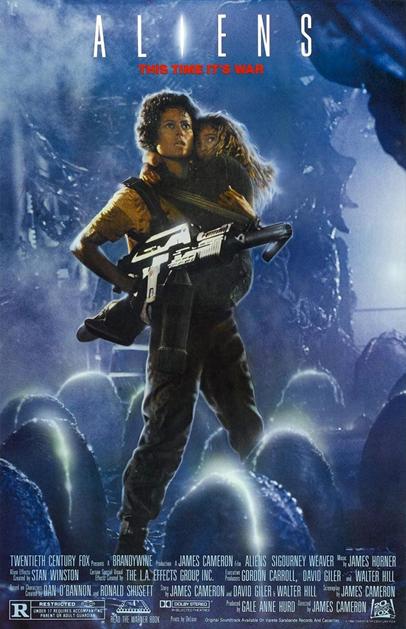
Retro Nostalgia: Aliens (1986) and Ripley's Maternities (Some Rambly Thoughts)

(What follows are some random thoughts I had while re-watching James Cameron's Aliens.  I'd love to open up a nice discussion about the film, so feel free to leave a comment agreeing/disagreeing with or adding to my argument(s).)

I've always loved the relationship between Ripley and Hicks.  Obviously, it's implied that there's a significant romantic link between them, but the film makes light of it through jokes, in part so the very real problem -- survival in the face of certain death -- never falls prey to the romantic narrative underneath.  And there's also a sense -- for me, anyway -- that Ripley and Hicks don't

Saturday, June 08, 2013

Retro Nostalgia: Contact (1997) and Conflating Faith and Science and Its Hopeful Ethos

Anyone with a passing familiarity with Carl Sagan's popularization of science will recall his profound optimism, both with humanity's scientific endeavors and its almost desperate need to strive for "more."  I think it's fair to say that he imagined science as humanity's great thrust to greatness -- to controlling itself and its environment.  After all, he famously said that "[imagination] will often carry us to worlds that never were. But without it we go nowhere."  And while he was not a religious man, he didn't fear suggesting that science could provide a spiritual vision of the world:

Thursday, April 18, 2013

Retro Nostalgia: Gattaca (1997) and Framing the Multivalent Ethical Dilemma

Before Andrew Niccol's Gattaca (1997) begins in earnest, we are compelled to think about its underlying ethical dilemma:  is a meritocratic system based on (mostly pre-selected) genetic variables justified, even if that means denying some people equal access simply because their genes say there is something wrong with them?  If you have seen the film, then you know how the story ends -- the genetic "weakling" succeeds at doing the impossible, throwing into question the very notion that one's genetics are an absolute determination of one's potential.  Thus, one possible side question is:  without the aforementioned meritocratic system, would Vincent/Jerome have fought so hard to succeed?  Questions like this are why films like Gattaca, The Truman Show, The Minority Report and, to a lesser extent, District 9, Logan's Run, and

Thursday, April 04, 2013

Retro Nostalgia: Metropolis (1927) and the Torment of Humanity's Dreams

I've often wondered if there is something unique about the "serious" science fiction of the first 30 years on the 20th century (i.e., non-pulp work).  Surely critics more familiar with the era can attest to this with some degree of authority, but since I do not have that experience, I must speak from what little authority I have as a reader and a relatively new teacher of SF/F literature.

From this limited perspective, Fritz Lang's remarkable 1927 film, Metropolis, resembles visionary works such as E. M. Forster's "The Machine Stops" (1908) and Karel Capuk's R.U.R. (1920), each drawing in no small part from earlier SF writings, such as Mary Shelley's Frankenstein (1818) or the lesser known Copellia by Arthur Saint-Leon (among others).  The machinic imagination of mankind, in a sense, has always been a part of SF's consciousness, right from the earliest "true" SF novel, Frankenstein, to the most important (stylistically and philosophically) productions of the era traditionally know as the "Pulp Era" -- a more accurate label would be "The Formative Era."*

Wednesday, March 27, 2013

Retro Nostalgia: Mars Attacks (1996) and Its Detached Timestamp

Long-time viewers of science fiction film will likely recognize Tim Burton's homage to 50s/60s SF cinema.  How could they not?  From the narrative undertones of the Cold War's nuclear fears to its borrowing and twisting of the narrative structure of H. G. Wells' War of the Worlds and its 1953 adaptation, which helped solidify a developing SF cinematic aesthetic (the Orson Welles radio drama certainly stuck Wells' terrifying tale of alien invasion in the public consciousness beforehand), the film is in every way a mockery of the 50s and 60s.*  But it's not simply the politics or the narrative that make the 1996 alien invasion comedy Mars Attacks! an amusing bedfellow of or foil to the 1950s (and 60s).  Rather, its visuals are an at times direct parody/assault on the material and social logic of the era, despite having no clear temporal placement of its own -- after all, the film is neither set in the 1950s, nor the 1990s, and instead

Monday, March 11, 2013

Retro Nostalgia: The Day the Earth Stood Still (1951), the Hero Scientist, and the Possible Utopia(?)

There's something truly nostalgic about SF narratives that make the scientist the hero.  There aren't a lot of those narratives left, if we're honest.  Characters use science, sure, but they are rarely the creators of science, or its purveyors.  But not the old school SF movies.  Oh no.  In a lot of those stories, scientists are front and center.  They're occasionally the bad guy, but they're always the ones figuring things out, discovering the new and amazing things about the world.  Even in Forbidden Planet, in which the main scientist is, for all intensive purposes, the villain (well, not really -- his id is the villain), the romanticism of science and the scientist is crucial to the plot.

The Day the Earth Stood Still (1951) falls into the positive variety of these pro-scientist films.  Most of us know the story, primarily because it was recently remade into what I can only describe as a film without any substance:  an alien named Klaatu appears on Earth, which terrifies the hairless ape creatures; Klaatu desperately tried to make humanity listen to him, but in the end, he's forced to use the threat of annihilation to, we hope, bring humanity in line -- for self-

Monday, February 25, 2013

Retro Nostalgia: Forbidden Planet (1956) and Romancing the Science

I have never seen Forbidden Planet.  It's one of those films that SF enthusiasts say you have to see, but I have never made the time to do so.  Until now...

As a first time viewer of a now-50+-year-old movie, I find it necessary to offer a number of concessions:  1) I cannot expect the visuals to meet contemporary standards of "realism" (limited budgets + limited technology); 2) I cannot expect characters to develop in ways that are anything but consistent with a 1950s cultural milieu; and 3) I must accept pseudoscience.  That's more or less how I came into the film.  After all, if you watch Forbidden Planet, you'll become aware of the limitations of the cinematic medium during the 50s, the rampant, almost "rapey" sexism that was all too common during the "glory days," and the laughable nonsense that passed for "science" then (and still passes for "science" today).

And yet, for such a campy film, Forbidden Planet does something that only the best SF films do:  eloquently visualizes and explores the science of a future world, even if, upon further inspection, much of that science is impossible, unexplained, or downright false (it was the 50s, after all).  The

Monday, February 18, 2013

Retro Nostalgia: The Dark Crystal (1982) and the Necessity of a Remake

When I first saw The Dark Crystal over a decade ago, I recall feeling amazed by the story.  As kids, I think we have a tendency to open ourselves to imaginative possibilities that adults have closed themselves off to (possibly because adults have "seen it all").  Watching The Dark Crystal as a kid was like jumping headfirst into my own imagination.*  Re-watching the film brought back some of those mostly-nostalgic memories, in particular because the world of The Dark Crystal is a fully realized one.  There are enormous sets, moving plants and critters, unique characters, and astonishing puppetry.  It's hard not to marvel at how much effort went into making this film.

The problem?  Time has not been kind to Jim Henson's 1982 classic.  Unlike The Labyrinth, which survives its ancient green screen and sometimes stiff puppetry largely because it is a quirky fantasy flick for kids, The Dark Crystal simply doesn't hold up as well.  The stiff puppetry, a product of the time more than anything else, reminds us that we're looking at, well, puppets; to suspend disbelief, we have to trick our minds in ways we generally wouldn't have to.  This is true of

Tuesday, February 12, 2013

Retro Nostalgia: Legend (1985) and the Power of Innocence

(A different subtitle might say this:  "A World of Oppositions, Stricken By Their Equilibrium."  This, of course, assumes I will follow Jason Sanford's story-title-generation process for these features.  I'll leave artistic license aside for now...)

One of the curious things about Ridley Scott's 1985 fairy tale -- appropriately entitled Legend -- is how desperately it clings to its fairy tale origins.  I do not mean "desperate" in a negative sense; rather, I see Legend as trying to avoid falling into the trap of its own making precisely so it can maintain its format in a way that benefits the fairy tale that is its heart.  Thus, what begins as a saccharine childish fantasy of naive, star-crossed lovers from different worlds (Princess Lily from the Court of Men and Jack from the Court of Nature) falls into the abyss of its darkest undercurrents (love, betrayal, darkness, blood, and utter wickedness) before it is righted by a

Tuesday, February 05, 2013

Poll: The Next Retro Nostalgia Film (#2)? You Decide!

And now it's your turn to decide which film I'll watch for this Monday's Retro Nostalgia feature.  Choose wisely!

Retro Nostalgia: Logan's Run (1976) and the Infantilization of Humanity

(Note:  There are a few spoilers below. If you have not seen Logan's Run and want to, I recommend watching it before you read this post.  I'm not ruining the entire movie or anything; I just know that I would prefer a completely untainted first viewing.  If you don't care about a few spoilers, then read on.

Note 2:  This is a little late.  It should have appeared yesterday.  I hope you'll forgive me, considering that I didn't have the film selected until late Sunday evening.)

Many of you already know that I am currently teaching an American dystopia class.  One of the novels I had considered teaching was William F. Nolan and George Clayton Johnson's Logan's Run, which was later turned into a 1976 film (discussed here) and a 1977 TV series (which I have never seen).  There are a few more novels/stories in the series/universe and a new film adaptation is currently in the works.  As a piece of dystopia, the film plays on a number of the social concerns of the 1960s and the 1970s, among them the population boom scare fed by Paul R. Ehrlich

Sunday, February 03, 2013

Poll: The Next Retro Nostalgia Film? You Decide!

Earlier, I asked for film suggestions for my Retro Nostalgia feature thinking that there would be some kind of simple consensus.  Boy was I wrong!

And so, in order to decide which film I'm going to watch for tomorrow, I'm creating this little poll, which you all get to vote in.  It'll run until midnight, since I need time to actually watch whichever film you all decide on.

Anywho!

Friday, July 13, 2012

Retro Nostalgia: The Bourne Identity (2002) and the Politics of Amnesia

One of the things that fascinates me about the Bourne movies is the question raised by his amnesia within the ideology of terrorism (read:  War on Terrorism, etc.).  To think about Bourne's amnesia as a symptom of a particular form of national ideology is to understand that his amnesia is not simply a convenient plot device (though it is one), but also a symptom of a public amnesia.  In other words, just as Bourne's condition enables him to alter the real by making it imaginary -- i.e., changing one's identity entirely -- so too do the cast of characters who use ignorance (or willful amnesia) to wipe themselves clean of culpability (ex. Ward Abbott).  The public does not know, and those that do know fulfill one of three identities:  1) true amnesiac; 2) willful amnesiac; and 3) maintenance amnesiac (Conklin, who maintains the barrier between those that don't need to know (the public) and those that don't want to know (Abbott)).

Bourne's identity, however, is split by a seeming contradiction.  On the one hand, his amnesia defines him as one who does not know himself; on the other, he is defined by what he does not (or cannot or will not) remember, but about which others have profound knowledge.  To not know

Friday, June 15, 2012

Retro Nostalgia: The Fifth Element (1997) and the Legacy of Camp

The Fifth Element is one of those films that the genre community loves not because it is a good film, but because it's actually pretty awful, and intentionally so.  At least, that's how I interpret it.  It has always seemed like a film that deliberately sought out science fiction's pension for high-flying, mythological fantasy (in space).  In some sense, it's the opposite of Starships Troopers, released in the same year.  Both films are satires:  Starship Troopers a more socio-political satire of the military industrial complex, and The Fifth Element a satire of genre -- or what I call the  "legacy of camp."
What amuses me about The Fifth Element is how easily it manipulates genre conventions to produce a narrative that functions in part through humorous hyperbole, and yet never needs to make a whole lot of sense.  The central premise, for those that don't know or only vaguely remember, is much like any Doctor Who season finale:  some kind of evil, ancient alien force appears out of nowhere (in the form of a planet that gobbles up aggressive energy, like missiles, to increase its size), and the only one who can stop it is a genetically engineered messiah (Leeloo, played by Milla Jovovich) and an ex-soldier.  Of course, there are lots of obstacles in the way:  an inept human government/military, an evil corporate loon with the weirdest hairdo in history (Gary Oldman), some evil mercenary space orcs, and a couple of socially awkward priests.  Let's also not forget that one of the most important scenes in the entire movie is an opera/faux-future-pop mashup laid over Leeloo's comical smackdown of those absurd space orcs.  And did I mention that the music in said scene is performed by a blue alien diva with tentacles?  Yeah.
The plot is eccentric enough -- and ever so genre -- but the film's technological imagination is where the nonsensical really shines.  Take, for example, the main city:  hover cars are everywhere, despite societal evidence that this would be a complete disaster; Chinese restaurants deliver in person, flying around in makeshift sailing ships; Korben Dallas (Bruce Willis) has enough high-powered rifles to make even an NRA activist scared (and apparently he's not the only one); and homes are equipped with self-cleaning showers and other gadgets that would make Bill Gates wet himself.  Elsewhere, we're to believe that scientists can reconstruct any biological being from a handful of cells; luxury cruise ships roam the stars undefended, while mercenaries destroy everything they're paid to eliminate; and aliens of unimaginable cleverness (who made Leeloo) are so inept at protecting their own ships that their destruction becomes a convenient plot device.  It's the kind of movie that, if it took itself seriously, would fall apart the moment someone started to think about it all.

But The Fifth Element doesn't take itself too seriously.  It's camp through and through.  The acting is overboard, right down to a somewhat dumbfounded Tommy Lister playing President of, well, everything and Gary Oldman pulling out all the stops as the ridiculous Zorg, weird hairdo, accent, and all.  It's as if the creators sat down one day and said, "How can we make this movie so ridiculous it's actually entertaining?"  And it's that willingness to embrace the campy side of SF that makes The Fifth Element one of those rare humorous gems, memorable not for being a gamestopper like 2001:  A Space Odyssey or Blade Runner, but for being that absurd movie we can all watch and love together.  It never needed to be a good movie.  It only ever needed to be that right mixture of camp and humor (a skill Joss Whedon has learned to master quite well).
This is where I have to wonder:  What other films do the same thing?  Do they work as well as The Fifth Element?  Why or why not?

------------------------------------------

Retro Nostalgia is the product of my compulsive re-watching of classic and/or quality science fiction and fantasy films (and their related components).  In each feature, I'll cover some element of a particular film that interests me, sometimes from an academic perspective and other times as a simple fan.  Previous columns can be easily found via the "Movie Rants" label.

Sunday, June 10, 2012

Retro Nostalgia: Alien (1979) and the Uncanny Valley

Having recently viewed and podcasted about Ridley Scott's prequel, Prometheus, I decided it would be a great idea to revisit the Alien franchise by re-watching Ridley Scott's original:  Alien.  Released in 1979, the film remains one of the most terrifying science fiction movies to hit the big screen, despite the obvious dating in its technology (updated considerably in Prometheus -- because computers with green letters and typewriter clicking sounds are so obviously old school).  But what is it that terrifies us about the xenomorph in this film and its immediate sequels (Aliens and Alien 3)?
For me, it has to do with the premise behind the concept of the Uncanny Valley:
At its most basic, Masahiro Mori's concept suggests that the more human an inhuman thing appears, the more uncomfortable human beings become.  Many have applied the concept to robotics and video games, but I think the above image shows how it can also apply more broadly to the fantastic.  While some research suggests that the hypothesis doesn't hold up under scrutiny, I do think it remains an important explanation for why we are terrified of the xenomorph and other science fiction creations (perhaps someone could explore how it relates to Splice, which seems to dig into an even greater human terror:  our creations turning on us).
Where the xenomorph sits on the scale is up to speculation, but re-watching Alien reminded me how human these creatures really are.  It's against those humanoid features that its most terrifying aspects play out on the screen.  It's a bipedal creature with arms and hands not unlike our own, with an identifiable head, pelvis, and similar humanoid features, such as feet.  But its skin is insect-like; it's mouth is full of sharp teeth and hides a second mouth that shoots out to puncture flesh; it's head is elongated to exaggerated levels; its blood is acidic; and it has a long, skeletal and pointed tail, which it uses to coax terrified prey closer to its mouth.

All of these features at once remind us of ourselves, but also remind us of what we are not.  And for me, that's bloody terrifying.  Giant squid other kinds of incredibly inhuman creatures don't terrify me nearly as much as those beings that verge into human territory.*  This is perhaps why the Space Jockey, as re-imagined by Ridley Scott in Prometheus, made me uneasy.  Once you see what they look like underneath all that bizarre armor, they are surprisingly human, more so even than the xenomorph.  And something about that makes their actions in the movie more terrifying, but also strangely more familiar (but that's perhaps something to think about another day...).
What about you?  What terrifies you about the xenomorph or other science fiction monsters?  The comments are yours.

--------------------------------------------------

*I'm speaking about terror with regards to the unreal.  If a xenomorph and a giant squid showed up in my living room, both with the intent to kill me, I would be equally terrified of both.  Thankfully, that would never happen.

Tuesday, June 05, 2012

Retro Nostalgia: Sunshine (2007) and Science Fiction's Supreme Optimism

I've argued before that science fiction is a naturally optimistic genre.  One of the main reasons for this is the fact that SF almost always imagines a future in which we still exist.  While watching Sunshine, however, my position became more nuanced.  It's not that we are still alive; it's that we've survived.

Sunshine is one such movie.  Set in a future in which the Sun has prematurely begun to die out, humanity has been given the seemingly impossible task of jump-starting the gas furnace of the Sun and save Earth.  Impossible is an understatement, really.  It's pretty clear from the start of the film that humanity has not progressed all that far from our present in terms of technology.  We've mastered a few more stages of spaceflight, put bases and communication arrays on the moon, managed to solve gravity issues on long-range spaceships, figured out how to maximize oxygen production, plant growth, etc., and built ships large enough to house multiple humans and to protect them from radiation, the Sun's heat, and so on.  None of that should inspire confidence in our ability to control stars.

And as the opening moments remind us, this is more true than we can possibly know.  The first

Sunday, June 03, 2012

Retro Nostalgia: The Fascinating Paradox of Sphere (1998) (Or, Why Science Fiction Makes Us Think)

I recently re-watched the 1998 film adaptation of Michael Crichton's Sphere (starring Dustin Hoffman, Sharon Stone, and Samuel L. Jackson, among others).  What fascinated me about the film was that despite all its flaws, it is still an example of science fiction doing what it does best:  explore the big ideas (Wikipedia tells me this is also true of the book, but since I haven't read it, I can only comment on what is in the film).

For those that have not seen Sphere, I suggest you watch it before reading beyond this point, because I'm going to ruin the ending.  Starting now...

The big idea in Sphere is a twist on the traditional "first contact" story.  A ragtag bunch of scientists (and a psychologist played by Hoffman) are brought in secret to an underwater facility by the U.S. military.  There they learn that the military has discovered a 300-year-old spacecraft, which they suspect to be alien.  It turns out, however, that the craft is neither 300-years-old nor alien; rather, it is of American origin and from the future, having crashlanded in Earth's past after a brush with a black hole.  To add to the mystery, the characters discover a strange sphere inside the ship (nobody knows if it's alien or not, and no answers are ever actually given).  Eventually we discover that all those who go inside the sphere gain the ability to bring their thoughts to life.

In the concluding scenes (inside a decompression chamber), the surviving members of the team consider the implications of what they've learned.  Hoffman's character rightly concludes that humanity is too primitive for the kind of power granted by the sphere, as their nightmarish foray in the underwater facility shows (they all more or less bring their nightmares to life).  And so all three characters decide they will use the power to forget what happened, thereby denying humanity access to the information.

What I find compelling about this ending is how it fulfills its own prophecy.  Because the ship is from the future, we're drawn to the realization that the choice of the characters to forget means that the mistakes which led them to this realization must always happen.  It also means that humanity never actually learns the lesson that these individuals do, making it impossible for any kind of species-centered growth -- there will be no forewarning of the dangers, no future-reversion, in which technology from the future influences the technology of the past, leading us to that future point (yay, a paradox!).  But the paradox lies in that problem:  if the spacecraft has no record of what the scientists discovered in the past, then something must have happened to prevent that information from reaching the authorities.  We're led to believe that this means nobody is meant to survive, but the truth is that the information is destroyed, making certain that nobody knows and that everything proceeds in blindness.  Anyone thinking about this problem knows that something must happen or the whole world collapses (which is a problem for Sphere, a serious film, but not really one for Back to the Future, a humorous film).

That idea -- of meeting our future head-on and grappling with its implications, both technologically, socially, and psychologically -- is what SF does best.  It doesn't really matter if Sphere is a great movie on its own; what matters is if its ending compels one to think -- and ask the big questions.  How do we grapple with technology that makes the "dreams come true" idea a reality?  What do we do when we know our own future, and it's immediate ramifications?  And is it really possible to forget such power and history?  And if you don't forget, does that mean your future changes?  Do we fall into one of those weird Back to the Future paradoxes?  Would you know if things changed?

And, of course, there's this one:  What is the sphere?  Where did it come from?  Will we ever know?

I'll leave it there for now, because I want to see what others thought about the conclusion of Sphere.  How did you interpret the paradoxes and ideas presented in those final moments?